AMD at $570—are you chasing it?
Just as something went sideways over at Jensen Huang’s camp, money poured into AMD like crazy, sending it up 30% in a single week. Is this a relay race for AI chips, or are market manipulators riding NVDA’s coattails to cash in on latecomers chasing the rally?
First, the surface picture: the news is explosive, but the price is starting to hesitate.
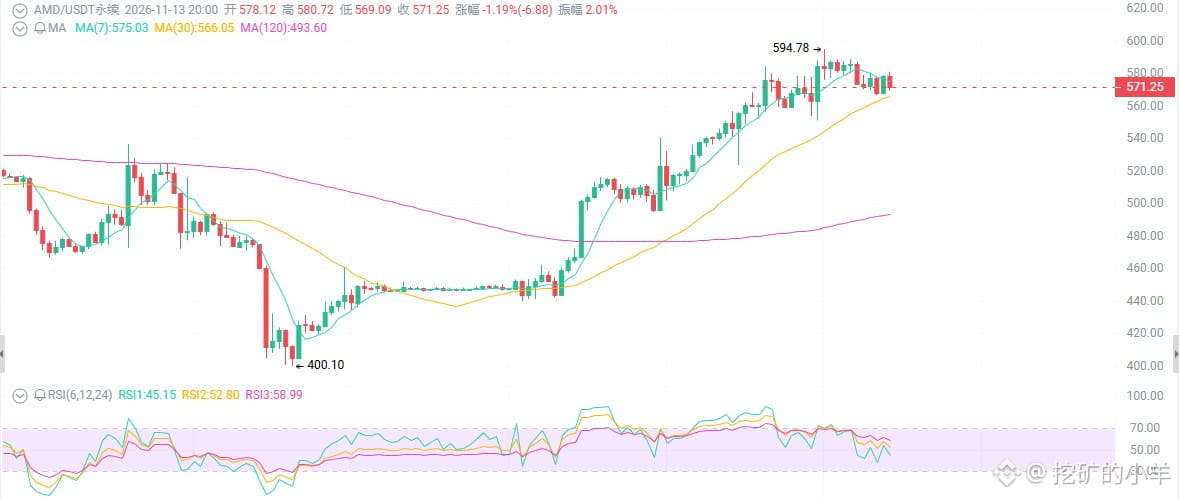
AMD surged more than 30% over the past week, clawing its way back from lows just above $400 to $570 and recovering most of the ground lost since its October high of $658. But today it started giving some of that back—the classic “profit-taking after a strong run” playbook.
The charts tell you this: it’s back above both the 50-day and 200-day moving averages, the MACD histogram has turned positive, and the RSI is neutral-to-strong at 57–58. The structure is intact, but the stock is definitely getting hot in the short term.
First thing: this isn’t AMD getting stronger—it’s NVDA running into trouble.
AMD has Jensen Huang to thank for this rally.
The moment there’s even a hint of trouble on NVDA’s board, money immediately looks for “alternatives,” lifting AMD and Broadcom alike. AMD is being packaged as the “Plan B for AI chips.”
But stay clear-eyed—AMD is still a follower, not a leader.
That said, being a follower has its advantages: while NVDA dominates and gets the lion’s share, AMD only needs a small slice of the pie. At $570, that could still mean upside of several tens of percent.
Second thing: the earnings are genuinely solid, not just a pie-in-the-sky story.
Q3 earnings on November 3:
Revenue of $13.4 billion, up 45% year over year
Data center revenue of $8.5 billion, up 97% year over year—nearly doubled
Q4 guidance of $17 billion, up 66% year over year, with growth still accelerating
This isn’t just an “expectation”—it’s money already in the bank.
EPYC server CPUs are taking market share from Intel, Instinct MI400-series GPUs are going after the share left on the table by NVDA, and the Helios rack solution is starting to ramp up. BofA directly raised its price target to $700; the consensus target is $658.
The story AMD is telling now is: I have market share in CPUs, I offer value in GPUs, and I have a complete rack-scale solution. That’s an “end-to-end AI platform,” not just selling a single chip.
Third thing: macro conditions are a headwind—and that’s the biggest risk.
The 10-year U.S. Treasury yield is 5.12%—that number is a knife pointed at high-valuation growth stocks.
AMD’s beta is around 2.5. When macro conditions tighten, it falls twice as hard as the broader market. Concerns about the sustainability of AI capital spending, data center power approvals, and policy uncertainty after the midterm elections—all these risks are still lurking.
Fundamentals are the engine; macro is the brake. Right now, both pedals are being pressed at once.
Just as something went sideways over at Jensen Huang’s camp, money poured into AMD like crazy, sending it up 30% in a single week. Is this a relay race for AI chips, or are market manipulators riding NVDA’s coattails to cash in on latecomers chasing the rally?
First, the surface picture: the news is explosive, but the price is starting to hesitate.
AMD surged more than 30% over the past week, clawing its way back from lows just above $400 to $570 and recovering most of the ground lost since its October high of $658. But today it started giving some of that back—the classic “profit-taking after a strong run” playbook.
The charts tell you this: it’s back above both the 50-day and 200-day moving averages, the MACD histogram has turned positive, and the RSI is neutral-to-strong at 57–58. The structure is intact, but the stock is definitely getting hot in the short term.
First thing: this isn’t AMD getting stronger—it’s NVDA running into trouble.
AMD has Jensen Huang to thank for this rally.
The moment there’s even a hint of trouble on NVDA’s board, money immediately looks for “alternatives,” lifting AMD and Broadcom alike. AMD is being packaged as the “Plan B for AI chips.”
But stay clear-eyed—AMD is still a follower, not a leader.
That said, being a follower has its advantages: while NVDA dominates and gets the lion’s share, AMD only needs a small slice of the pie. At $570, that could still mean upside of several tens of percent.
Second thing: the earnings are genuinely solid, not just a pie-in-the-sky story.
Q3 earnings on November 3:
Revenue of $13.4 billion, up 45% year over year
Data center revenue of $8.5 billion, up 97% year over year—nearly doubled
Q4 guidance of $17 billion, up 66% year over year, with growth still accelerating
This isn’t just an “expectation”—it’s money already in the bank.
EPYC server CPUs are taking market share from Intel, Instinct MI400-series GPUs are going after the share left on the table by NVDA, and the Helios rack solution is starting to ramp up. BofA directly raised its price target to $700; the consensus target is $658.
The story AMD is telling now is: I have market share in CPUs, I offer value in GPUs, and I have a complete rack-scale solution. That’s an “end-to-end AI platform,” not just selling a single chip.
Third thing: macro conditions are a headwind—and that’s the biggest risk.
The 10-year U.S. Treasury yield is 5.12%—that number is a knife pointed at high-valuation growth stocks.
AMD’s beta is around 2.5. When macro conditions tighten, it falls twice as hard as the broader market. Concerns about the sustainability of AI capital spending, data center power approvals, and policy uncertainty after the midterm elections—all these risks are still lurking.
Fundamentals are the engine; macro is the brake. Right now, both pedals are being pressed at once.