#sxt $SXT @SpaceandTime
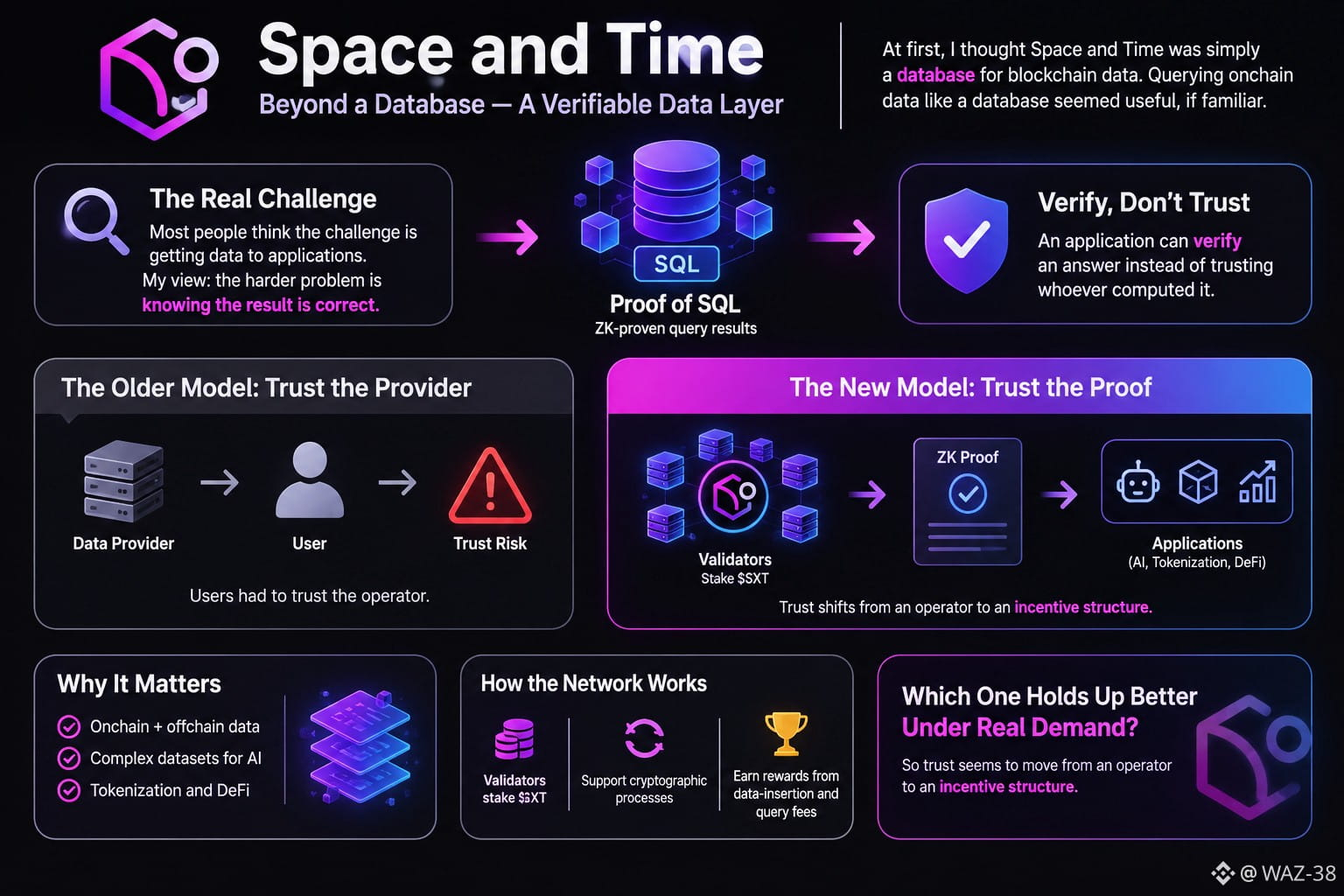
At first, I thought Space and Time was simply a database for blockchain data. Querying onchain data like a database seemed useful, if familiar.
Looking closer, the database is not the point. Most people think the challenge is getting data to applications. My view is that the harder problem is knowing the result is correct. Proof of SQL returns ZK-proven query results, so an application can verify an answer instead of trusting whoever computed it. That matters more as onchain and offchain data are combined into complex datasets for AI, tokenization and DeFi.
The older model asked users to trust the provider. This one asks them to trust the proof, which depends on a network staying honest. Validators stake $SXT to secure it and support the cryptographic processes, while participants earn rewards from data-insertion and query fees.
So trust seems to move from an operator to an incentive structure. Which one holds up better under real demand?