
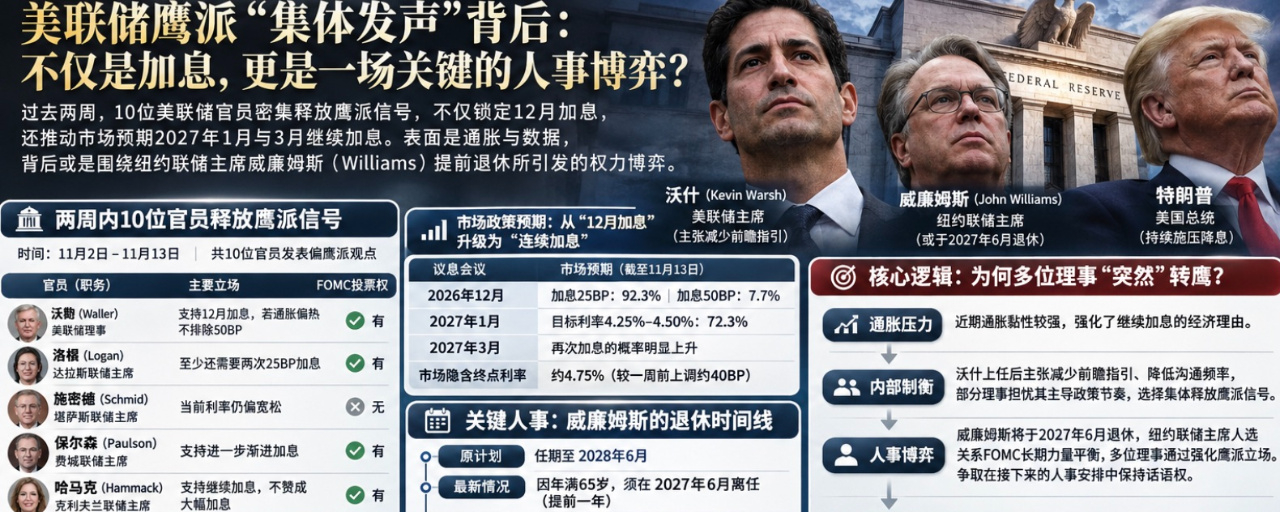

From last week through this week, several Fed governors have sent hawkish policy signals, not only cementing expectations of a December rate hike but also raising the possibility of hikes in January and March 2027. Why are several governors suddenly guiding market expectations to counter Warsh's policy?
Since November 2, 10 Fed governors have commented on current inflation and signaled their expectations for future policy. Aside from Bowman and Goolsbee, who could be considered “conditional hawks,” all the others have expressed clearly hawkish views!
More importantly, these 10 governors include 6 voting members of the FOMC, meaning that, at least nominally, 50% of the governors currently support a December rate hike and may even expect a more hawkish path! #加密美股齐跌,下轮反弹的驱动力在哪?
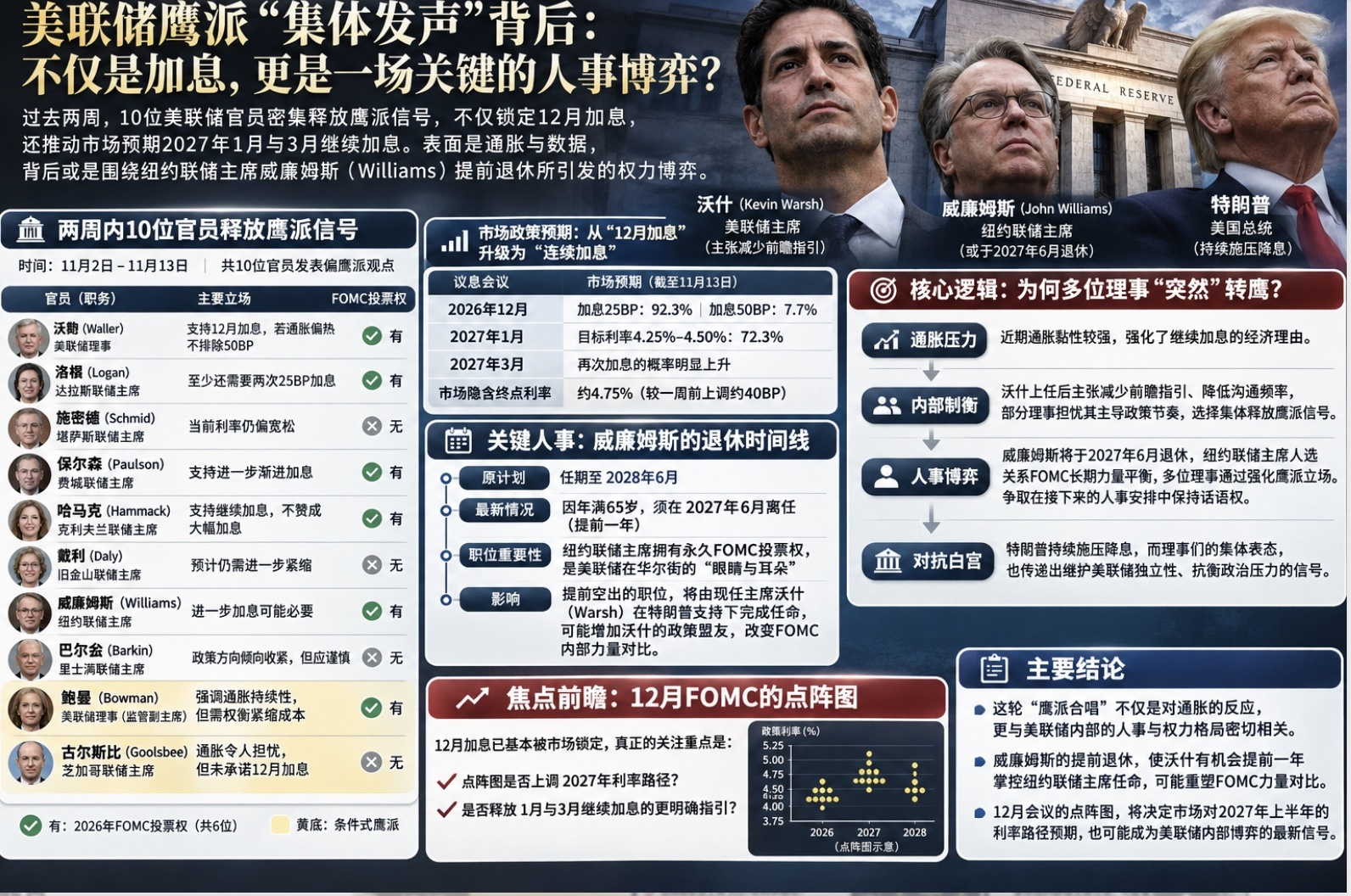
This has effectively locked in market expectations of a rate hike in December and increased the likelihood of consecutive hikes in January and March 2027. It remains unclear whether the market expects the rate-hiking cycle to resume.
It is unusual these days to see several Fed governors in a row signal their policy outlook, especially since Warsh took office advocating less forward guidance on policy and reiterated that position several times. After that, many governors began speaking publicly less often and discussing interest rates less, but the past two weeks have been highly unusual.
I believe this is clearly a sign that divisions within the Fed are deepening. The key issue is not policy, but a critical personnel appointment!
In June 2027, John Williams, a key regional bank president, will face a career turning point: retirement. At 65, Williams will have reached retirement age. This key regional president, who has served at the Fed even one year longer than Powell, could have a profound impact on the Fed’s sensitive internal dynamics.
Williams was originally expected to serve until June 2028, but he will reach the retirement age of 65 a year early. Under the Fed’s existing internal rules, Williams would have to step down in June 2027.
If Williams retires, Chairman Warsh would gain control of this key personnel appointment a year early. It would also mean adding a new member to Warsh’s camp, making the power struggle within the Fed even more complex.
Last month, Williams said he expected to serve until June 2028. The New York Fed president has a permanent vote on the FOMC and helps set U.S. interest rate policy. The role also makes the president the Fed’s “eyes and ears” on Wall Street, underscoring its importance.
So, who gets this position matters a great deal. Although Warsh has not yet made his position clear, with Trump in office, Warsh will evidently find it easier to take control of the Fed and make the appointment. By June 2028, his authority will be significantly weakened.
In fact, Williams’s retirement and the New York Fed personnel appointment should not be coming up at this point. But when you consider the recent hawkish remarks by several Fed governors alongside the fact that Williams’s retirement has been thrust into the spotlight, the timing of these two developments is striking!
Trump wants rate cuts more than anything, but several Fed governors are now taking the opposite position. They are not only backing a rate hike in December, but even suggesting that the hiking cycle could continue through March next year. So the December hike is no longer the main focus; the December dot plot is. It will determine the market’s overall direction in the first half of 2027!