
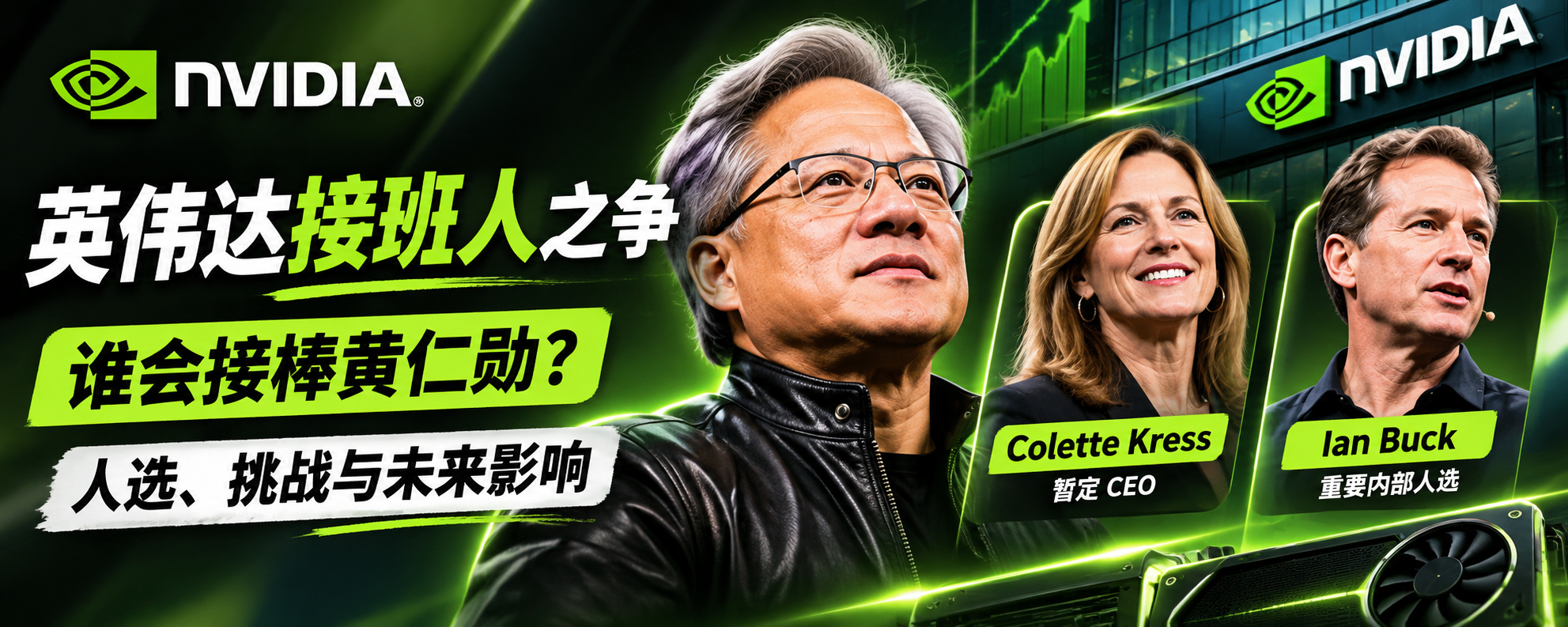


During a livestream about Nvidia on Binance Square last night, I mentioned that the risks to watch are management-related. The main questions are whether Jensen Huang will step down and who will take over as CEO afterward.
And whether the new CEO has sufficient technical expertise, strategic vision, and management skills.
The news was officially announced shortly afterward: Jensen Huang is stepping down, and CFO Colette Kress will temporarily take over as CEO while the board searches for a permanent successor.
When the news broke, the share price of $NVDAB briefly plunged to 150, but it has since recovered to 170.
The two December options trades I opened last night both made money, and the long position I opened on the 11th has also broken even.
————————
Today I want to talk with you about potential successors and what impact this could have going forward 👇
1) First, let’s talk about Colette Kress, the interim CEO
Colette Kress has served as Nvidia’s CFO since 2013, so she knows the company’s finances, operations, and customer relationships very well.
The thing is, her professional background is mainly in financial management, rather than chip development and technology strategy.
Of course, her strength is that she knows Nvidia’s business very well (after all, she’s the CFO).
Nvidia is no longer just a company that sells graphics cards; it’s a technology giant with a huge data center business, global customers, and a complex supply chain.
At a company of this scale, financial management, capital allocation, and customer relationships are all extremely important.
But she also faces an obvious challenge: can she, like Jensen Huang, judge where the next generation of AI technology should be headed?
So I think she’s a very suitable interim candidate, but whether she can become the long-term CEO remains to be seen~
————————
2) Another internal candidate worth watching is Ian Buck
Ian Buck joined Nvidia in 2004 and has long been involved in GPU computing and the development of the CUDA ecosystem.
In fact, Nvidia has not only made excellent chips; it also has a very powerful CUDA platform.
A quick explainer: CUDA is, simply put, Nvidia’s GPU software ecosystem.
You can think of it as an operating system and toolkit for GPUs, making it easier for developers to use GPUs for large-scale parallel computing. It’s especially suited to training and running AI models.
CUDA has been around for nearly 20 years and has built up a huge base of developers, software libraries, tools, and mature applications.
So someone with a technical background like Ian Buck’s could be very important to Nvidia’s future direction.
But strong technical skills don’t necessarily mean someone will make a great CEO.
He has spent many years focused on technology and products, but whether he has enough experience running a large company as a whole, allocating capital, and managing investor relations remains to be seen.
————————————
3) Other internal candidates
Besides Ian Buck, the media have also mentioned several other Nvidia insiders.
🔷Jeff Fisher: A senior Nvidia executive who has long been responsible for the GeForce gaming business and related products. He knows GPU products and the consumer market very well and is a veteran within the company.
🔷Madison Huang: Jensen Huang’s daughter, currently a senior director at Nvidia responsible for marketing products related to Physical AI.
Some media outlets have also included her in long-term succession discussions, but she currently has less management experience and seniority than other executives.
⚠️Other names mentioned in the media include co-founder Chris Malachowsky and external candidates Rene Haas and Tim Cook.
However, these are only potential candidates discussed in the media; it does not mean Nvidia’s board has formally nominated anyone.
——————————————
Coming back to the question: why does it matter who succeeds Jensen Huang as Nvidia’s CEO?
Because for Nvidia, Jensen Huang is more than just a CEO—he has been a key driver of the company’s technological direction and business strategy for decades.
Nvidia’s position today was not built on GPU chip performance alone.
It also reflects long-term strategic planning—from the CUDA software ecosystem and AI chip development to data centers and the broader AI infrastructure.
So the new CEO won’t just be taking over a chip company, but a technology giant that is deeply involved in the development of the global AI industry.
Ultimately, whether the new CEO can continue Jensen Huang’s technology strategy, business approach, and leadership will directly affect Nvidia’s future competitive advantage and market confidence.
——————————————
Lastly, I’ll share my thoughts on Nvidia’s upcoming third-quarter earnings report, due on November 17.
I think there’s a decent chance the results will beat expectations, but as I mentioned earlier, uncertainty around the leadership transition could still have some effect on market sentiment and the share price.
So in the short term, we can’t judge the share price solely by the earnings results. We also need to consider the new CEO candidate, the management handover, and how confident the market is in Nvidia’s future strategy.
That’s why the call options I bought expire in December: I’m giving the market a little more time to assess the earnings, the new CEO candidate, and how it digests this management transition.
But looking at Nvidia over the long term, I’m still very optimistic—strictly from a long-term perspective~
Alright, that’s all for today. If I keep going, this’ll turn into another long essay 😓