
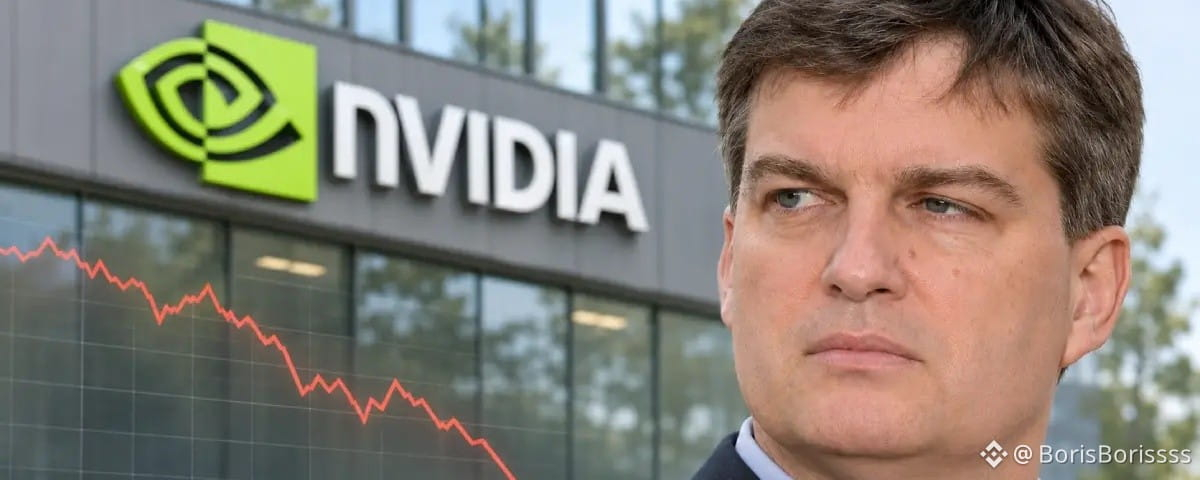

Investor Michael Burry, known for betting against the U.S. mortgage market before the 2008 crisis, considers Jensen Huang’s departure a serious risk for NVIDIA. In a post published on November 12 on the Cassandra Unchained account, he urged the company’s supporters to use a potential rise in the stock price as an opportunity to exit their positions.
Burry’s final recommendation is extremely concise: “Get out.” At the same time, the investor is not predicting an immediate collapse. His argument is that Huang’s departure could gradually change NVIDIA’s relationships with customers and weaken the model that has allowed the company to maintain exceptionally high growth rates.
Huang himself stepped down as NVIDIA’s president and CEO on November 12, after 33 years at the company’s helm. CFO Colette Kress has taken over on an interim basis.
Burry considers Huang part of NVIDIA’s competitive advantage
One of Burry’s main arguments is the risk of the company’s dependence on a key executive. In his view, Huang’s influence went far beyond product strategy, as the founder was personally involved in relationships with major customers and controlled a significant share of operational decisions.
The investor believes that without Huang, buyers could delay orders, negotiate better terms, or consider competitors’ equipment more actively.
For now, this is a forecast. After the CEO transition, NVIDIA said it expects to continue working with customers and carrying out its product roadmap without disruption.
At the same time, the risk of orders slowing exists regardless of Huang’s departure. In its latest SEC filing, NVIDIA warned that customers may delay purchases of new architectures due to a lack of data center infrastructure, limited funding, or slower technology adoption.
AI infrastructure funding raises questions
Burry’s second argument concerns the increasingly complex system for financing artificial intelligence infrastructure. He believes that investments, guarantees, and partner support create additional financial risk.
It would be inaccurate to call this system simply “hidden debt,” since NVIDIA publicly discloses a substantial portion of its obligations.
As of July 26, the company had $279 billion in obligations to secure supply and production capacity. Another $36 billion was tied to long-term agreements with certain AI cloud companies.
NVIDIA also discloses a maximum gross exposure of $108.5 billion in guarantees. Of that, up to $105 billion is related to support for building SB Energy infrastructure for a customer associated with OpenAI.
In addition, the company offers extended payment terms to certain major customers and has signed memorandums with financial partners to create platforms that could eventually attract more than $500 billion in third-party capital for AI infrastructure.
These figures confirm the scale of the industry’s financial interdependence that Burry describes, but they do not prove the existence of hidden obligations (the mechanisms listed were disclosed by NVIDIA itself to the SEC).
Risk of a slowdown in AI spending
Burry’s broader forecast is that the current pace of investment in AI infrastructure cannot continue indefinitely. If spending by cloud companies and model developers slows, NVIDIA could face slower growth and pressure on margins.
The company itself acknowledges this scenario as a risk. Its filings state that weaker demand for computing capacity or partners’ difficulties securing financing could negatively affect future revenue.
For now, this is a risk, not an observed contraction in the business. NVIDIA continues to report strong demand and is due to release its next quarterly results on November 17.
Burry’s bearish view of NVIDIA did not emerge after Huang’s departure. Happy Coin News previously reported that the investor expects a major correction in the AI sector and compares the current investment cycle to periods of excessive capital investment.#Write2Earn