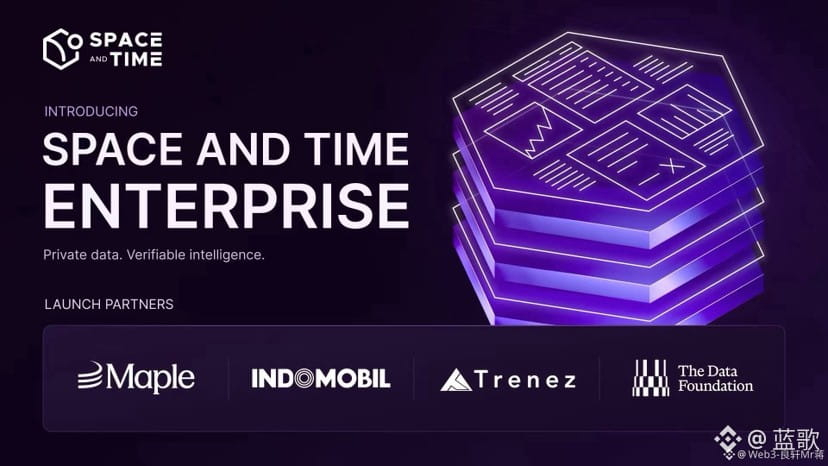
#sxt $SXT @SpaceandTime SXT: Opportunities and risks coexist— is this project worth studying? “Proof of SQL” is one of its core technologies. SQL is a commonly used database query language; Proof of SQL aims to generate a proof after executing an SQL query, allowing a third party to verify that the query results have not been tampered with, without fully exposing the underlying data. The claim in the article that “one million rows can be processed and proved in one second” describes performance under specific query, hardware, and dataset conditions; it should not be taken to mean that this speed can be consistently achieved in every scenario.
Public information shows that the technology has been integrated into the Google Cloud BigQuery ecosystem and can be used to verify database queries.
“Say something, and directly generate an on-chain application” refers to its developer experience geared toward natural language and AI: users describe what they need in natural language, and the tools help generate queries, data logic, or application prototypes. This lowers the barrier to development, but when real funds, permissions, or contract deployment are involved, developers still need to review the code, security, and data sources.
As for $SXT , “fuel” in the article is a metaphor: it refers to token utilities or fee mechanisms related to on-chain verification, queries, settlement, and other functions within the network or service. Deploying software in a company’s own environment and submitting results on-chain or calling network services involve two different cost structures. Whether fees apply and how they are charged depends on the product version and protocol rules; it cannot simply be assumed that all local use is free.
Proof of SQL technology: Developers can run SQL queries on both on-chain and off-chain data while generating zero-knowledge proofs, enabling smart contracts to verify that query results are authentic and untampered with, without having to rely entirely on a centralized data provider. Simply put, it “not only provides data results, but also proves that those results are trustworthy.”
$SXT