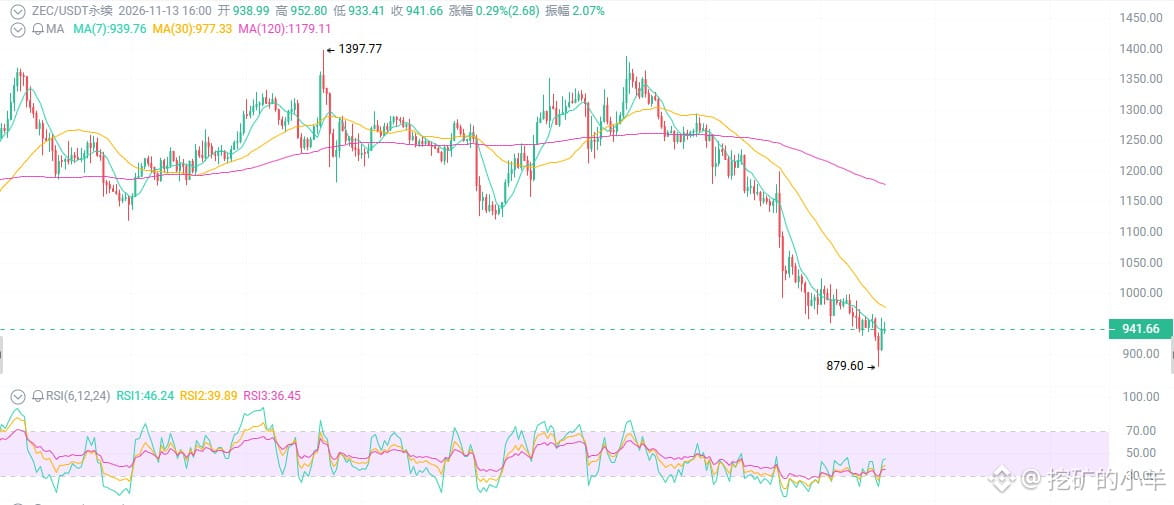
ZEC at $940: Are you selling at a loss or buying the dip?
It’s been only six days since the NU7 upgrade went live, and the price has fallen from $1,400 to $880. Grayscale spent $1 million on advertising, yet the ETF is seeing net outflows. Did the upgrade fail, or are market makers using the good news to shake out holders?
First, the surface-level picture: the good news arrived, and the price turned lower.
ZEC is down 25% over the past 7 days and 25% over the past 30 days, plunging from highs of $1,300–$1,400 to $880. Liquidation data over the past 24 hours shows that long positions took the biggest hit. The candlestick chart tells you this: the price has fallen below the 20-day and 50-day moving averages, the MACD is bearish, and the RSI has dropped to 33, close to oversold territory.
But the weekly chart tells a different story: the long-term uptrend that began at the 2024 low is still intact.
First: the market has voted with its feet on the NU7 upgrade
NU7 officially went live on November 6. Block times were cut from 75 seconds to 25 seconds—three times faster. 60% of fees go into a sustainable reserve, the old Sprout privacy pool has been frozen, and work on quantum resistance has begun in parallel.
This is the most technically ambitious upgrade since Zcash was launched.
And the result? The price plunged from $1,300 to $880.
A classic case of “buy the rumor, sell the news.”
Second: Grayscale is advertising, but the ETF is bleeding
Grayscale invested $1 million to support the Zcash ETF (ZCSH) ecosystem and is also running ads.
Sounds like institutional backing? The data tells a different story: ZCSH has recently seen consistent net outflows, with the largest single-day outflow reaching $14.6 million. Cumulative outflows for November are around $30 million, and assets under management are declining.
Ad dollars are being spent, while funds are heading for the exit.
But look at it another way: when ETF outflows, a price dump, and an extreme fear index reading of 20 all happen at the same time, it’s often not a top—it’s a shakeout.
Third: on-chain data is telling a different story
The price is falling, but:
The value held in Shielded (privacy pools) is around $4.7 billion, and the new Ironwood privacy pool continues to grow.
Around 17.04 million coins are in circulation, or 81% of the total supply. The next halving isn’t until 2028—there’s no inflationary pressure on the supply side.
Active addresses and transaction volumes remain decent, and developer activity has actually increased since the upgrade.
More interestingly, some whales are making profits on short positions, while dormant wallets are sending coins to exchanges—both are sources of short-term selling pressure. But selling pressure will eventually be absorbed; demand for privacy won’t disappear. The tighter regulation gets, the stronger Zcash’s narrative becomes.