I didn’t expect Washington to panic just one day after Jensen Huang left.
The Democrats have gone way too far this time, coming out swinging right from the start. First, lawmakers called for a halt to $AI construction, then they went after Jensen Huang hard. Both moves sent U.S. stocks tumbling.
Now Jack Reed, the top Democrat on the Senate Armed Services Committee, has publicly called on Congress to assess whether Nvidia $NVDA is too big to fail—and whether trouble there could spill over into U.S. banks and credit markets.
His reasoning is that Nvidia has backstopped the entire AI ecosystem through complex financing arrangements.
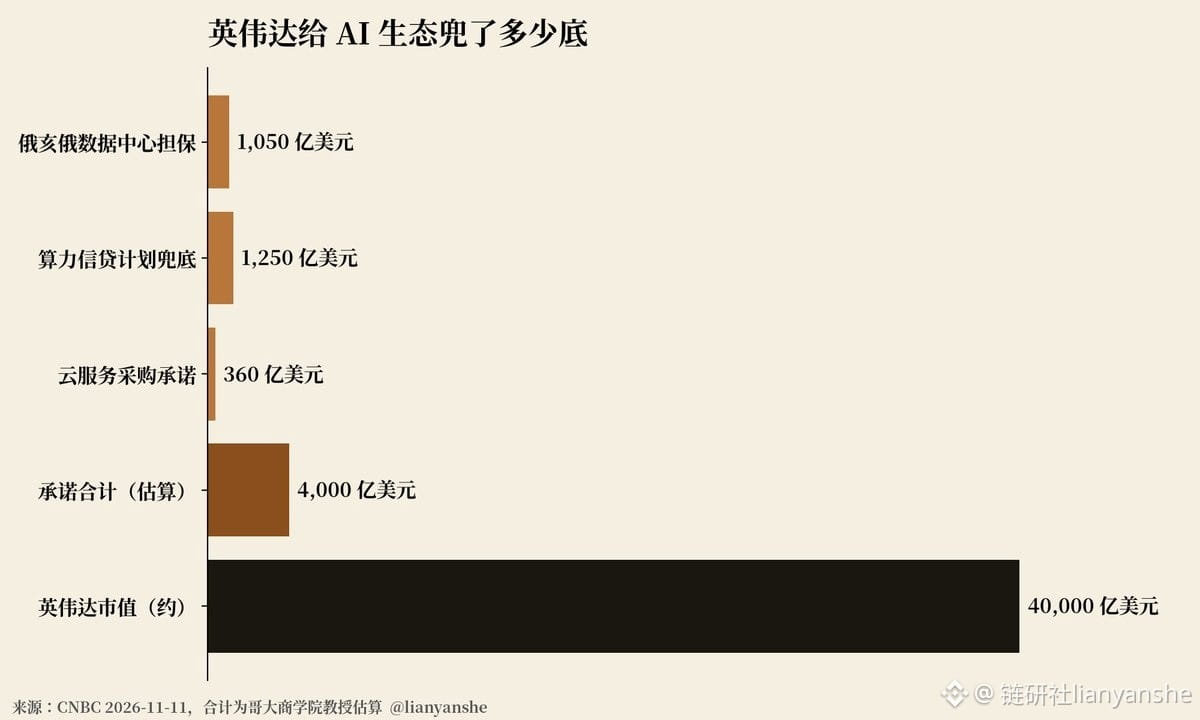
Just how big is this backstop? I looked through the public figures to gauge how serious the situation is.
The Ohio OpenAI data center project: $105 billion in phased guarantees.
Wall Street’s $500 billion computing-power credit plan: Nvidia could backstop up to $125 billion.
Commitments to purchase up to $36 billion in cloud services from cloud providers.
A Columbia Business School professor estimates that these commitments add up to around $400 billion.
The person responsible for signing these deals (Jensen Huang) has just stepped down.
The Wall Street Journal reported that back in August, Huang criticized Kress over these kinds of guarantee schemes, saying she was just an accountant crunching numbers. Now Kress is the one taking over.
Even more interestingly, according to The New York Times, Trump called Huang on Tuesday and urged him to fight for the position. Bloomberg says Huang held out for weeks, then unconditionally surrendered late Wednesday night, saying all he cared about was that it didn’t matter and he didn’t care.
More people want him to stay than he himself does.
So, could Nvidia collapse? Can Nvidia still manage without Jensen Huang? Either way, it has already become a serious political issue.
In banking terms, Nvidia isn’t too big to fail. It doesn’t face the risk of a bank run; people will keep buying its chips. Its $400 billion in commitments amounts to just 10% of its roughly $4 trillion market capitalization.
The risk of spillover lies further downstream. Nvidia backstops new cloud providers, which borrow money to buy chips, with the funds coming from private credit and banks.
The impact has already spread to the stock price. Nvidia has fallen for six straight weeks, its longest losing streak since 2012. It’s down 29% since early October, wiping out around $1.6 trillion in market value and losing its spot as the world’s most valuable company to Apple.
Three things to watch next could determine whether the situation escalates.
1. Three House committees have asked Jensen Huang to attend a closed-door hearing. If he still refuses, they’ll issue a subpoena.
2. Commerce Secretary Lutnick has agreed to testify before Congress. Lawmakers want to know how much the administration knew in advance.
3. Earnings are due at 5:20 a.m. Singapore time on November 18. The market expects revenue of $108.9 billion, up 91% year over year. Can the results ease some of the market’s concerns? Will Nvidia still be Nvidia without Jensen Huang? The conference call may offer the answers we’re looking for.