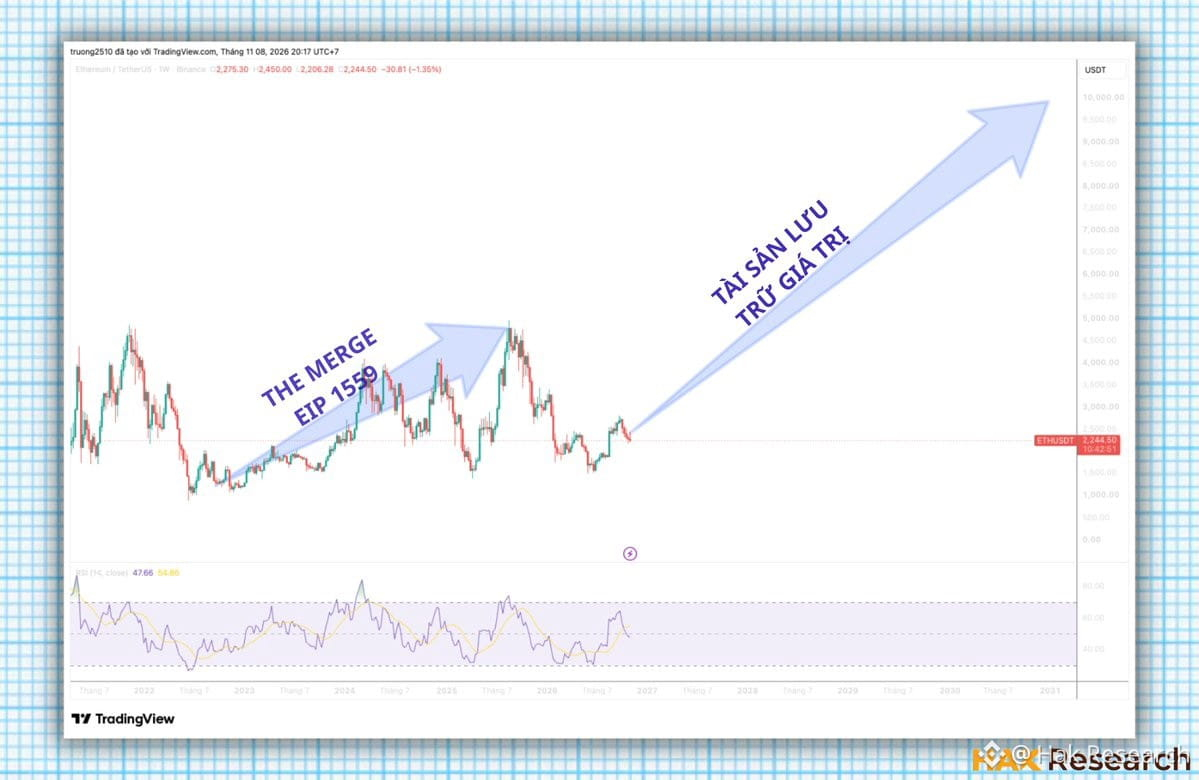

🏦 Vitalik: Should $ETH be a store of value rather than a fee-burning token?
In his latest comments, Vitalik Buterin argued that focusing on ETH as a store of value makes more sense and is more meaningful than focusing on ETH as a token used to burn fees.
This could mark a shift in direction since The Merge and EIP-1559. According to the argument presented, if we want $ETH to become an effective fee-burning token:
1️⃣ There would need to be substantial fee spending, reducing validator income and potentially creating conflicts in operating the network.
2️⃣ The people in charge would have to intervene heavily to ensure every new trend and product makes its way onto Ethereum and attracts users.
3️⃣ Fees would have to be high, resulting in a poor user experience.
These things run counter to decentralization and CROPS:
• C – Censorship Resistance
• O – Open Source
• P – Privacy
• S – Security
These are the qualities Ethereum is striving for to make $ETH a store of value. EIP-1559 will no longer be the main focus, but it will continue operating as usual and will not be removed.
Solana’s Toly agrees: you can’t focus on fees as a product; you need to choose a product that brings value to users and do it well.
In the previous cycle, The Merge and EIP-1559 coincided with $ETH rising from around $1,500 to nearly $5,000. The image in the post is a chart illustrating the “store of value” thesis, with an arrow pointing toward $10,000 — this is my perspective, not a target stated by Vitalik.
Do you think $ETH pursuing the store-of-value narrative is more convincing than the fee-burning approach? 👇
#ETH #Ethereum #Layer1