BTC at 68,500: Should You Cut Your Losses or Hold On?
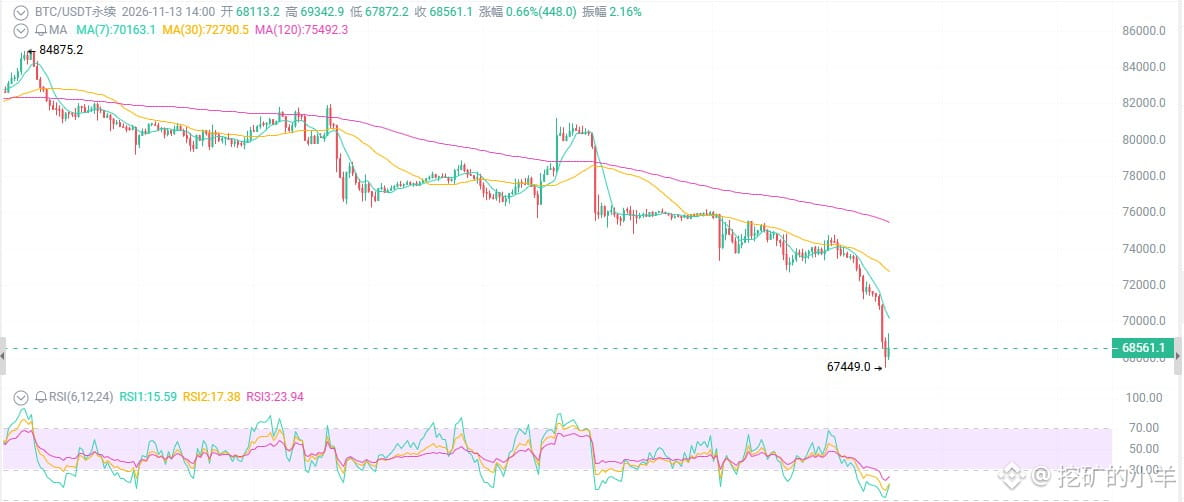
October CPI came in hot, the probability of a rate hike surged to 80%, ETFs saw $1.28 billion in outflows in a week, long positions worth $1 billion were liquidated, and the Fear Index fell to 19. Everyone is calling a crash. But just now, BTC bounced hard from 67,500 back to 68,500. Is this sharp leg down the final shakeout, or a bull trap before an even bigger plunge?
First, the surface picture: the screen is full of bad news. But have you noticed one thing?
BTC fell 6% in 24 hours, with a low of 67,500. The daily RSI is at 24, in oversold territory. The 200-day moving average is at 73K, and price has long since fallen below it. Short-term holders’ cost basis is 75.7K, so everyone is sitting on unrealized losses.
When everyone is bearish, can the bottom really be far away?
First: Institutions are selling—but don’t forget how much they still hold
Spot ETFs have seen net outflows for several days in a row, reaching $1.28 billion in a single week at one point. BlackRock’s IBIT saw nearly $300 million in outflows in one day.
Yet ETFs still hold more than 1 million BTC in total, over 6% of the total supply.
This isn’t “institutions have left.” They trimmed their positions at higher prices, but haven’t touched their core holdings. Institutions want it to rise again more than anyone.
The ones really selling at a loss are the retail investors who bought in at 100K. Panicking at 68,500 and FOMO-buying at 100K are essentially the same problem: letting emotions take the wheel.
Second: Hash rate hasn’t collapsed, and the post-halving supply squeeze is still in effect
BTC’s total network hash rate remains elevated, around the 1,000 EH/s level. New coin issuance continues to tighten after the halving, and BTC’s long-term scarcity remains intact.
The share of supply in profit has fallen below 58%. Historically, every time it has dropped near this threshold, it has coincided with a local bottom.
The price is falling, but the network hasn’t collapsed. Miners haven’t capitulated. The fundamentals haven’t deteriorated.
What’s gone bad is leverage, sentiment, and the people betting on price direction with 20x contracts.
Third: This downturn is fundamentally a macro problem, not a BTC problem
October CPI rose 0.4% month over month, while core CPI rose 0.3%, both above expectations. The probability of a December Fed rate hike briefly surged above 80%. Bond yields rose, the Nasdaq pulled back, AI stocks turned volatile, and BTC fell along with them.
Look at it clearly—BTC is not a safe-haven asset right now; it’s a high-beta tech stock. When the Nasdaq falls, BTC tends to fall even harder. Stablecoin supply contracted by $14 billion over 30 days, draining liquidity.
But think about it the other way: if the macro outlook shifts, BTC could rebound more sharply than anything else.
Keep an eye on three things next: PPI data, the December FOMC meeting, and daily ETF flows. Any one of them turning positive could be the spark.
October CPI came in hot, the probability of a rate hike surged to 80%, ETFs saw $1.28 billion in outflows in a week, long positions worth $1 billion were liquidated, and the Fear Index fell to 19. Everyone is calling a crash. But just now, BTC bounced hard from 67,500 back to 68,500. Is this sharp leg down the final shakeout, or a bull trap before an even bigger plunge?
First, the surface picture: the screen is full of bad news. But have you noticed one thing?
BTC fell 6% in 24 hours, with a low of 67,500. The daily RSI is at 24, in oversold territory. The 200-day moving average is at 73K, and price has long since fallen below it. Short-term holders’ cost basis is 75.7K, so everyone is sitting on unrealized losses.
When everyone is bearish, can the bottom really be far away?
First: Institutions are selling—but don’t forget how much they still hold
Spot ETFs have seen net outflows for several days in a row, reaching $1.28 billion in a single week at one point. BlackRock’s IBIT saw nearly $300 million in outflows in one day.
Yet ETFs still hold more than 1 million BTC in total, over 6% of the total supply.
This isn’t “institutions have left.” They trimmed their positions at higher prices, but haven’t touched their core holdings. Institutions want it to rise again more than anyone.
The ones really selling at a loss are the retail investors who bought in at 100K. Panicking at 68,500 and FOMO-buying at 100K are essentially the same problem: letting emotions take the wheel.
Second: Hash rate hasn’t collapsed, and the post-halving supply squeeze is still in effect
BTC’s total network hash rate remains elevated, around the 1,000 EH/s level. New coin issuance continues to tighten after the halving, and BTC’s long-term scarcity remains intact.
The share of supply in profit has fallen below 58%. Historically, every time it has dropped near this threshold, it has coincided with a local bottom.
The price is falling, but the network hasn’t collapsed. Miners haven’t capitulated. The fundamentals haven’t deteriorated.
What’s gone bad is leverage, sentiment, and the people betting on price direction with 20x contracts.
Third: This downturn is fundamentally a macro problem, not a BTC problem
October CPI rose 0.4% month over month, while core CPI rose 0.3%, both above expectations. The probability of a December Fed rate hike briefly surged above 80%. Bond yields rose, the Nasdaq pulled back, AI stocks turned volatile, and BTC fell along with them.
Look at it clearly—BTC is not a safe-haven asset right now; it’s a high-beta tech stock. When the Nasdaq falls, BTC tends to fall even harder. Stablecoin supply contracted by $14 billion over 30 days, draining liquidity.
But think about it the other way: if the macro outlook shifts, BTC could rebound more sharply than anything else.
Keep an eye on three things next: PPI data, the December FOMC meeting, and daily ETF flows. Any one of them turning positive could be the spark.