

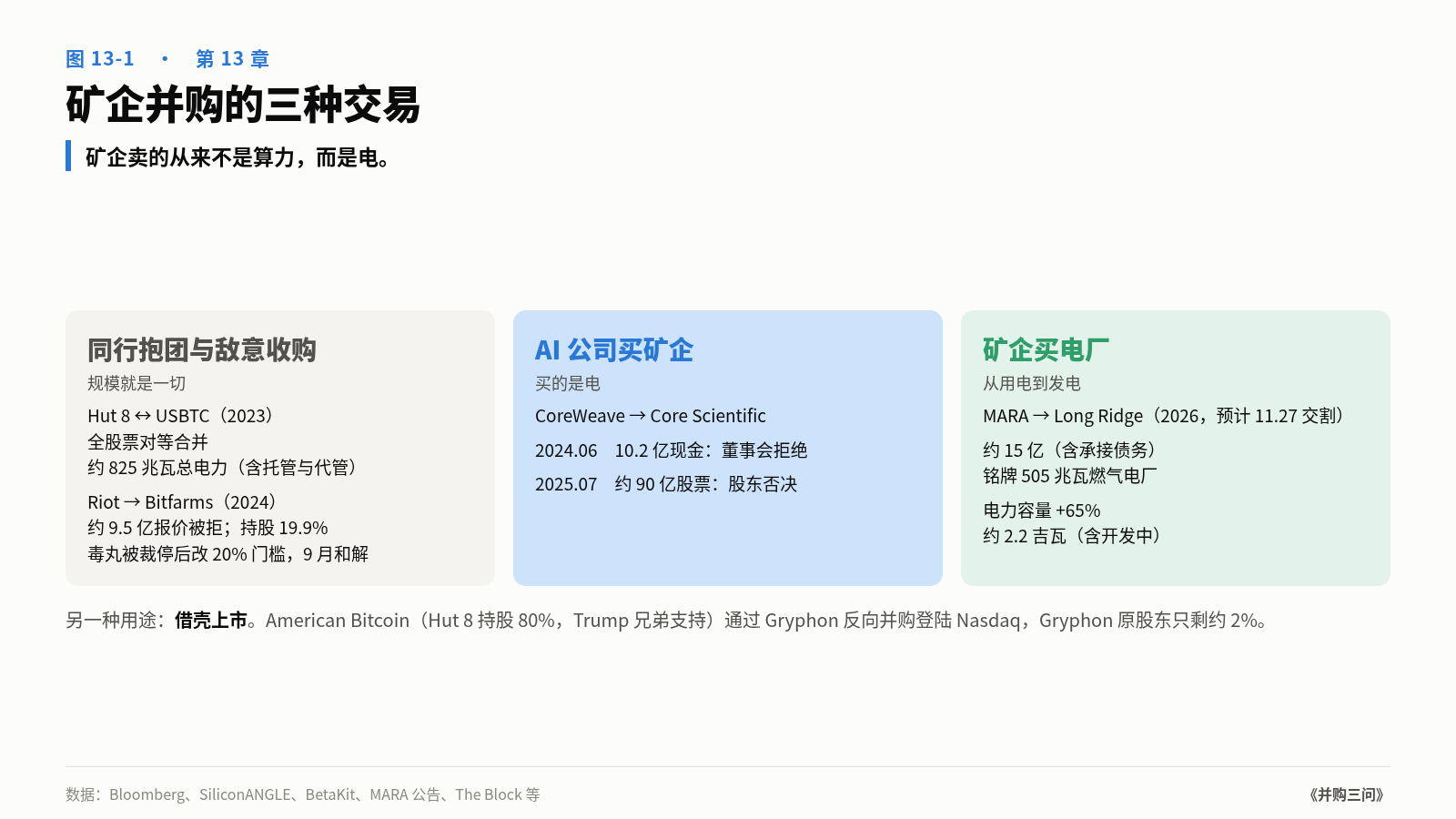
On June 3, 2024, AI cloud computing company CoreWeave made an unsolicited acquisition offer to Bitcoin miner Core Scientific: $5.75 per share, all in cash, for a total of approximately $1.02 billion.
Three days later, Core Scientific’s board unanimously rejected the offer, saying it undervalued the company.
At the time, the rejection seemed a little risky. Core Scientific filed for bankruptcy protection in December 2022, when cryptocurrency prices plunged, and only completed its restructuring and relisted on Nasdaq in early 2024. A mining company that had just clawed its way out of bankruptcy had turned down $1 billion in cash.
In hindsight, it was right to say no. In fact, before the offer, the two companies had just signed a series of 12-year hosting agreements: Core Scientific would provide CoreWeave with approximately 200 MW of computing infrastructure, with expected revenue of more than $3.5 billion over the initial term. After the acquisition was rejected, the partnership went ahead as planned. Core Scientific’s share price later rose to around five times CoreWeave’s original offer at its peak, based on closing prices, before falling back to around twice the offer by November 2026.
In July 2025, CoreWeave came back with an offer of approximately $9 billion, all in stock, at a fixed exchange ratio. This time, Core Scientific’s board agreed, but its shareholders did not. Two Seas Capital, which held approximately 6.3% and described itself as the company’s largest active shareholder, publicly opposed the deal, arguing that the price “materially undervalued” the company. Two major proxy advisory firms, ISS and Glass Lewis, also recommended voting against it. On October 30, 2025, shareholders voted the deal down, and it was terminated.
The same company said no twice in just over a year: first to a low cash offer, then to a high stock offer.
This chapter covers M&A among Bitcoin mining companies. Their story runs almost parallel to those in the other chapters of this book: over the past three years, the targets in this industry have shifted from “mining rigs” to “power”; buyers have shifted from other mining companies to AI companies; and Bitcoin’s price is increasingly no longer what determines whether a deal succeeds.
What mining companies are selling
First, a basic question: what’s the most valuable thing a Bitcoin mining company owns?
The answer used to be mining rigs and computing power: how many machines there are, and how many hashes they can calculate per second. But mining rigs are consumables, replaced by a new generation every few years. Computing power can be bought at any time, as long as you have the money to buy the machines.
What’s truly scarce is power: a site that’s already connected to the grid, has signed a long-term power purchase agreement, and has obtained local permits, as well as the number of megawatts it can supply. In the United States, securing a grid connection for a new large data center often means waiting in line for years.
This suddenly became extremely valuable after 2024 because AI companies need power too. Data centers that train and run large language models consume huge amounts of electricity, just like Bitcoin mining sites. The sites mining companies already have connected to the grid and permitted are exactly what AI companies are short of.
That’s why mining-company M&A is, in essence, M&A involving power assets. In terms of the second of the three questions, this is an extreme example of something that’s “still there after the people are gone”: grid connections, power purchase agreements, land, and permits have nothing to do with any particular person.
Three types of deals
Looking at both the deals in our sample and those outside it, mining-company M&A over the past few years can be divided into three types.
Type 1: Miners join forces and hostile takeovers
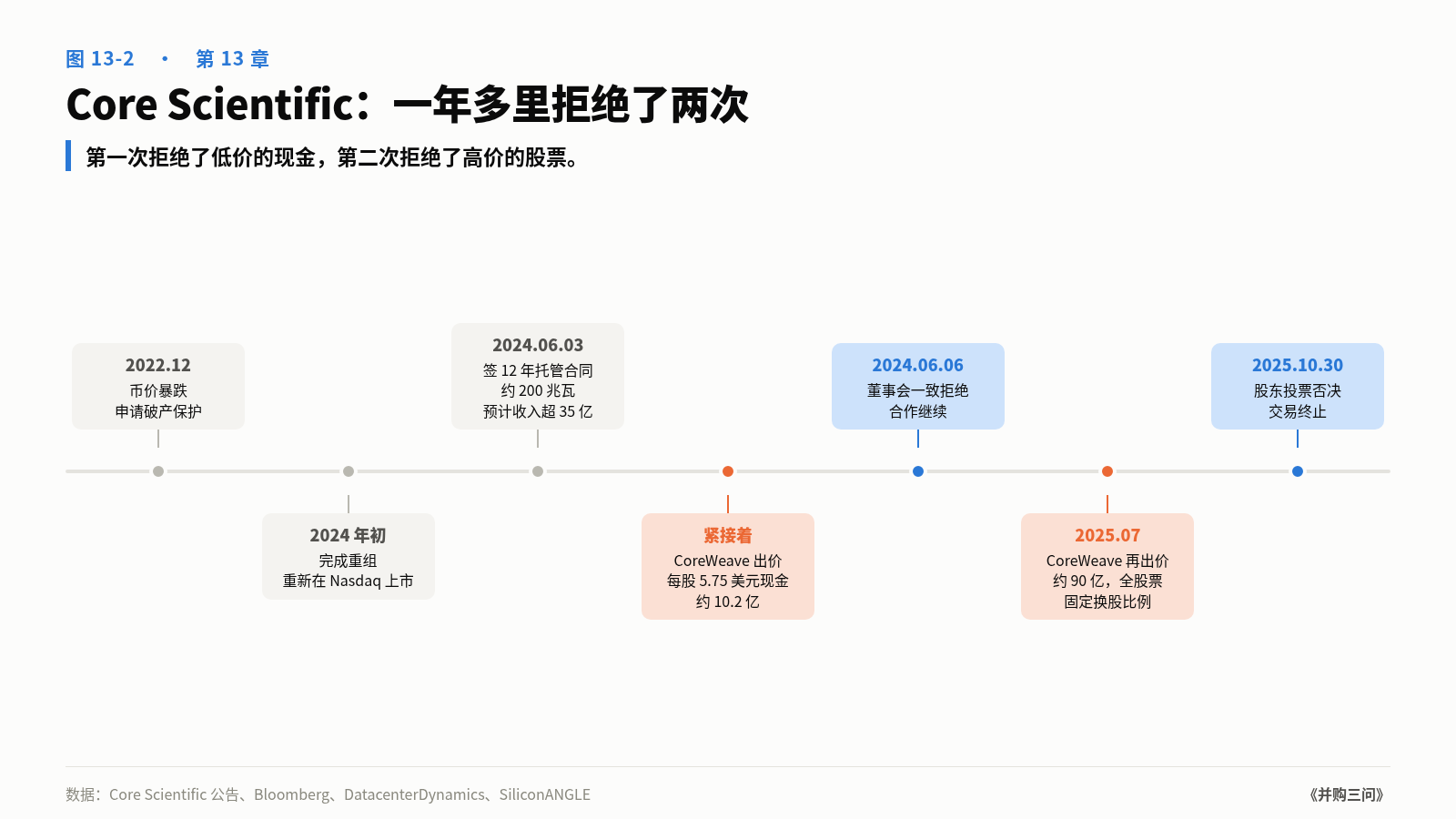
Hut 8 and USBTC (completed in November 2023). The two mining companies merged as equals in an all-stock deal during the bear market. The combined company had access to approximately 825 MW of total power, spanning self-mining, hosting, and managed services. You can think of it as a deal to “band together to weather the winter”: in a bear market, better to join forces than wait separately to be picked off.
Riot’s hostile takeover of Bitfarms (2024). This was a rare public hostile takeover battle in the crypto industry. In spring 2024, U.S. miner Riot Platforms made an acquisition proposal of approximately $950 million to Canadian miner Bitfarms. Bitfarms rejected it, saying the price was a substantial undervaluation. Riot then bought Bitfarms shares on the open market, at one point reaching a 19.9% stake, and called for a special shareholder meeting to replace Bitfarms’ board.
Bitfarms responded with a “poison pill”: if anyone acquired more than 15% of the shares, the company would issue new shares to other shareholders, diluting the hostile bidder’s stake. Riot challenged the poison pill before the Ontario Capital Markets Tribunal. On July 24, 2024, the Tribunal ordered a cease trade of the 15% threshold poison pill, reasoning that it was below Canada’s 20% takeover bid threshold. Bitfarms adopted a new poison pill with a 20% threshold that same day. After several months of back-and-forth, the parties reached a settlement in September 2024: Bitfarms adjusted its board composition, Riot withdrew its demand for a special shareholder meeting, and accepted a standstill provision. Without Bitfarms’ board approval, Riot could not increase its stake to 20% or more (except through a formal takeover bid). The provision would remain in effect until the earlier of one business day after Bitfarms’ 2026 annual meeting or June 1, 2026.
The takeover battle ended without an acquisition, but it showed one thing: in the mining industry, scale is everything, and the fastest way to expand is to buy someone else’s power.
In addition to these two deals, there were several smaller acquisitions between peers in 2024, almost all involving power and sites: Riot bought Block Mining for approximately $92.5 million at closing, plus up to $32.5 million in earn-out payments; CleanSpark bought GRIID at an enterprise value of approximately $155 million; and Bitfarms announced an all-stock acquisition of Stronghold at an equity value of approximately $125 million, plus the assumption of approximately $50 million in debt (an enterprise value of approximately $175 million). The deal closed on March 14, 2025. After the April 2024 Bitcoin halving, the new-coin reward per block fell from 6.25 to 3.125. Mining companies’ revenue potential was sharply squeezed, leaving smaller miners with higher electricity costs to be acquired or forced out.
Type 2: AI companies buy mining companies
CoreWeave and Core Scientific, discussed at the beginning of this chapter. This deal is a landmark event in the mining industry’s shift from “mining” to “AI infrastructure.”
The two offers were rejected for different reasons, but the underlying logic was the same: Core Scientific’s shareholders believed that AI demand was repricing the value of their power assets, and they didn’t want to sell before that repricing was complete.
The first offer, $1.02 billion in cash, was rejected because the price was too low: the board believed that AI demand would make the company worth much more. In hindsight, that judgment was right.
Opponents of the second offer, $9 billion in stock, gave two reasons: first, that the price materially undervalued the company; and second, that the fixed exchange ratio offered no price protection, leaving the value received by Core Scientific shareholders entirely dependent on CoreWeave’s share price, which fluctuated sharply after CoreWeave went public in March 2025. Two Seas itself also held CoreWeave shares and did not oppose the logic of combining the two companies; it opposed the price and the structure.
As Chapter 11 discussed, when you pay with stock, the risk falls on the seller. Core Scientific’s shareholders refused to take on that risk.
Type 3: Mining companies buy power plants
MARA acquires Long Ridge (announced in April 2026). MARA, one of the world’s largest publicly traded Bitcoin mining companies, announced that it would acquire Long Ridge Energy & Power from FTAI Infrastructure in a deal valued at approximately $1.5 billion, including the assumption of at least $785 million in debt.
This time, MARA wasn’t buying another mining company but a power plant: a 505 MW nameplate-capacity combined-cycle gas-fired power plant in Hannibal, Ohio (currently permitted to sell 485 MW), along with more than 1,600 acres of land planned for a digital infrastructure campus. Annualizing Long Ridge’s performance in the second half of 2025, adjusted EBITDA was approximately $144 million. According to MARA when it announced the deal, the acquisition would increase its owned and operated power capacity by about 65%, bringing capacity in operation and development to a combined total of approximately 2.2 GW. The U.S. Federal Energy Regulatory Commission (FERC) approved the deal in early November 2026 (MARA announced this on November 5); according to MARA’s November 17 Form 8-K, the deal is expected to close on November 27, alongside the related bond transaction, subject to customary closing conditions.
The significance of this deal is that mining companies are no longer just buyers of electricity; they are becoming producers of it. A Bitcoin mining company buys a power plant, then sells the electricity to its own mining rigs and AI customers. Its business model is shifting from “using electricity to mine” to “generating electricity, then deciding whom to sell it to.”
The best deal: Galaxy buys Helios in a crisis
The most dramatic transformation in mining-company M&A came from a buyer that appears in this book as a loser: Galaxy.
In August 2022, Galaxy terminated its acquisition of BitGo (Chapter 5). A few months later, in December 2022, it made another deal: it bought the Helios mining site in Texas from financially distressed British miner Argo Blockchain, which urgently needed to avoid bankruptcy. Galaxy bought Helios for $65 million and provided Argo with an additional $35 million secured loan to refinance its existing equipment loan. Galaxy also agreed to continue hosting Argo’s mining rigs at Helios.
This was a classic distressed-asset bargain (Chapter 6): a seller in a hurry, a buyer paying cash, and a power asset that would still be there after the people were gone.
Two years later, AI had repriced the asset. In November 2024, Galaxy disclosed that it had signed a nonbinding term sheet with a U.S. hyperscaler for high-performance computing hosting at Helios, with the option to dedicate all 800 MW of approved power to HPC. It subsequently exited mining: its two-year hosting agreement with Argo ended in late 2024, its own mining rigs were sold off over time, and it completed the wind-down of its Helios mining business in the first quarter of 2025, recording approximately $57 million in impairment and disposal costs. In March 2025, CoreWeave became Helios’s anchor tenant. The first phase of the lease covered 133 MW of critical IT load, and Galaxy expected the 15-year lease to generate approximately $4.5 billion in revenue. The lease was later expanded to a total of 526 MW of critical IT load. According to Galaxy’s August 2025 announcement, CoreWeave had committed to all 800 MW of Helios’s approved power, with average annual revenue over the 15-year term expected to exceed $1 billion. Galaxy raised $1.4 billion in debt financing to convert Helios. At an 80% loan-to-cost ratio, together with the $350 million of equity Galaxy invested, the first phase of the conversion alone would cost approximately $1.75 billion. The first phase began generating lease revenue in the second quarter of 2026. For the second phase, Galaxy issued another $3.5 billion in senior secured notes. According to Galaxy’s 2025 annual letter to shareholders, the capital investment associated with the 800 MW leased to CoreWeave is expected to exceed $7.5 billion.
The same buyer: a $1.2 billion deal signed at the top in 2021 fell through in 2022; at the end of that same year, it spent tens of millions of dollars to buy a mining site in a crisis. That site then secured a 15-year lease for all 800 MW, expected to generate average annual revenue of more than $1 billion. The price: more than $7.5 billion in expected construction investment, including approximately $1.75 billion for the first phase alone. This is almost the perfect illustration of the three questions in M&A: the same buyer, but getting the timing right led to a completely different outcome.
The Trump brothers’ mining company: going public through a reverse merger
There’s another deal in the mining sector worth discussing on its own, because it shows another use for M&A: going public through a shell company.
In March 2025, Hut 8 contributed most of its Bitcoin mining business to a company called American Data Centers in exchange for an 80% stake. The company was backed by Eric Trump and Donald Trump Jr., and was later renamed American Bitcoin.
In May 2025, Nasdaq-listed small-cap miner Gryphon Digital Mining announced that it would “acquire” American Bitcoin in an all-stock deal. But according to reports, after the transaction closed, Gryphon’s former shareholders held only about 2%, while American Bitcoin’s shareholders—including Hut 8 and the Trump brothers—held about 98%. The new company trades on Nasdaq under the ticker ABTC, with Eric Trump serving as co-founder and chief strategy officer.
On paper, Gryphon acquired American Bitcoin. In reality, American Bitcoin went public by using Gryphon’s listing. This is the same structure as the reverse mergers by DATs discussed in Chapter 11: what’s being bought is a listed shell.
Statistically, these deals count as M&A, but they have little to do with the three questions. Their value lies in giving a private company quick access to a “currency” for raising funds in public markets: tradable stock. This currency matters to mining companies because they need to keep raising money to buy power and equipment.
The three questions of mining-company M&A
Let’s look at the deals in this chapter through the lens of the three questions:
Timing: increasingly unrelated to the price of Bitcoin. When Core Scientific rejected CoreWeave’s first offer, the price of Bitcoin was not low. When Riot launched its hostile bid, Bitcoin had just undergone its April 2024 halving, which cut the new-coin reward per block in half, and the industry was being reshaped. The pace of mining-company M&A is increasingly driven by demand for AI data centers and the scarcity of power assets.
Asset: power is the ultimate “asset that’s still there after the people are gone.” Grid connections, power purchase agreements, land, and permits are all independent of people. This makes mining-company M&A more like traditional infrastructure M&A than other crypto deals, and valuations are increasingly similar too: based on price per megawatt and cash flow from long-term contracts.
Interface: AI tenants are the new interface. The value of a mining company’s power assets depends on whether it can find AI customers. Core Scientific’s value soared because CoreWeave became its tenant; according to reports, MARA’s Long Ridge site has already attracted interest from AI and data center tenants. A mining site without AI tenants is still just a mining site.
How this chapter fits into the book
Mining-company M&A may seem far removed from exchanges, custody, and stablecoins, but it confirms two of the book’s conclusions:
First, licenses depreciate; interfaces do not. A mining company’s “license” is its power assets. The same site with a grid connection is an asset whose value fluctuates with the price of Bitcoin in the hands of a miner that only knows how to mine. In the hands of a company with AI tenants, it becomes infrastructure generating cash flow from long-term contracts. Its value depends on who owns it and what it’s connected to.
Second, the form of payment determines who bears the risk. Core Scientific’s shareholders rejected CoreWeave’s stock; Bitfarms held off Riot through a poison pill, boardroom maneuvering, and an eventual settlement; American Bitcoin used a reverse merger to obtain publicly traded stock. In the mining industry, stock is both a weapon for buyers and something sellers are wary of.
If you’re looking at deals involving mining companies or power assets
Value assets by megawatts and contracts, not computing power. Computing power can be bought; grid connections and long-term power purchase agreements cannot.
Check whether there are AI tenants. A site that has already signed an AI tenant can be worth several times as much as one that is still looking for tenants.
Be wary of fixed exchange ratios. Core Scientific’s lesson: if the buyer’s share price is more volatile than your asset, a fixed exchange ratio means you’re taking on the buyer’s risk.
Hostile takeovers are a real possibility in this industry. If you’re a mining company with valuable power assets but an undervalued share price, prepare your defenses in advance.
Distinguish strategic acquisitions from reverse mergers. Their valuation logic is completely different, so don’t compare them as if they were the same kind of deal.
The conclusion of this chapter in one sentence: mining companies have never really been selling computing power, but electricity; now that AI companies are competing for power too, mining-company M&A is shifting from crypto deals to infrastructure deals.
Sources for this chapter
CoreWeave’s first offer and its rejection ($5.75 per share, $1.02 billion, approximately $3.5 billion in hosting agreements): Core Scientific hosting agreement announcement, June 4, 2024; Core Scientific rejection announcement, June 6, 2024; Bloomberg; DatacenterDynamics. Core Scientific bankruptcy and relisting: Verdict. Share price (peak closing price of approximately $29.16 on June 18, 2026; closed at $10.99 on November 24, 2026; closing prices, on the same basis as Chapter 15): Macrotrends
Rejection of CoreWeave’s second offer (Two Seas’ approximately 6.3% stake, ISS and Glass Lewis): SiliconANGLE; DatacenterDynamics; Reuters syndication. Two Seas’ reasons for opposing the deal: Two Seas open letter; Two Seas investor presentation
Riot/Bitfarms: The Block (poison pill); BetaKit (settlement); BeInCrypto. Suspension of the poison pill: Ontario Capital Markets Tribunal reasons for decision; Bitfarms statement, July 24, 2024. Standstill terms: Bitfarms registration filings
Hut 8/USBTC: The Logic; merger announcement (approximately 825 MW of total power)
American Bitcoin/Gryphon: Cointelegraph; The Logic
MARA/Long Ridge (approximately $1.5 billion, 505 MW, $144 million EBITDA, approximately 2.2 GW): The Block; Paul Weiss; MARA transaction announcement, April 30, 2026. FERC approval and expected closing date: MARA press release, November 5, 2026; MARA Form 8-K, November 17, 2026
Galaxy/Helios (approximately $65 million; CoreWeave’s 133 MW expected to generate approximately $4.5 billion in revenue; 526 MW; $1.4 billion in debt financing; leasing begins in Q2 2026): The Block; The Block (delivery); Delphi Digital. Purchase price and $35 million loan: Galaxy transaction announcement. Nonbinding HPC term sheet in November 2024: Galaxy Q3 2024 earnings report. Capital investment for 800 MW exceeding $7.5 billion: Galaxy 2025 annual report and CEO letter. $3.5 billion in notes for the second phase: Galaxy Q3 2026 earnings report. Mining wind-down and $57 million impairment: Galaxy Q1 2025 earnings report. Commitment to all 800 MW and average annual revenue exceeding $1 billion: Galaxy financing announcement, August 15, 2025
Mining-company acquisitions in 2024: Architect Partners 2024 annual report. Block Mining: Riot announcement. Stronghold: transaction announcement; closing disclosure
Notes on the data: Reports give different dates for Riot’s offer—April and May—so the article says “spring 2024.” The post-merger ownership percentages for American Bitcoin follow the approximately 98% to 2% split cited by most reports. The article gives the approximate date of Core Scientific’s relisting as “early 2024.” The specific date of FERC approval appears only in secondhand reports, so the article says “early November.” “The most dramatic transformation” and “banding together to weather the winter” are the author’s characterizations. There is no directly comparable figure for Helios’s return, and the first phase of the conversion alone is expected to cost approximately $1.75 billion, with the full 800 MW expected to cost more than $7.5 billion (these are estimates, not amounts already spent). The status of MARA/Long Ridge is as of November 25, 2026; it should be rechecked after the closing date.
—
This is Chapter 13 of my new book, The Three Questions of M&A (16 chapters total). One chapter is published each day.
Author: Wang Xiaoming (Blue Lotus)