


 📁 Square Sample Case File
Sample ID: CX-2026-1101
Source: Binance Square community (anonymized)
Collection date: 2026-11-13
Classification library: Typical Fatal Pitfalls Case Library / Emotions and Pitfalls Volume
Compliance risk level: High (includes discussion of the asset’s price movements and predictions of a breakdown)
------
I. Original Sample Information (Anonymized)
【Publisher Profile】
Nickname: [Anonymous A] (displaying a TOP badge on the 30-day profit leaderboard)
Status: Newly holding (43 minutes ago)
【Original Post】
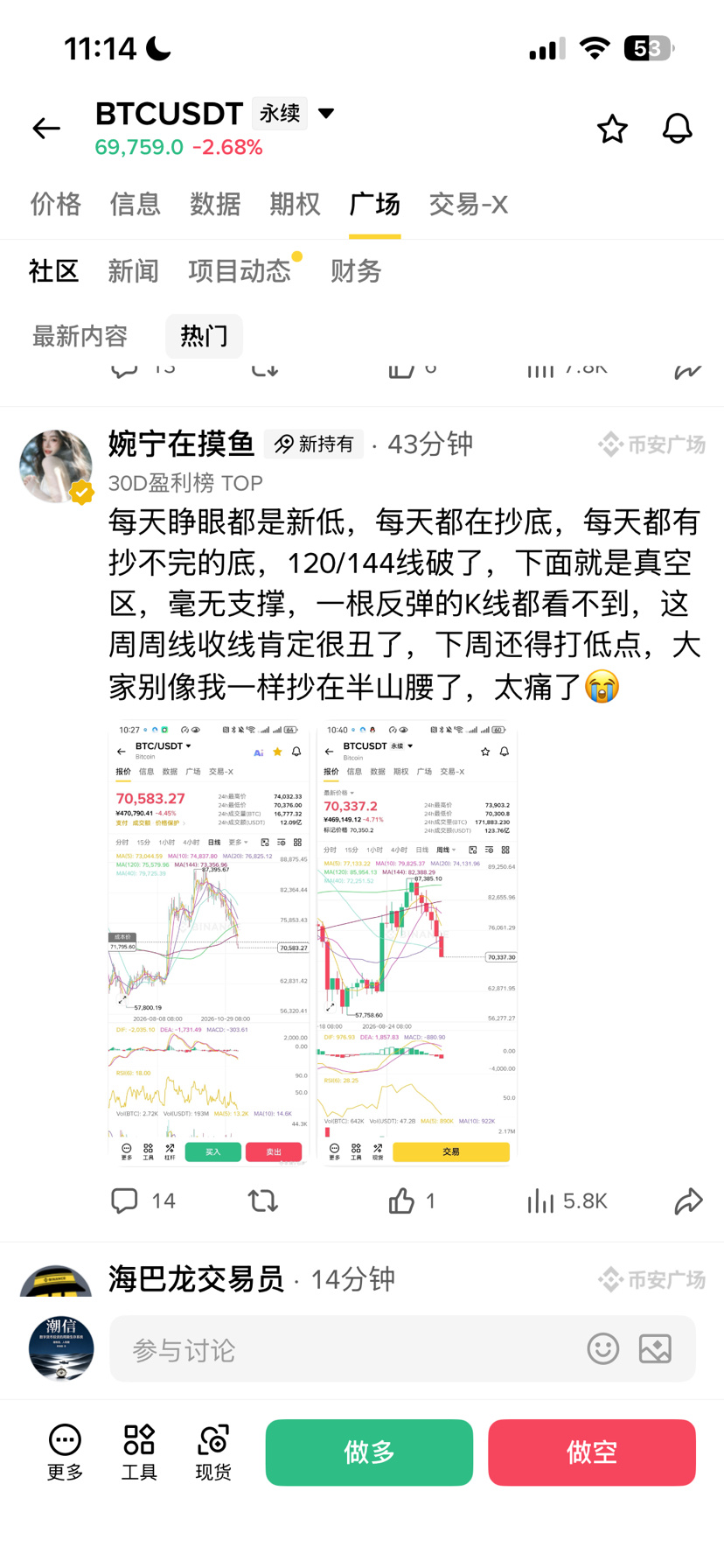
“Every day I open my eyes to a new low. Every day I buy the dip, and every day there are more dips than I can buy. The 120/144 lines have broken, and below them is a vacuum zone with absolutely no support. I can’t see a single rebound candle. This week’s weekly close is bound to look ugly, and next week we’ll probably hit new lows again. Don’t make the same mistake I did and buy halfway down the mountain. It hurts so much 😭”
【Image Details】
Image 1: BTCUSDT 4-hour candlestick chart (price around 70,583; moving averages trending down; MACD bearish crossover)
Image 2: BTCUSDT weekly candlestick chart (price around 70,337; mentions the 120/144 moving averages breaking down)
【Engagement Data】
14 comments, 1 like, 5.8K views/shares
------
2. Blind Spots and Emotion Tags
• Behavioral tags: Linear extrapolation, buying the dip halfway down, ignoring structural breakdowns, frequent impulsive entries
• Emotion tags: Despair, pain (FOMO), cognitive dissonance
------
3. Teaching Analysis (For Coaching Use)
1. Cognitive Bias
The person clearly knows that “a break below the 120/144 lines means there’s nothing but open space below” (technical risk), yet still “buys the dip every day.” A classic case of “knowing what to do but not being able to do it.”
2. Behavioral Blind Spot
Blindly extrapolating linearly (“the weekly chart looks ugly → it’ll make a new low next week”), then repeatedly trying to catch falling knives while the trend is unclear and emotions are in turmoil.
3. Emotional State
At an emotional circuit-breaker point after severe losses (“it hurts too much”). At this point, there’s a high risk of irrationally adding to positions or revenge trading.
------
4. Rudder-Master Compliance Intervention Script
【Public Guidance in the Group】
“Stop there. We don’t discuss specific assets or price levels in this group.”
I saw your post. In the trading market, your principal may look like gold bars, but it can be lost in an instant.
Our rules aren’t about predicting whether prices will rise or fall next week. They’re about helping you stop for 24 hours when it “hurts too much.”
Back to today’s task: open your blind-spot log and honestly record your emotional swings when you “buy the dip halfway down.””
【Private Message: Emotional Intervention】
“I saw your post. The feeling that it “hurts too much” is real, but the market is never short of stories about making money. What’s in short supply is a structure that helps you survive.
The circuit breaker is now triggered: stop trading for 24 hours.
Open your exit card and look at the second column: What are your trigger conditions? Just record them—don’t trade.”
------
5. Related Training Tools
• Expectancy ledger: Track the planned execution rate and actual expectancy of your “buy the dip” trades.
• Circuit-breaker practice card: Rehearse the process for stopping when you’re down 30% on paper.
• Blind-spot log: Specifically record your physical and emotional reactions when “catching a falling knife.”
------
6. Archiving and De-identification Notes
• Archive location: (36 Loss Case Library) — Emotions and Blind Spots Volume
• De-identification requirements: For internal training, hide specific platform names and user nicknames. Retain only the candlestick-chart structure and emotional wording.
• Compliance boundary: This case is for cognitive training and practicing decision-making structures only. It does not constitute investment advice, recommend specific assets, or guarantee returns.
-----
Recommended Improvements:
What the person involved should do right now
First, the most important thing: the right thing to do right now isn’t to “decide what to do.” It’s to “make no decisions for now.”
The person is currently in a “hurts too much” state. Any decision made in this state is driven by emotion, including “I might as well sell everything” and “I’ll buy the dip again to average down.” These actions look opposite, but are essentially the same: using actions to ease emotional pain.
The right sequence is these five steps. Don’t skip any of them.
------
Step 1 | Physically stop trading (now, immediately)
Not “I’m done for today,” but a concrete, visible action you can follow through on:
• Close the order-entry screen and exit the trading app
• Write this on your phone or on paper: “I stopped trading at [time] on [date].”
• Set a reminder for 24 hours from now
Why does it have to be a physical action? Because “I’ve decided to calm down” isn’t an action—it’s a wish. Wishes don’t work when you’re in pain.
This step doesn’t solve any problems. It does just one thing: takes decision-making power back from your emotions.
------
Step 2 | Write down “facts” and “emotions” separately
Take a piece of paper and draw a vertical line down the middle.
Left column: Facts Right column: How I feel right now
The moving averages have broken It hurts too much
I’ve bought the dip several times halfway down I keep buying the dip every day. I can’t stop.
I’m currently sitting on an unrealized loss I’m afraid it’ll drop further
I don’t know where the next support is I feel so stupid
Once you’re done, take a look: the left column can be quantified; the right column can’t.
All the person’s pain right now comes from using what’s in the right column to make decisions about what’s in the left column.
------
Step 3 | Work out “how much is left,” not “how to break even”
This is the most important step, and also the easiest one to skip.
You only need to calculate three figures:
1. What percentage of your total capital is currently tied up in this position? (Not how much you’ve lost, but how much is still tied up.)
2. If it drops another 20% tomorrow, will I still be okay? (Will it affect my life? Could I get liquidated?)
3. What is the maximum loss I can afford right now? (A specific amount, not a percentage.)
Once you’ve worked it out, you’ll usually reach a simple conclusion: either you can afford to lose more on this position, in which case leave it alone for now; or you can’t afford to lose more, in which case you need to reduce it.
Note: This conclusion must come from the calculations, not from your feelings. And I can’t make it for you—you have to work it out and write it down yourself.
------
Step 4 | Acknowledge your blind spot, but don’t berate yourself
In this post, the person has actually shown a clear understanding of their own behavior:
• “The 120/144 lines have broken; there’s nothing but open space below” — they saw it
• “There’s no end to the dip-buying every day” — they know what they’re doing
• “Don’t buy halfway down like I did” — they’re already reviewing their actions
What they lack isn’t understanding; it’s permission to stop.
So write one sentence—not a self-reprimand, just a record:
“This time, my mistake was [buying the dip halfway down]. What triggered me wasn’t the market; it was [not being able to accept the loss].”
Once you’ve written it down, close the notebook. Don’t start criticizing yourself at this step. Self-criticism creates new emotions, and new emotions lead to new actions.
------
Step 5 | Find one person and say just one thing
Don’t ask someone, “Do you think it’ll keep falling?” Find someone and say:
“I stopped trading today.”
The point isn’t to seek comfort. It’s to let someone else witness that you’ve stopped trading. Actions that are witnessed are easier to maintain.
If there’s no one like that around, write it down on paper and include the time.
------
Three things you must not do
1. Don’t add to your position to average down in this state.
Averaging down doesn’t get you back to breakeven. It turns a small, manageable mistake into a fatal one. This is the third of the Seven Fatal Blind Spots.
2. Don’t “sell everything at once” in this state.
It sounds decisive, but it’s still an emotional reaction. After selling, you’ll most likely do one of two things: chase a rally or re-enter the market out of revenge. Stop first, then decide how much to reduce.
3. Don’t ask anyone, “Do you think it’ll keep falling?”
There’s no answer to that question. And when you ask it, you already have an answer you want to hear—you’re just looking for someone to reassure you.
------
One last thing, and the most important
The right thing to do isn’t necessarily the thing that makes money.
After following the five steps above, the market may keep falling and your account may look worse. That’s normal.
But here’s the difference:
• If you make decisions based on emotion, once this pain passes, you’ll feel it again in the same situation next time.
• If you make decisions based on a structure, you may still feel pain this time, but you’ll have a record. When you look back at it three months from now, you’ll know how you made it through.
The market is never short of stories about making money. What’s in short supply is a structure that helps you survive.
What they need to do now isn’t win it back. It’s make sure they’re still around tomorrow to make decisions.
------
#潮信数字货币投资的周期生存系统 Sample Collection