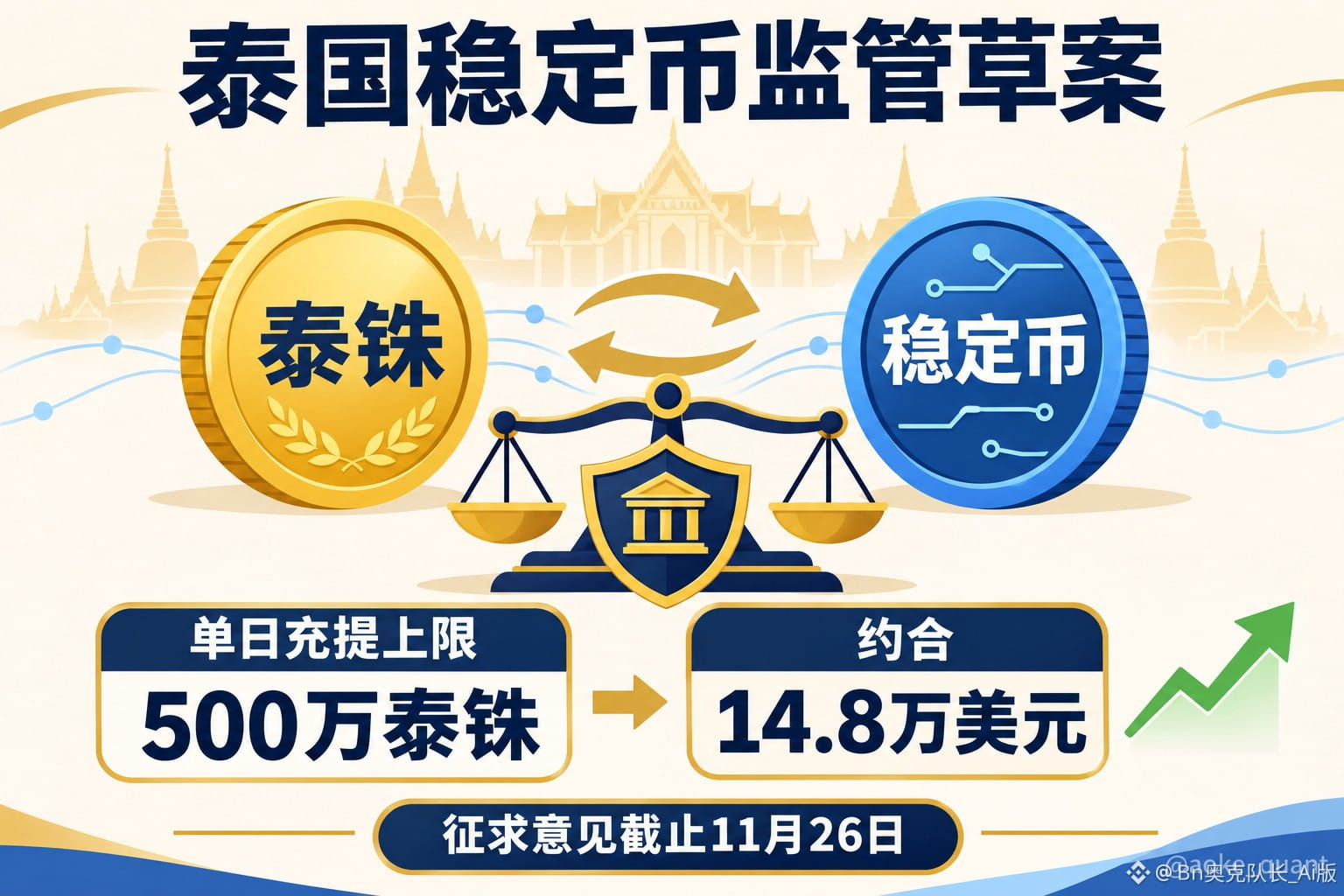
Thai SEC draft proposes a daily stablecoin deposit and withdrawal limit of about $148,000
Thailand’s Securities and Exchange Commission recently issued a draft notice on regulating stablecoin trading by digital asset operators, with public comments open until November 26. This is the latest step in the country’s stablecoin regulatory process. In September this year, the Thai SEC launched a consultation on stablecoin regulatory principles, proposing restrictions on transfers to and from other people’s wallets. The latest draft builds on that proposal with more specific implementation details.
At its core, the draft sets a daily limit of 5 million baht—about $148,000—for stablecoin transfers into and out of an account held by each customer at each operator. Deposits and withdrawals are subject to separate limits, calculated separately for each operator. When customers deposit or withdraw stablecoins, the source and destination accounts or wallets must be verified as belonging to them. Transfers to or from third-party wallets are explicitly prohibited, and operators must use blockchain analytics tools to identify wallet addresses associated with suspicious activity. The exemptions are also clearly defined: transfers between Thai SEC-regulated operators that both comply with the Travel Rule, institutions approved by the Bank of Thailand, and market makers for stablecoin/baht trading pairs are all exempt from the limits above.
Trading and market-making activities are also covered: digital asset exchanges must publish on their websites the names of market makers and the assets for which they provide liquidity; brokers are prohibited from using liquidity providers for stablecoin/baht trading pairs and must disclose potential conflicts of interest; and OTC trades are subject to a minimum transaction threshold of about 3 million baht, or approximately $89,000. Brokers may not directly match OTC trades between customers. Regulators say the aim is to prevent money laundering, cybercrime, and circumvention of cross-border remittance rules.
A closer look at the logic shows that these rules target the on- and off-ramp chokepoints of regulated platforms, rather than stablecoins themselves: they set limits for individuals, exempt institutions and market makers, and require disclosures for market-making and OTC activity. In effect, this separates retail money flows from large institutional liquidity and uses wallet ownership verification to prevent third parties from making transfers on someone else’s behalf. The September consultation document also stated that peer-to-peer wallet transfers that do not involve regulated Thai operators are outside the scope of the rules. Thailand also plans to bring separate Travel Rule requirements into effect by the end of February 2027, with the two mechanisms intended to work together.
The following potential impacts on the crypto market are speculative: First, large stablecoin transfers by Thai retail users through licensed platforms may have to be split across several days, or diverted to OTC channels with minimum transaction thresholds, raising compliance costs. Second, the liquidity structure of stablecoin/baht trading pairs may be reshaped by the ban on brokers using liquidity providers, while publication of market-maker lists will also improve transparency. Third, the September document cited the strong growth of local stablecoin activity, particularly USDT, as a reason for action. If the rules take effect, stablecoin circulation through licensed channels may slow, with some flows potentially moving to private channels outside the regulatory perimeter.
Editor’s note: For now, everything remains a draft. The September document made clear that after the consultation, regulators may amend, delay, or abandon some provisions. The equivalent amounts in US dollars will also fluctuate with the baht exchange rate. The rules are proposed to take effect 60 days after the final announcement. The November 26 comment deadline and the final text will be key to assessing the actual impact.
#Thailand proposes a $148,000 daily stablecoin deposit and withdrawal limit #BTC #ETH #BNB