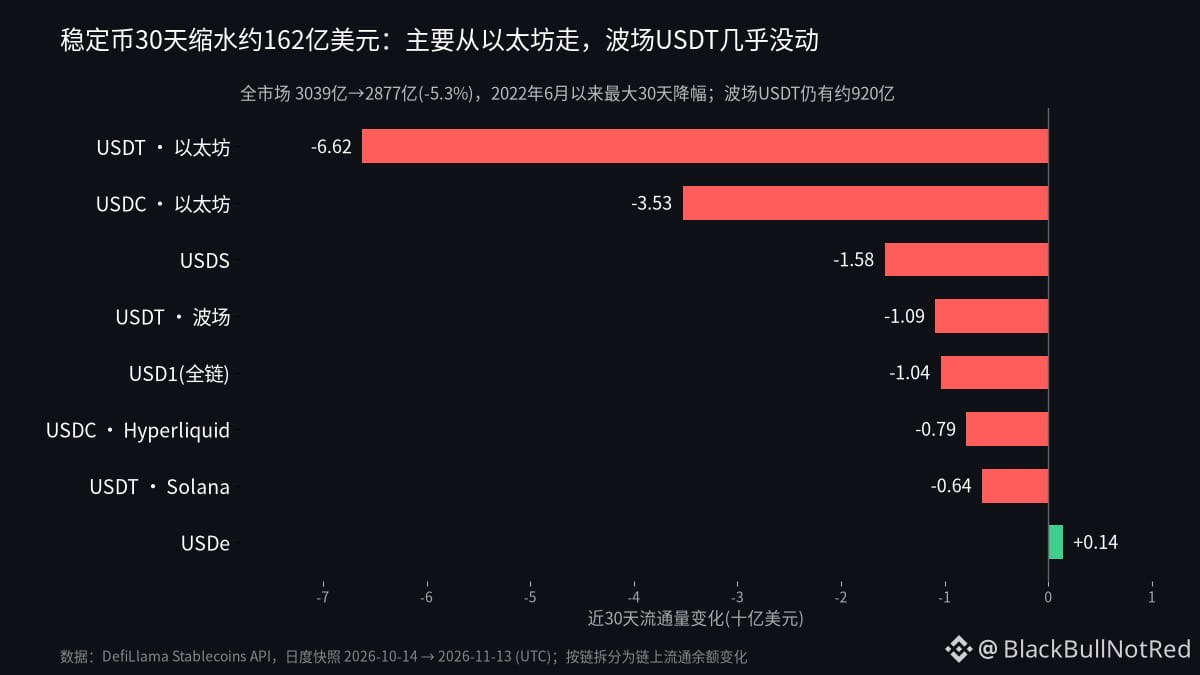
Stablecoins shrank by $16.2 billion in a month. According to DefiLlama, that’s the steepest 30-day drop since June 2022. But before joining the chorus of “massive capital flight,” let’s break down which chains are bleeding. The picture looks a little different.
USDT fell by about $8.4 billion over the past 30 days, including $6.6 billion on Ethereum and only $1.1 billion on Tron. The roughly $92 billion in USDT on Tron is mainly used for transfers, currency exchange, and OTC trading. It’s down just over 1% in a month—basically unchanged. What’s moving is the big money on Ethereum: market makers, funds, lending pools, and exchange treasuries. These are also largely the big players who can redeem directly with the issuer for cash.
USDC shows a similar pattern: down $3.5 billion on Ethereum and $790 million on Hyperliquid. Put simply, USDC on HL is used as margin for perpetuals. A nearly $800 million decline in a month means contract traders are pulling money off the table.
My take: it’s not that people have stopped using stablecoins. Leveraged capital and big players are reducing positions and moving dollars back off-chain. Payment demand is still there, while speculative demand is shrinking. That’s more concerning than the phrase “total stablecoin supply is falling,” because the marginal buyers driving token prices are precisely this group of investors—and the USDT used for transfers on Tron isn’t going to come in and buy your altcoins.
A few things to clarify:
A decline in on-chain balances only tells us that coins were redeemed and burned or moved elsewhere. It doesn’t mean every dollar represents someone selling and leaving; some may simply have been sitting idle in treasuries and then redeemed to earn a return on U.S. Treasuries. The “$14.2 billion in outflows over 30 days” figure circulating on X doesn’t match DefiLlama’s numbers—the methodologies differ, so don’t quote it as-is. And don’t scare yourself by comparing this with 2022: that time, supply fell by $28.6 billion, or 15%, in 30 days, and UST also went straight to zero. This time it’s down 5.3%, with a total pullback of about 8% from the May 17 peak of $312.8 billion.
One more detail: USD1 is down about $1 billion in a month, nearly a quarter of its supply—the biggest drop among the top 10 stablecoins. The team hasn’t offered an explanation, so holders should keep an eye on where it’s flowing.
When can we say this has stopped bleeding? Watch for balances on Ethereum and HL to stop falling, rather than looking at the total. Tron’s share of the total is so stable that it can mask genuine capital outflows.
#稳定币 #USDT