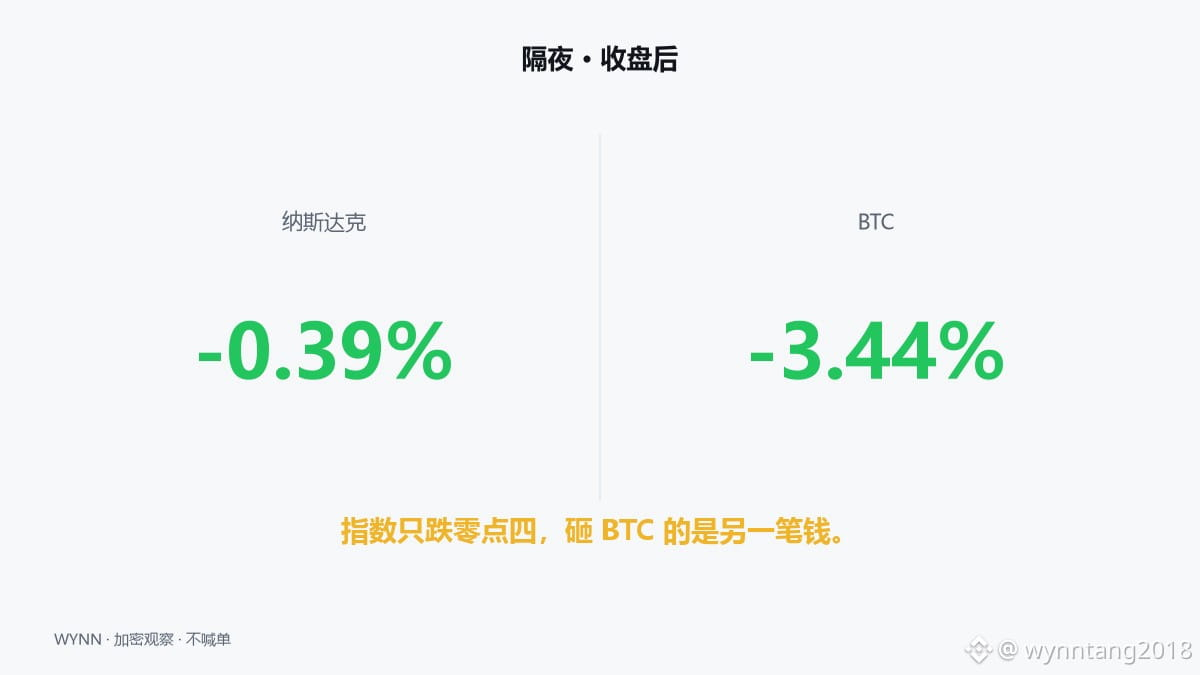
The index fell just 0.4%. Something else was behind BTC’s drop.
The consensus is that Nvidia’s leadership change hammered tech stocks, and crypto got dragged down with them. But AMD and Broadcom each rose more than 5% that same night, while the Nasdaq fell just 0.39%. BTC dropped 3.44% in 24 hours—8.8 times the Nasdaq’s decline. With an eightfold difference, the cause can’t be the same.
Now look at volume. BTC’s 24-hour trading volume was 1104 million dollars, just 0.96 times its 30-day average. A drop of more than 3% without a surge in volume means buyers pulled back. The decline wasn’t evenly distributed, either: between 7 p.m. and 11 p.m. Beijing time last night, BTC shed 2.48 percentage points—70% of the full-day drop.
Where did the money go? Look at three other names. DOGE traded 39.1 million, exactly its 30-day average volume, while its price fell just 1.28%. PEPE’s price barely moved; its 72.2 million in volume was 1.20 times its average—the only one of the three to see a volume increase. ZEC fell 1.95%, with 156.0 million in volume, just 0.82 times its average.
This means the money pulling out was just the capital that flowed into BTC through ETFs and public companies’ balance sheets. Trading is still happening within the market. I’m bearish on BTC’s relative strength over the next few days, not the entire market: ETF net outflows are like a one-way pipe.
One thing I’m watching: if DOGE’s 24-hour volume tops 50 million dollars during today’s Asian session and its price keeps falling, I’ll change my mind—that would mean money is leaving.
What do you choose: follow the volume and stay in altcoins, or wait for BTC to see a volume surge of its own?
$DOGE $PEPE $ZEC #BinanceSquare #USJoblessClaimsRise #Dogecoin
Crypto assets are high-risk. The above reflects my personal observations and is not investment advice. Please make your own decisions (DYOR).