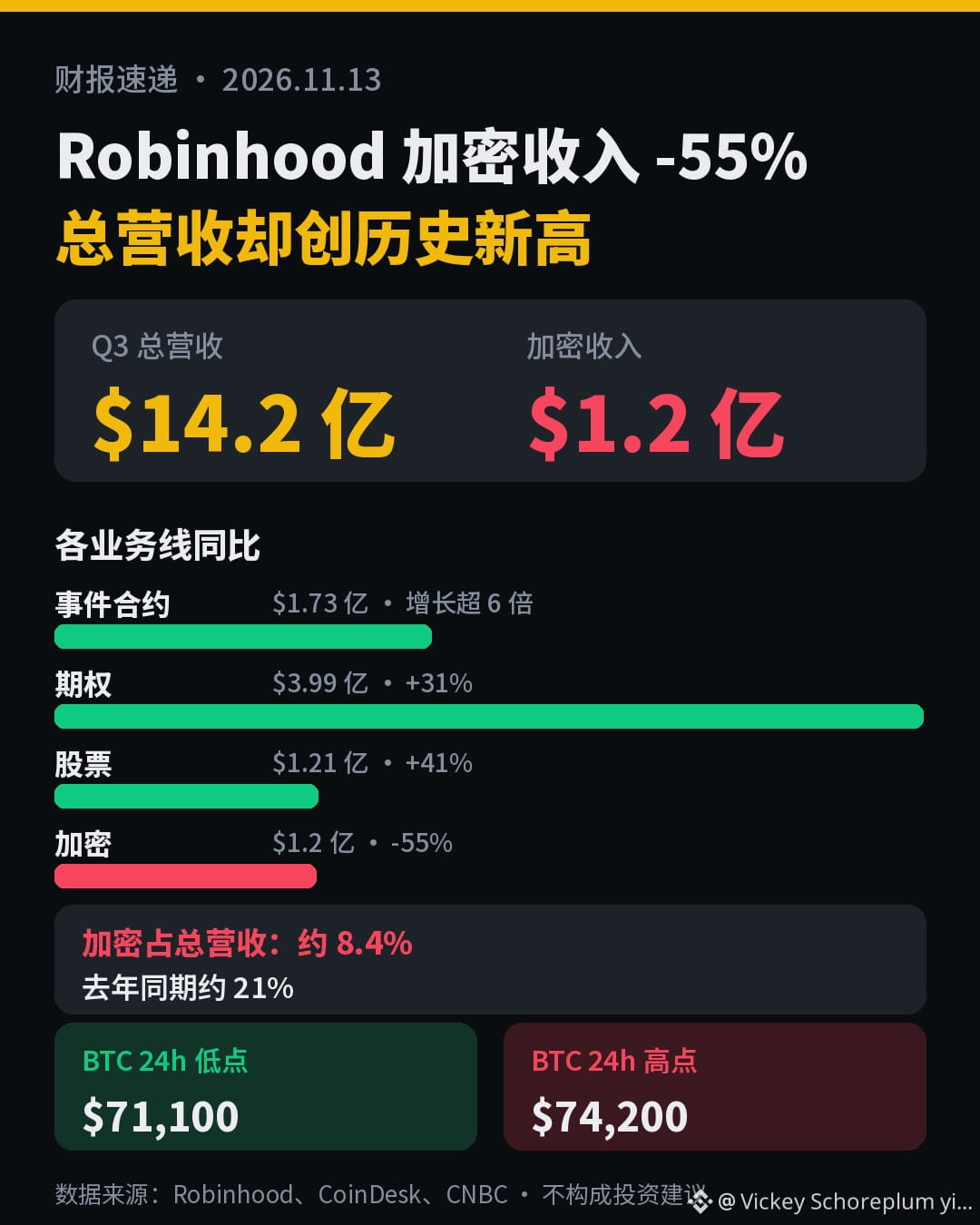
📉 Robinhood’s crypto revenue plunged 55%—so why did total revenue hit a record high?
Robinhood reported its Q3 2026 earnings on October 27: total revenue rose 12% year over year to $1.42 billion, a record high. But revenue from its crypto business fell 55% year over year to just $120 million, down from about $267 million in the same period last year.
📊 Its revenue mix is shifting
• Event contracts (prediction markets): $173 million, up more than sixfold year over year
• Options: $399 million, up 31%
• Equities: $121 million, up 41%
• Crypto: $120 million, down 55% year over year, accounting for about 8.4% of total revenue, compared with about 21% in the same period last year
⚠️ But it wasn’t all good news
Diluted EPS came in at $0.51, down 16% year over year and below analyst expectations. Transaction-based revenue was $867 million, also slightly below Wall Street’s $879 million forecast. Shares fell about 7% in after-hours trading following the earnings report.
🤔 What does this mean for the market?
Retail money hasn’t disappeared—it’s flowing into options, prediction markets, and U.S. stocks. The decline in crypto trading volume reinforces BTC’s continued weakness: when retail enthusiasm cools, the story of platforms making money from crypto becomes harder to sell. Treating brokerage stocks as stand-ins for BTC can lead you to misjudge where their profits really come from.
BTC is currently around $71,500, with a 24-hour range of about $71,100–$74,200: watch for further declines if it breaks below the low; sentiment is likely to improve noticeably only if it climbs back above $74,200.
Do you think retail money will flow back into crypto? Share your thoughts in the comments 👇
👉 Trade BTC: https://www.binance.com/zh-CN/trade/BTC_USDT
#Beginner’s guide: Understanding TradFi from scratch #Robinhood #BTC #Crypto market
⚠️ This is not investment advice. Please be aware of the risks.