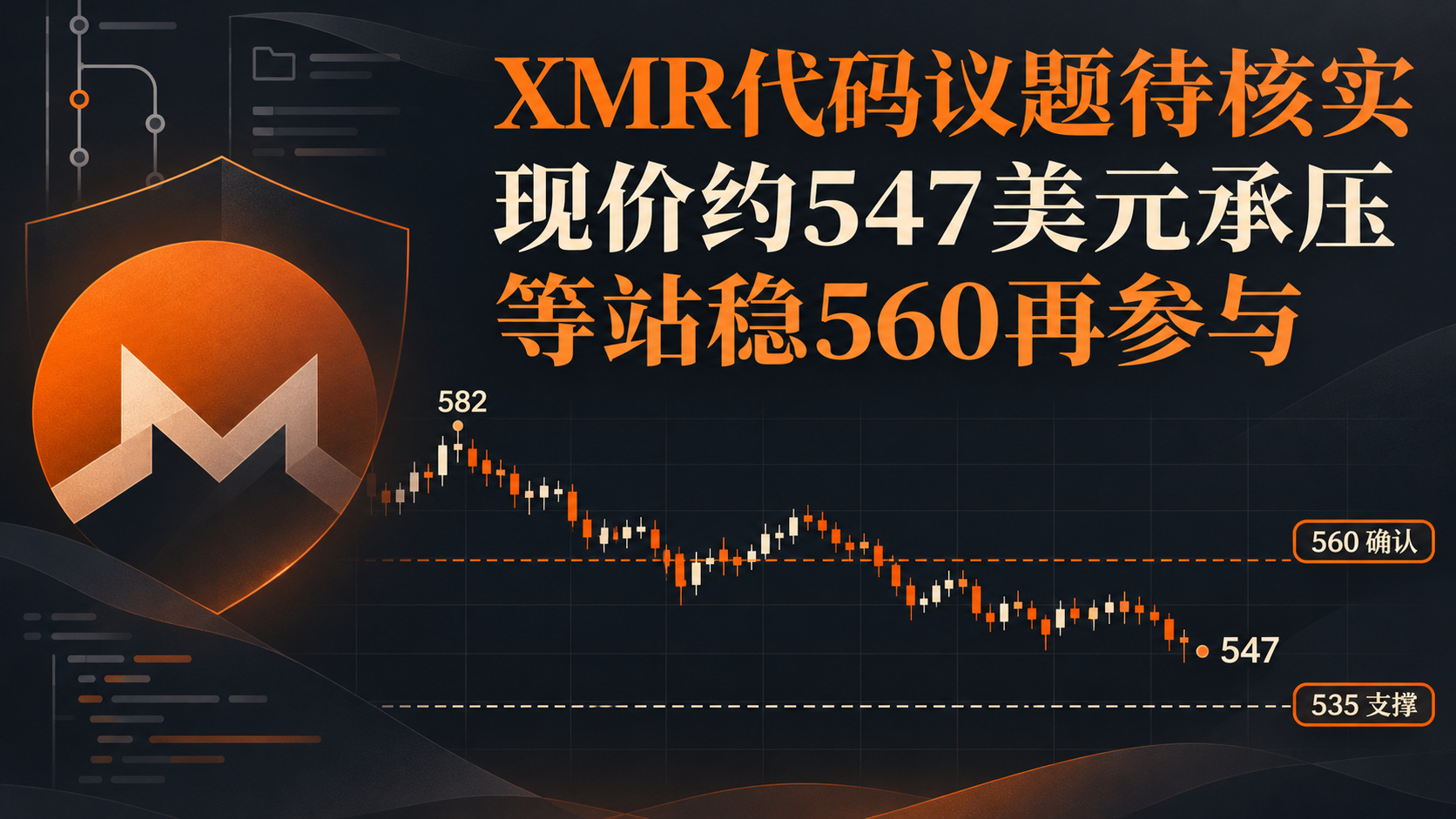
Privacy-boundary discussion emerges in XMR code repository | Price around $547, still under pressure | Wait for verification and a sustained move above $560
My stance is to wait and see. On November 6, a public issue numbered 11690 appeared in Monero’s official code repository. Based on the transaction-pool code path, the submitter speculated that when a node has seen a transaction but not yet publicly broadcast it, an external node might use a conflicting transaction with the same key image to observe whether the connection is dropped, and thereby infer whether the corresponding transaction is in the transaction pool. The issue explicitly says this is an analysis of the code path and has not been reproduced on a live network. It remains an open question for discussion; it cannot be described as a large-scale privacy leak that has already occurred, much less as evidence that the XMR chain has stopped operating. Project discussions also note that the existing design—of not disconnecting honest nodes because of conflicting transactions—involves trade-offs, and that any fix would need to balance false positives against verification costs.
The relevance to today’s price is risk assessment, not finding a catch-all reason for a decline. Monero’s core value proposition includes default privacy, so an issue that may affect privacy during transaction propagation is worth monitoring for maintainer reproduction, review, and remediation progress. But the public issue alone is not enough to establish the scope or ultimate severity of any vulnerability. Separately, MEXC previously announced that it would cease XMR spot trading at 09:00 UTC on November 13. Fewer trading venues can make execution and slippage more sensitive. This is an independent fact; there is currently no evidence that the code issue caused MEXC’s decision, and not all of the decline can be attributed to either development.
The market is already showing signs of pressure. At 07:42 Beijing time on November 13, Kraken XMR/USD was around $547.15, with a 24-hour opening price of about $582.10 and a range of $535 to $583.66. That is a roughly 6% decline from the open to the current price—a description of market action, not proof of causation. Around $535 is the day’s low; $560 is the short-term threshold I’m watching to see whether the price can reclaim it, while $580–$584 is resistance overhead. If the price breaks below $535 and the decline continues to deepen, the short-term stabilization view is invalidated. If maintainers confirm an exploitable issue and disclose its scope, I would also reassess the risk level. Conversely, if the issue is disproven or fixed, the original risk assumptions should no longer be carried forward.
If I were trading this myself, I would stay out for now, with only a small spot position reserved for a possible long entry and no leverage. I would consider entering in stages with 2% of total capital only if the project issue does not escalate into a confirmed serious incident, and XMR reclaims $560 and holds on a retest. If those conditions are not met, I would remain in cash. The first target is $580, where I would reduce the position by half; the second is around $594, where I would trim most of the remainder. I would set the initial stop below $548, but close early if the price falls back below $560 and continues weakening. A break below $535 would cancel this long-trade plan. If spreads widen significantly around the trading-venue transition, I would also skip the entry rather than let slippage eat into the planned return.
I’ll continue to monitor reproducible evidence and the outcome in the project repository, keeping “risk awaiting verification” separate from “a confirmed incident.” #XMR
The above is solely my personal market observation and does not constitute investment advice.