


Key conclusions
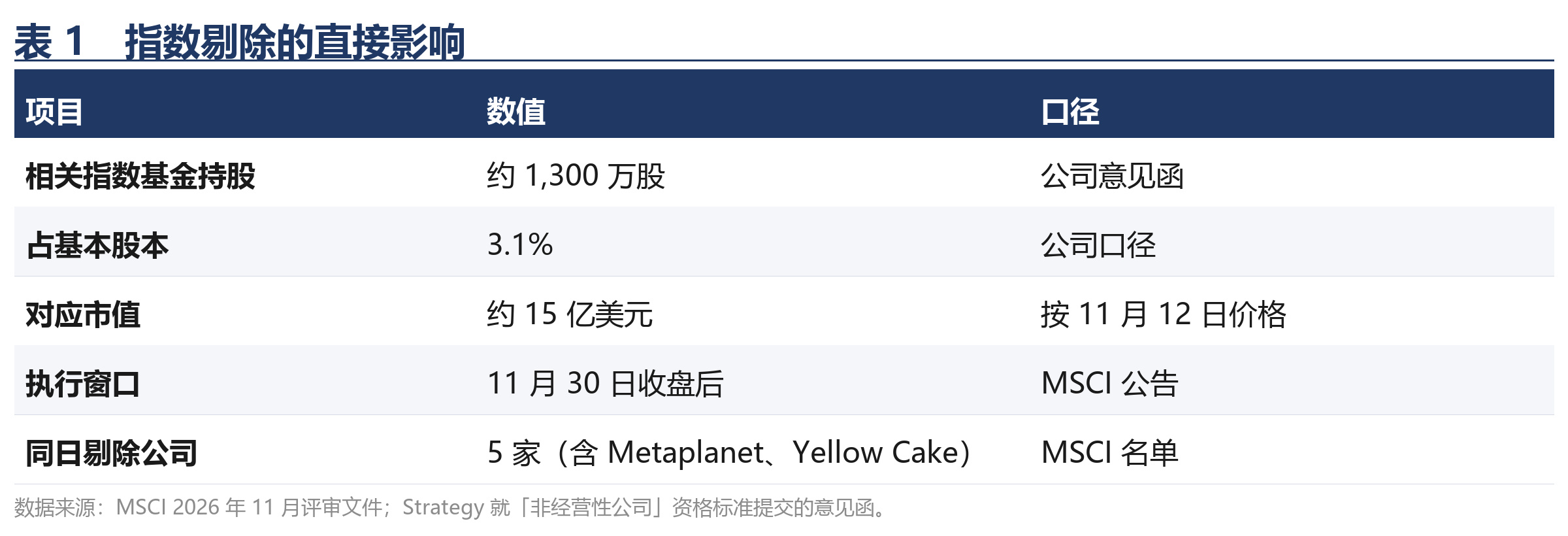
1. Direct selling pressure from #MSCI index exclusion is limited: approximately 13 million shares, 3.1% of the public float, or $1.5 billion—less than a day's trading volume.
2. The company shifted from net buying to net selling in Q2 2026; the index decision was unrelated to this shift and only increased its visibility.
3. Cash obligations (annualized dividends of approximately $1.68 billion) and equity financing efficiency (BTC Yield -3.7%) are the main constraints; $BTC price is not a constraint at present.
4. In the baseline scenario, the company remains a net seller in the first half of 2027 ($300 million to $500 million per quarter), while Bitcoin trades in a range of $68,000 to $78,000 over the same period.
This material is a compilation and analysis of public information and does not constitute investment advice.
I. Event and Index Impact
On November 11, MSCI announced the results of its November 2026 index review, confirming that Strategy would be removed from the MSCI USA and global investable market index series. The changes take effect after the market close on November 30, with the new constituents taking effect on December 1. The same list includes five other potential removal candidates, as well as Japan’s Metaplanet (MSCI Japan Small Cap) and the UK’s Yellow Cake.
The rule is based on the “non-operating company” eligibility criteria adopted on October 15: companies are first assessed for the presence of substantive operating assets. Those that fail are evaluated against five tests covering asset structure, expenses, operating cash flow, fair-value exposure, and reliance on external financing. Failure on four or more tests makes a company ineligible, and the criteria must be met for two consecutive annual reporting periods. The rule does not mention digital assets; it targets financial characteristics, not asset holdings.
Passive fund holdings are estimated based on company disclosures: funds tracking the relevant indices hold approximately 13 million shares, or 3.1% of basic shares outstanding, worth about $1.5 billion at the current price—less than the trading volume of a single day. On this basis, the price impact during the implementation window is expected to be concentrated around the November 30 close and should be absorbable.
II. Financial Structure: Cash Obligations and Coverage Ratios
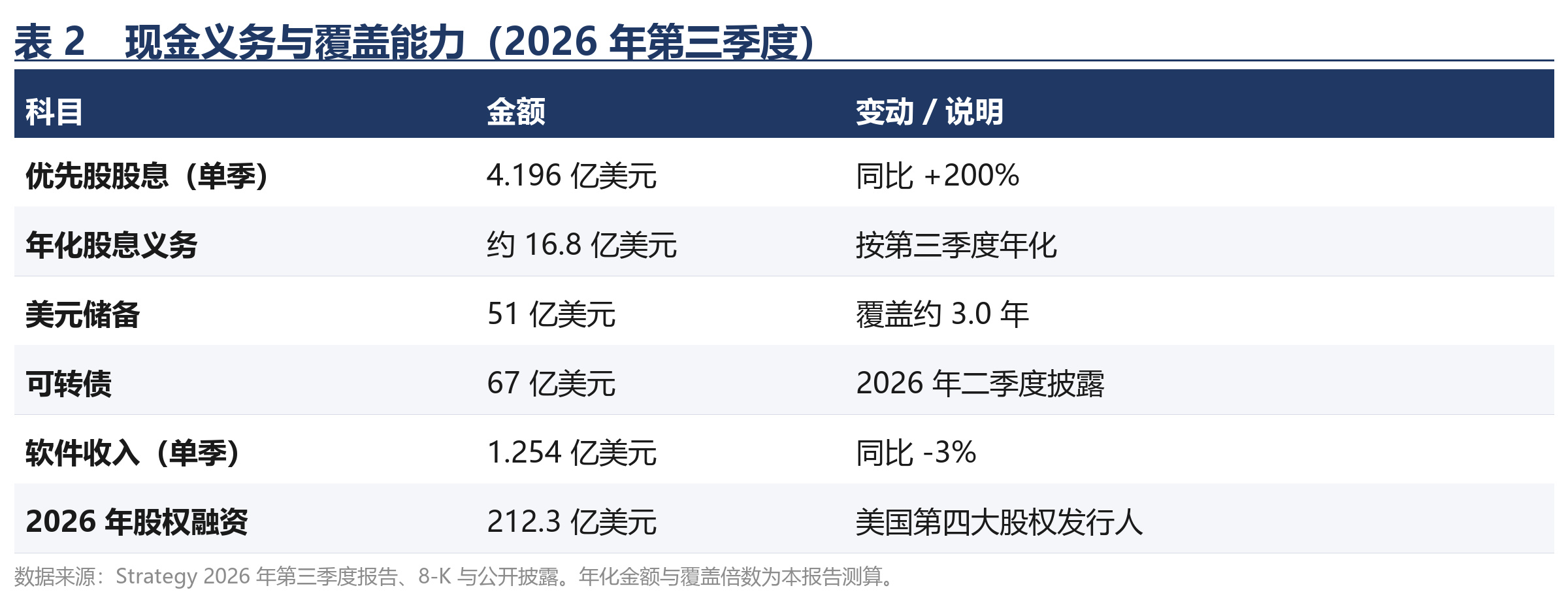
The index decision does not constrain the company’s operations. The real constraint is the preferred-stock dividend obligation, which continued to grow in 2026. Four perpetual preferred stocks (STRC, STRF, STRK, and STRD) pay cash dividends. Third-quarter dividend expense was $419.6 million, up 200% from $139.9 million in the same period a year earlier, or approximately $1.68 billion annualized. On October 28, shareholders approved daily accrual by a 99.3% vote. STRC began accruing daily on November 1. This change reduces reinvestment lag but does not alter the coupon rate.
Cash: The company disclosed $5.1 billion in dollar reserves as of October 25, which it says can cover dividends and interest for 3.4 years. Based on annualized third-quarter dividends, the coverage ratio is approximately 3.0 years. Third-quarter software revenue was $125.4 million, down 3% year over year, making its contribution to the dividend shortfall negligible. On the debt side, the company also has $6.7 billion in convertible notes, with a relatively long maturity profile and no near-term concentration of maturities.
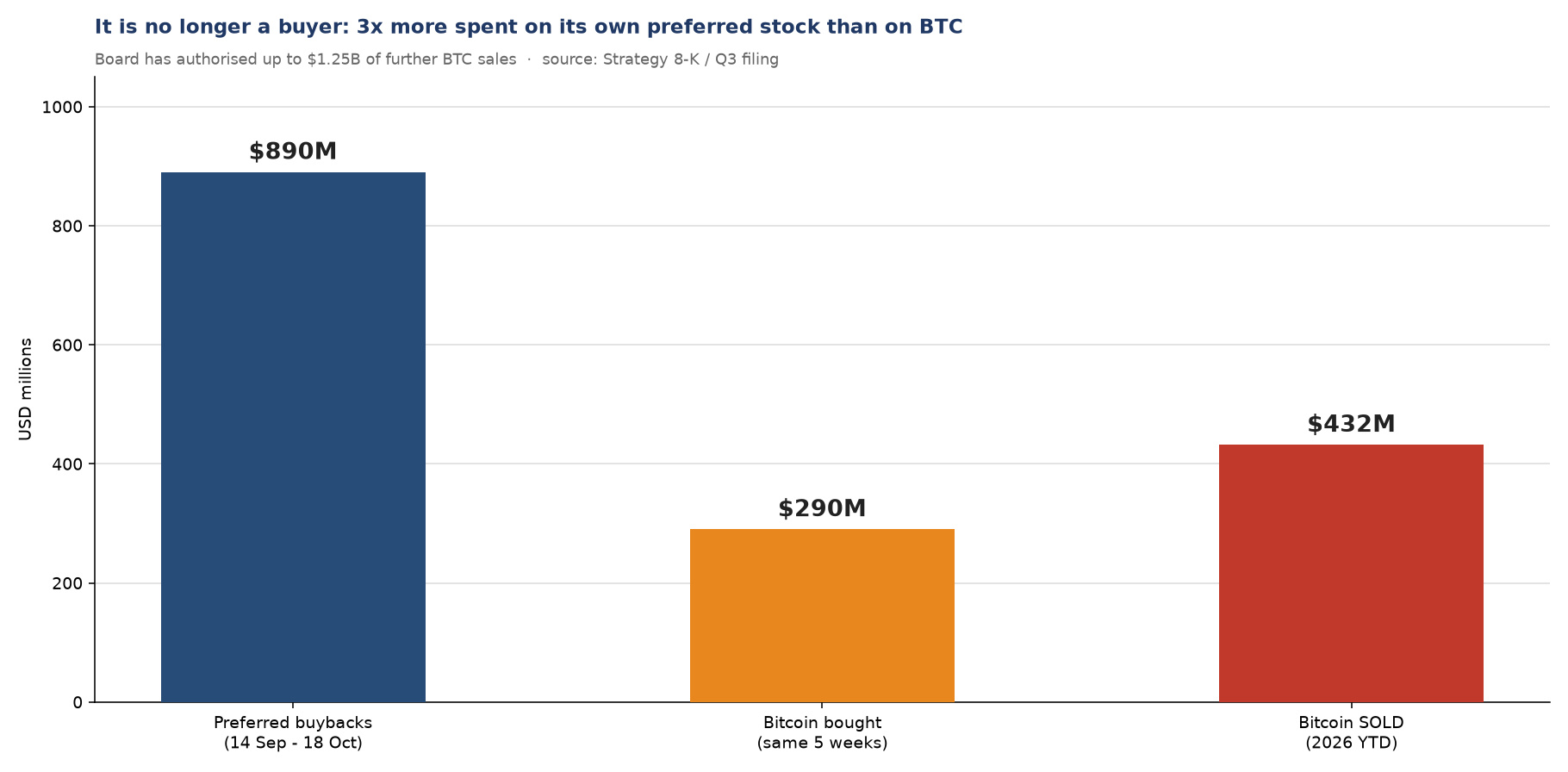
In capital allocation, management is prioritizing preferred stock over Bitcoin. The rationale is quantifiable: STRC has a par value of $100 and a 12% coupon, and currently trades at about $99. The company is repurchasing it at an average 13.5% discount, effectively settling $1 of principal for 86.5 cents and permanently eliminating a 12% dividend obligation. This delivers a substantially higher internal rate of return than adding to Bitcoin holdings while mNAV is around 1.08. From September 14 to October 18, the company repurchased $890 million of preferred stock and bought $290 million of Bitcoin over the same period. The repurchase authorization has been raised to $3 billion.
III. Treasury Position and Issuance Efficiency
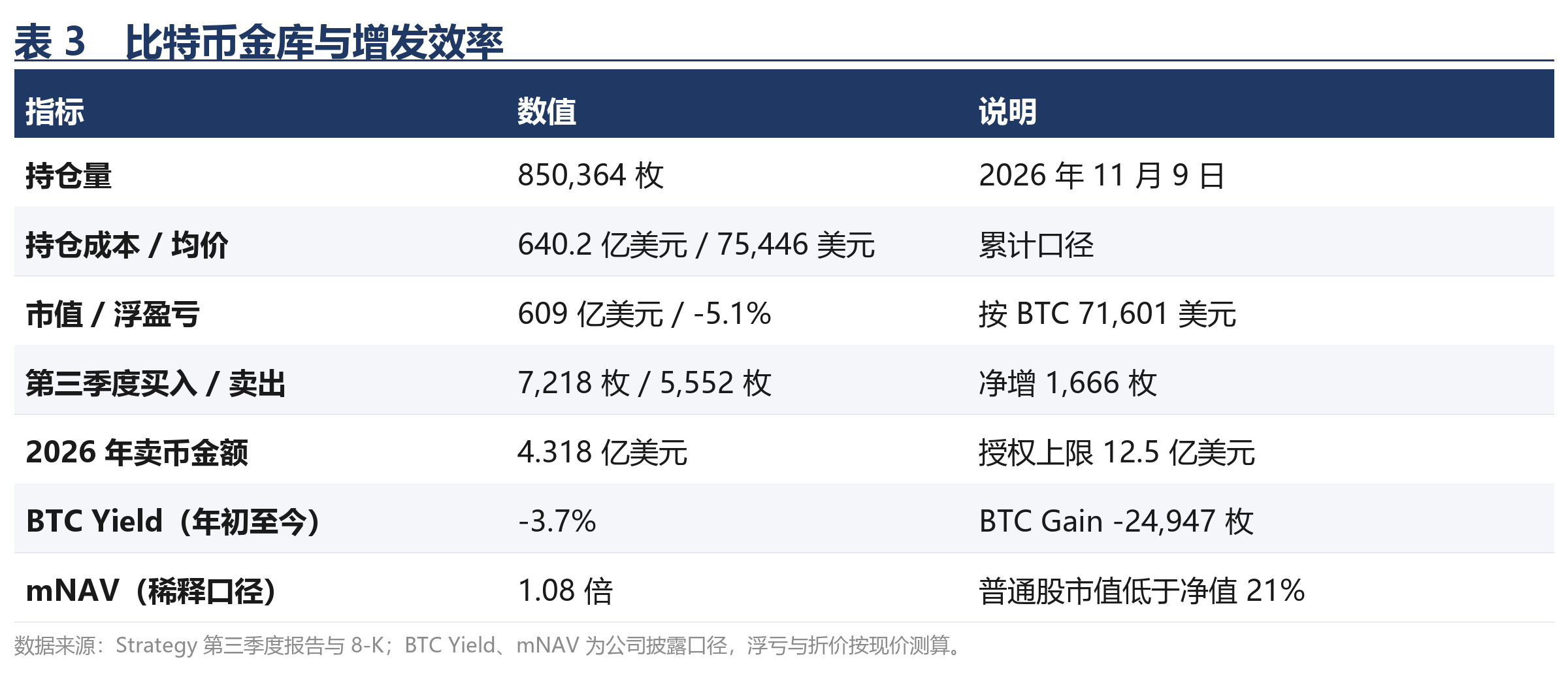
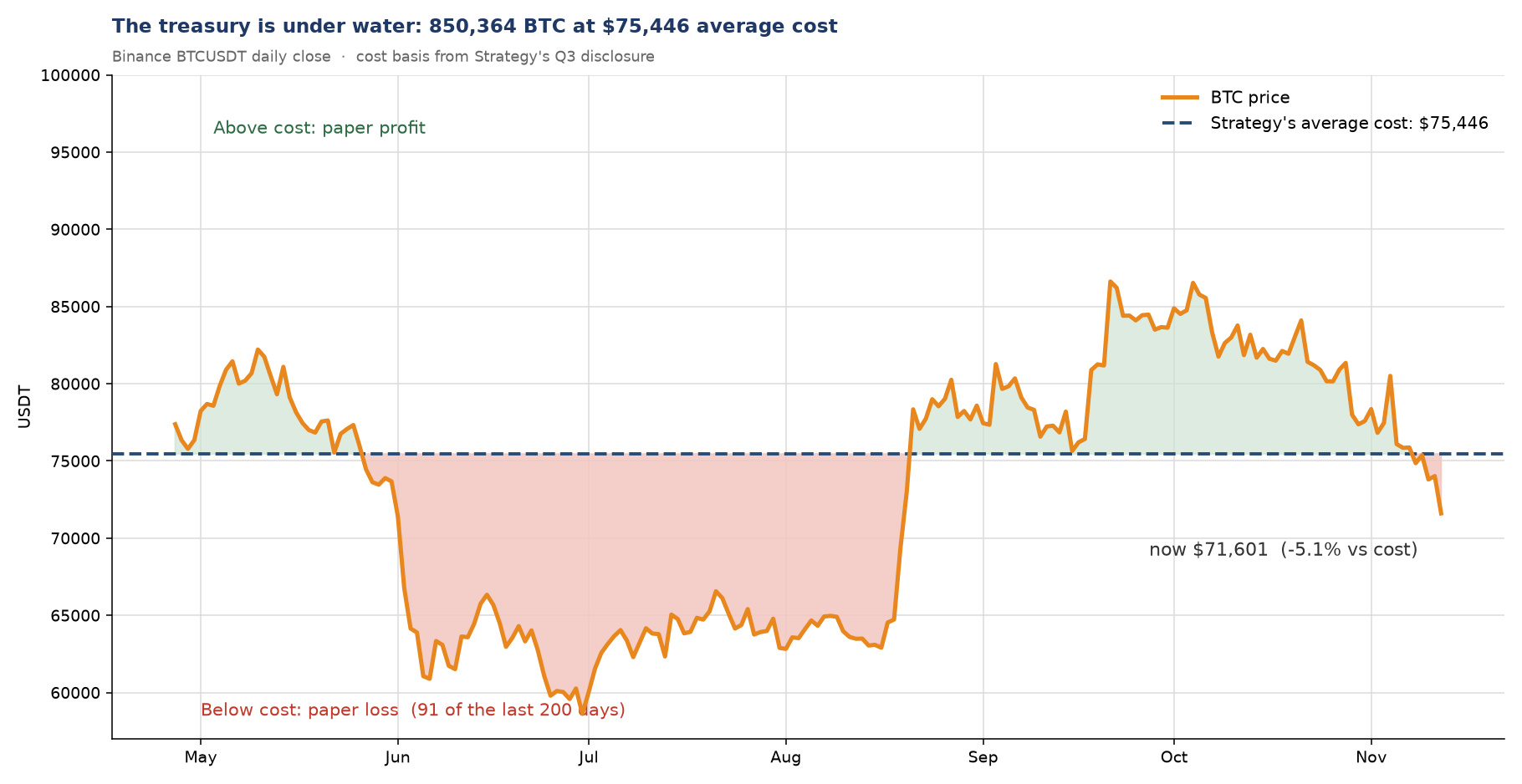
Bitcoin holdings stood at 850,364 coins as of November 9, with an aggregate cost of $64.02 billion and an average purchase price of $75,446, representing about 4.3% of circulating supply. At $71,601 per Bitcoin, the holdings are worth $60.9 billion, an unrealized loss of 5.1%. The company recognized $20.91 billion in fair-value gains in the third quarter. This is a non-cash accounting adjustment and does not constitute distributable cash flow.
The company bought 7,218 coins and sold 5,552 in the third quarter, for a net increase of 1,666 coins. Year to date in 2026, it has sold $431.8 million through its monetization program, against a board-authorized limit of $1.25 billion. In October, there were two weeks with no purchases, including one week in which only 250 coins were bought.
Issuance efficiency is another constraint. Equity financing totaled $21.23 billion in 2026, but the company’s own disclosures show BTC Yield of -3.7% and BTC Gain of -24,947 coins, or approximately -$2.03 billion: financing hit a record, yet the Bitcoin represented by each share declined. MSTR is down 51.7% over the past 12 months, so raising the same amount of capital requires issuing more shares. mNAV has converged to 1.08; based on a common-stock market capitalization of $48 billion, this is already 21% below the net value of its Bitcoin holdings. Under these conditions, issuing shares no longer has an accretive effect, directly explaining the company’s slower pace of purchases.
IV. Transmission Mechanism: Three Types of Buyers and Net Supply
Marginal demand for MSTR can be divided into three categories: index-tracking funds (which are not valuation-sensitive), passive products anchored to the share price, and active investors. The removal eliminates the first category, which accounts for 3.1%, and its impact is one-off. The second category mechanically reduces holdings when the price falls, making it a procyclical factor. Active investors are the most sensitive to issuance discounts. This structural change in the composition of demand means future share issuance will have to bear a deeper discount, further reducing financing efficiency and reinforcing the company’s inclination to use cash and Bitcoin to meet preferred-stock obligations.
Supply-side estimate: Based on third-quarter sales of 5,552 coins worth $348.6 million, annualized net sales are approximately 14,000 to 22,000 coins, equivalent to $1 billion to $1.6 billion. This represents about 9% to 13% of the approximately 164,000 coins expected to be newly mined in 2026. Compared with the company’s previous pace of net purchases of 1,000 to 2,000 coins per week, the direction has shifted from positive to negative. The scale is not a systemic shock, but during periods of net ETF outflows, the direction of marginal flows matters more than their absolute size.
Comparison over the same period: From September 19 to October 19, whale addresses holding fewer than 10,000 coins accumulated a total of 88,987 coins. The company bought 2,516 coins over the same period, less than 3% of that amount. BlackRock’s Bitcoin ETF saw $2 billion in net outflows over nine trading days. With both types of price-insensitive buyers turning away, price discovery is left to capital with shorter investment horizons.
V. Scenario Analysis
Using cash coverage, quarterly coin sales, and mNAV as the key variables, we present three scenarios and subjective probabilities. These probabilities reflect relative likelihoods based on the current information set and do not constitute point forecasts for prices.
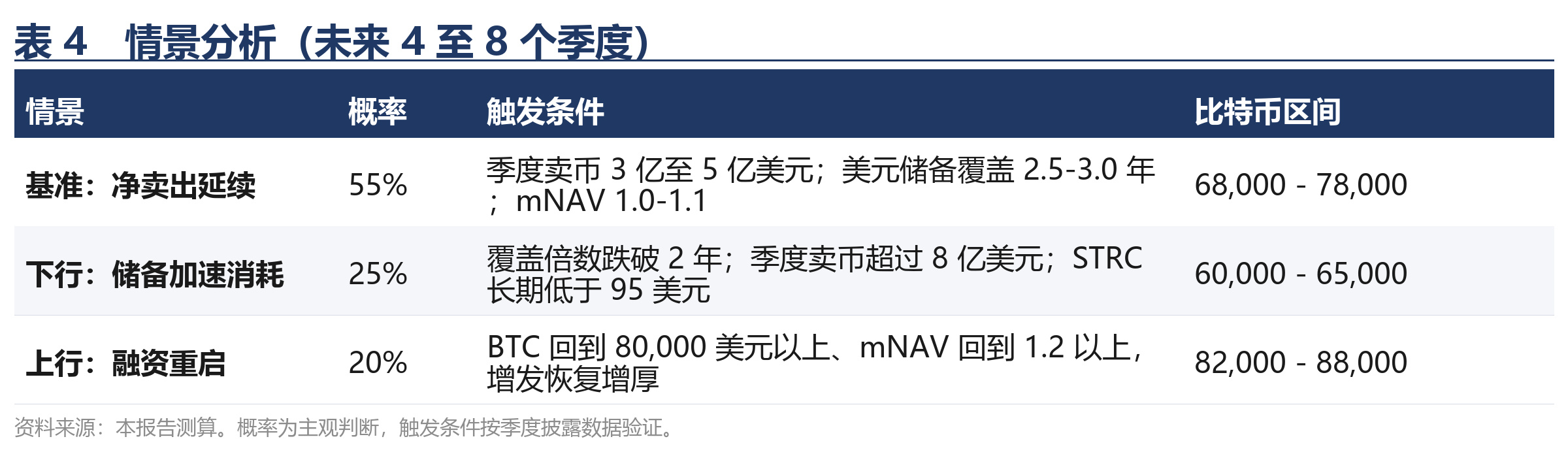
The symmetry is this: the index removal itself does not require the company to dispose of assets, and its 850,364 Bitcoin will not enter the market as a result of the announcement. Conversely, if a Bitcoin price recovery pushes mNAV back above 1.2, share issuance would once again become accretive, and the company could resume net purchases within a quarter. This path is likewise independent of the index decision.
VI. Risks and Monitoring Indicators
Upside risks: A rapid Bitcoin recovery lifts mNAV and preferred-stock prices, reopening the financing window; other index providers do not adopt similar rules, limiting the extent to which the removal can be extrapolated to other companies.
Downside risks: A prolonged discount in STRC raises the cost of preferred-stock financing; the convertible debt refinancing window narrows; the rules spill over to other digital asset treasury companies, causing industry-wide financing channels to contract in tandem; ETF outflows persist.
Monitoring indicators: Quarterly coin sales and the coverage ratio of dollar reserves (disclosed quarterly); STRC’s price deviation from its $100 par value; mNAV and BTC Yield; weekly net flows into spot Bitcoin ETFs; whether other index providers follow suit.