

The Battle for $73K, the “Commission-Bull” and the Institutional Diet
Welcome to your daily dose of financial adrenaline. If your crypto portfolio were a person today, it would probably be sitting in a corner, breathing into a paper bag and muttering something about the CPI and “ninja arbitrage bots.”
The cryptocurrency market is at a vibrant yet extremely tense moment. We’re witnessing a fascinating struggle between long-term institutional optimism and short-term retail panic, all seasoned with a touch of voracious fees.
Bitcoin’s Big Scare and the Retail Investor’s Magnifying Glass
Bitcoin (BTC) remains the star of the week. After flirting with all-time highs recently, the reigning cryptocurrency has had a reality check. BTC is currently struggling desperately to stay above its vital technical support around $73,000–$74,000 USD.
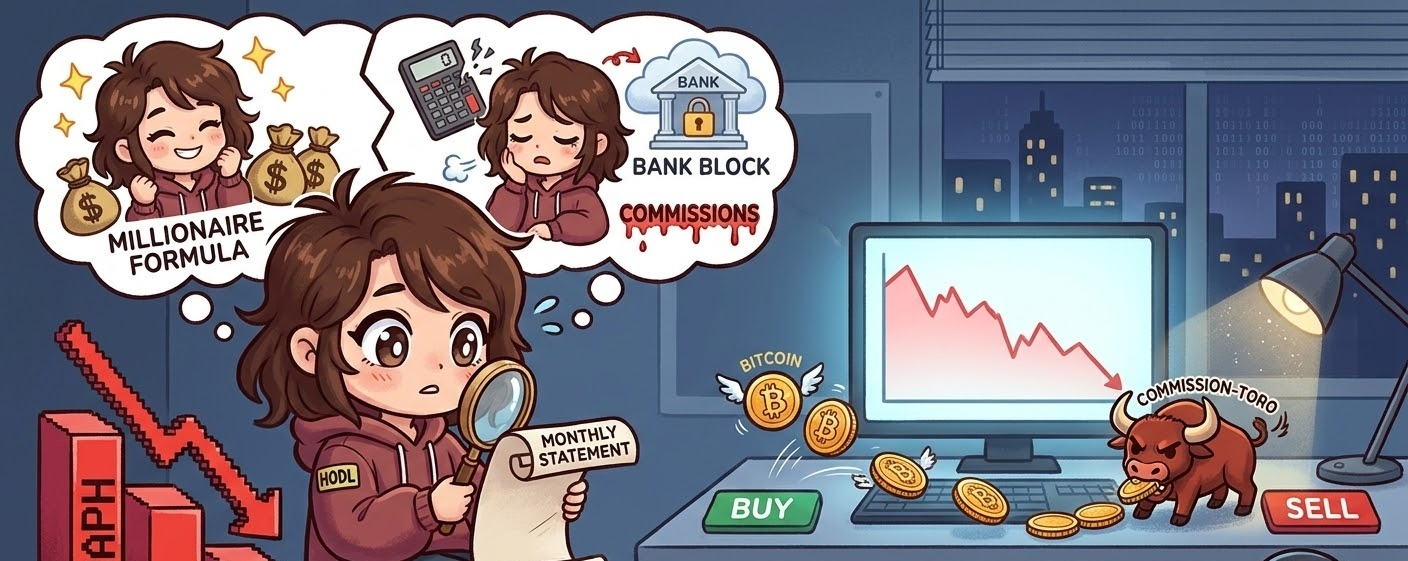
The culprit? The usual one: inflation in the United States (CPI). A reading that came in hotter than expected has made investors think twice before jumping into risky assets. If BTC breaks below this level, technical analysts—the folks who see the future in red and green lines—warn that the next major “floor” could be as low as $65,000 USD. It’s a moment when retail investors, like our chibi heroine, are literally examining their “Monthly Statements” with a magnifying glass, trying to figure out where their money went while the “Debt” and “Fees” bar charts keep climbing.
The “Fee Bull” and the Sad Reality of Arbitrage
While Bitcoin dominates the headlines, the “basement” of the crypto ecosystem is having its own drama. Many investors are trying to escape volatility by seeking refuge in seemingly “safe” strategies like P2P (peer-to-peer) arbitrage, thinking they’ve found the “Millionaire’s Magic Formula.”
The harsh reality? The P2P market is currently saturated with what we’ve dubbed the “Fee Bull.” This is a scenario where the potential profits from buying low on one exchange and selling high on another are instantly devoured by:
1. Network Fees: Transaction fees that rise when the network is congested.
2. Volatile Spreads: The price difference between “Buy” and “Sell” disappears in seconds because of high-speed ninja bots.
3. Bank Freezes: The arbitrage trader’s greatest fear: a preventive “Bank Freeze” due to suspicious activity, locking up funds just when they’re needed most.
It’s a brutal reminder that in crypto, “if something sounds too good to be true, there’s probably already a cosmic bot charging you a fee for it.”
The Institutional Diet and the BlackRock Factor
To add more spice, the Wall Street giants who came in triumphantly with ETFs seem to be lightening their briefcases. BlackRock, the world’s largest asset manager, has slightly reduced its Bitcoin and Ethereum holdings in recent days, triggering net outflows from ETFs.
This doesn’t mean they’re abandoning ship; like all savvy investors, they’re taking profits after recent gains or adjusting their portfolios amid economic uncertainty. However, for retail investors, seeing “Daddy BlackRock” sell is often enough to trigger a wave of “Panic Selling.”
In Summary: HODL or Sell?
We’re at a crossroads. If you’re a HODL investor (holding for the long term) and believe in the transformative power of technology, this week is just noise. But if you’re an active trader, it’s time to move with ninja speed and use a very precise calculator so you don’t end up handing your change over to the exchange.