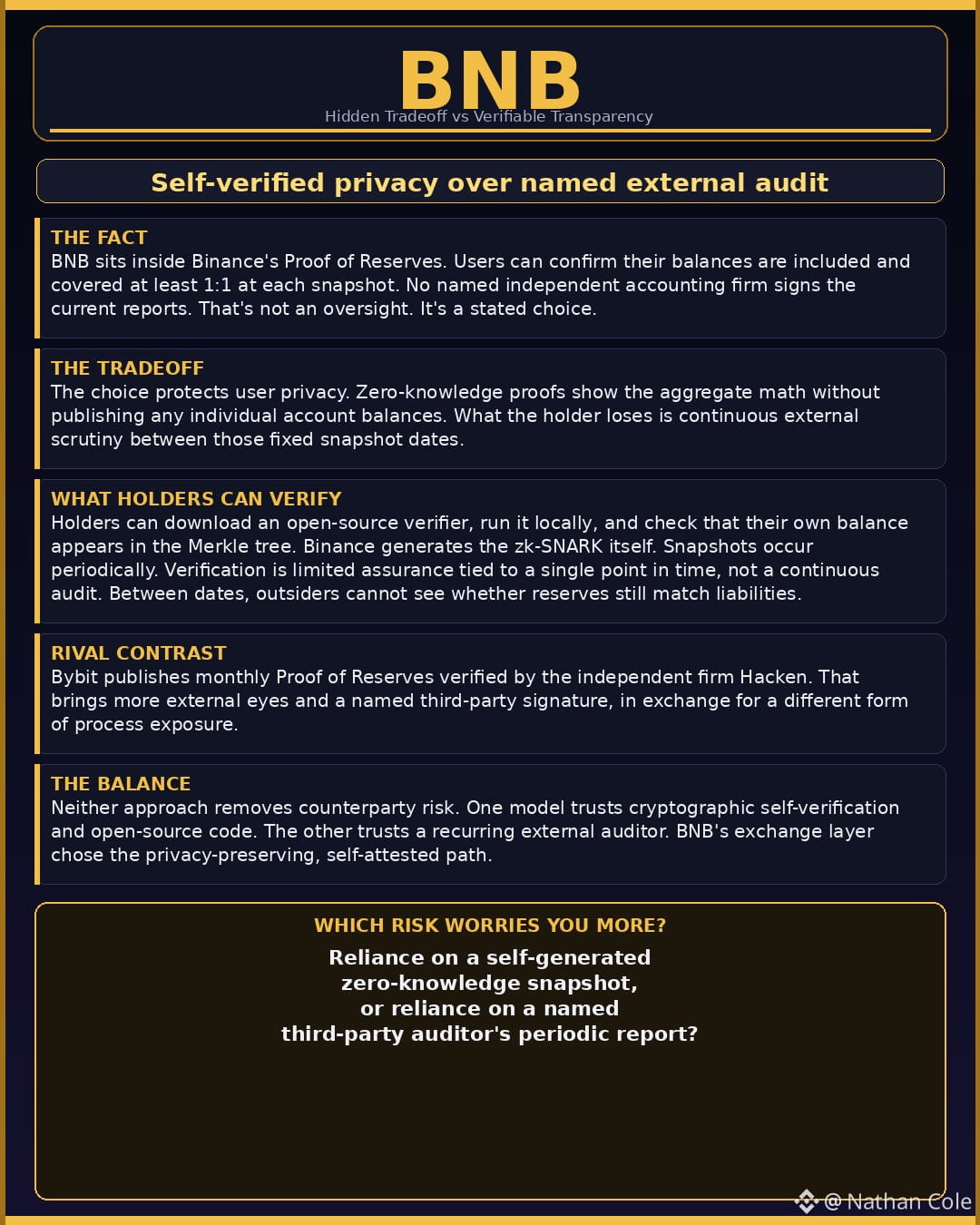
BNB sits inside Binance’s Proof of Reserves system. Users can confirm their BNB balances are included and covered at least 1:1 at the moment of each snapshot. No named independent accounting firm signs the current reports. That’s not an oversight. It’s a stated choice.
The choice protects user privacy. Zero-knowledge proofs let Binance show the aggregate math without publishing any individual account balances. What the holder loses is continuous external scrutiny between those fixed snapshot dates.
Holders can download an open-source verifier, run it locally, and check that their own balance appears in the Merkle tree. Binance generates the zk-SNARK itself and publishes the root. Snapshots occur periodically. The verification is limited assurance tied to a single point in time, not a continuous audit of the full balance sheet. Between attestation dates, outsiders cannot see whether reserves still match liabilities.
Bybit takes the opposite route. It publishes monthly Proof of Reserves verified by the independent firm Hacken. That brings more external eyes and a named third-party signature, in exchange for a different form of process exposure.
Neither approach removes counterparty risk. One model trusts cryptographic self-verification and open-source code. The other trusts a recurring external auditor. BNB’s exchange layer chose the privacy-preserving, self-attested path.
Which risk worries you more — reliance on a self-generated zero-knowledge snapshot, or reliance on a named third-party auditor’s periodic report?
The choice protects user privacy. Zero-knowledge proofs let Binance show the aggregate math without publishing any individual account balances. What the holder loses is continuous external scrutiny between those fixed snapshot dates.
Holders can download an open-source verifier, run it locally, and check that their own balance appears in the Merkle tree. Binance generates the zk-SNARK itself and publishes the root. Snapshots occur periodically. The verification is limited assurance tied to a single point in time, not a continuous audit of the full balance sheet. Between attestation dates, outsiders cannot see whether reserves still match liabilities.
Bybit takes the opposite route. It publishes monthly Proof of Reserves verified by the independent firm Hacken. That brings more external eyes and a named third-party signature, in exchange for a different form of process exposure.
Neither approach removes counterparty risk. One model trusts cryptographic self-verification and open-source code. The other trusts a recurring external auditor. BNB’s exchange layer chose the privacy-preserving, self-attested path.
Which risk worries you more — reliance on a self-generated zero-knowledge snapshot, or reliance on a named third-party auditor’s periodic report?