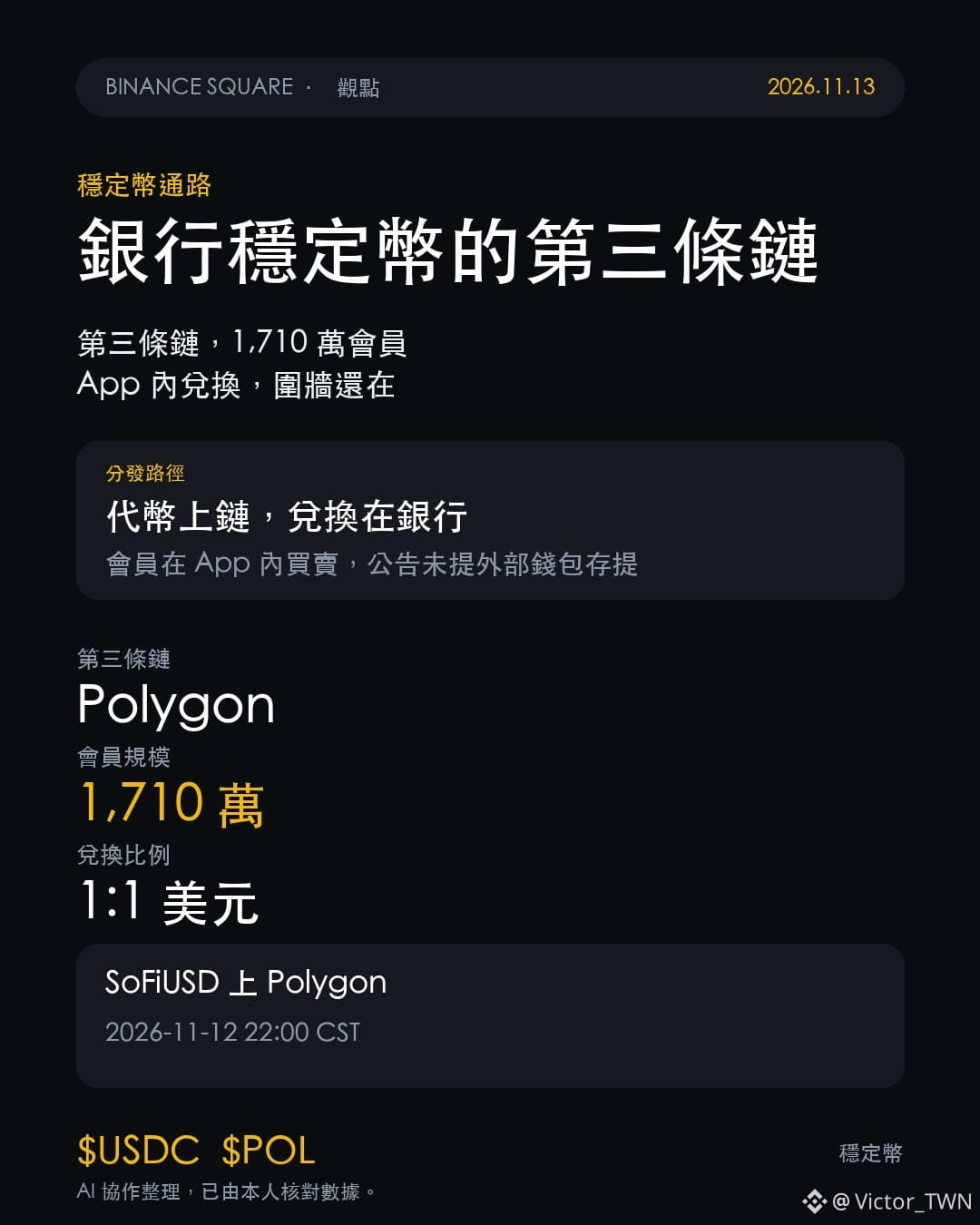
SoFiUSD has launched on Polygon, its third blockchain after Ethereum and Solana. Most headlines say “expanding reach”; what matters more to me is the distribution channel.
The issuer, SoFi Bank, N.A., is an OCC-regulated national bank. The token is redeemable 1:1 for U.S. dollars, and its 17.1 million members can buy, sell, hold, and convert it in the app. On Polygon, it joins the Open Money Stack, which already includes USDC, USDT, and PYUSD in the same interface.
But the announcement only describes transactions within the app; it says nothing about deposits to or withdrawals from external wallets. In other words, the token is on a public blockchain, but fiat conversion and customer relationships remain walled off. This adds a settlement venue, not dollar liquidity that the crypto market can borrow. I expect almost no price impact on BTC or ETH.
The pressure falls on USDC. Its moat is compliance and distribution, and a national bank has a stronger version of both in front of its own 17.1 million users. USDT’s edge is liquidity in trading, and this move doesn’t reach it yet. SoFi reported $162 million in crypto trading revenue last quarter, up 20% quarter over quarter, showing this is more than a trial run.
The market isn’t playing along: BTC at $71,786, down 3.29% over 24 hours; ETH at $2,009, down 3.30%; BTC funding rates still positive at 0.0098%; and ETH open interest up 0.28% over the past hour.
I’ll reconsider when there’s something verifiable: SoFiUSD’s on-chain supply on Polygon. If it stays at a negligible level over the long term, this is just an interface integration and a press release. If supply reaches meaningful scale, it means the bank is genuinely moving deposits onto a public blockchain—that would be a structural turning point. The second signal is when SoFi opens deposits to and withdrawals from external wallets.
What will we see first: bank stablecoins taking over payments, or becoming collateral on exchanges?
$USDC $POL #Market Hot Topics