
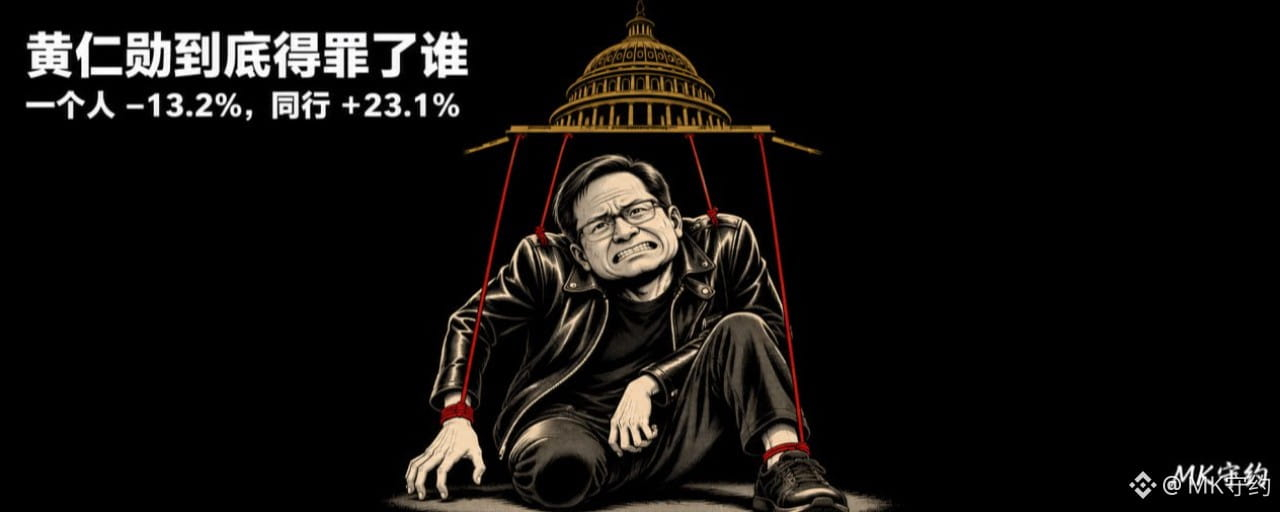


From last Thursday to this Wednesday, look at the three numbers together.
Nvidia fell from 200.13 to 173.73, -13.2% over the week.
In the same week, AMD rose from 449.04 to 552.90, +23.1%.
Micron rose from 690 to 811.30, up 17.6%.
If you only saw the first number, you’d think something had gone wrong with AI.
But peer stocks are rising, and rising sharply.
So this isn’t about AI; it’s about one company. More precisely, it’s about one person.
He didn’t lose to a woman; he lost to a timetable.
On November 8, Jensen Huang sent a letter to all employees.
In the letter, he admitted that he had been unfaithful to his wife.
That same day, Nvidia’s board announced an independent investigation into reports that “he had become a target of foreign intelligence activity.”
There’s not much to analyze in the news itself. A person betrayed a forty-year marriage; that’s private.
What’s worth analyzing is something else.
Why this particular week?
Let’s separate out the accounts first.
The only thing he admitted was “infidelity.”
The “intelligence” part comes from assessments by U.S. intelligence agencies, along with reporting by two media outlets.
China’s Foreign Ministry denied it, calling it “baseless speculation, pure slander and smear.”
The board itself said there is currently no reason to believe that any confidential information was leaked.
So as of today, not a single claim has been independently verified.
But notice: none of that changes what happened next.
Because what drives this has never been the facts. It’s the calendar.
The first account: his own words.
Over the past year, Jensen Huang has been one of Washington’s most persistent lobbyists.
He has publicly opposed further tightening restrictions on AI chip exports to China.
His exact words were: “We’re not talking about enriched uranium. We’re talking about chips—and chips they can make themselves.”
The person he was pushing back against was Anthropic CEO Dario Amodei.
Amodei compared selling chips to China to “selling nuclear weapons to North Korea.”
Last year, Trump approved Nvidia’s export of H200 chips to China.
This May, Jensen Huang flew to China aboard Air Force One.
All of these were commercially reasonable choices. Politically, they pinned him to a post.
This week, House Foreign Affairs Committee Chairman Mast put it bluntly.
He said Huang’s position on this issue diverges from the position we should generally take.
He also said it was a very serious problem for the CEO of America’s leading chip company to defend China’s position.
Read those two sentences together, and you’ll see a key distinction.
He didn’t accuse him of leaking secrets.
He accused him of taking the wrong position.
The second account: control of congressional investigations is about to change hands.
November 3: the midterm elections.
Democrats take both chambers of Congress.
In January, the committee gavels change hands.
The new Congress’s first move is usually to launch investigations.
Subramanyam of the House Oversight Committee spoke very plainly in an interview.
“Jensen Huang should resign.”
He also made an even more troubling demand.
The investigation should go both ways: what happened between Nvidia and China, and why the government seemed to know about it long ago but did nothing.
That last part isn’t asking about Jensen Huang. It’s asking about the White House.
The third account: the NDAA.
Those three letters are the part of this whole story you’re most likely to overlook.
The National Defense Authorization Act must pass every year. It’s the only piece of legislation guaranteed to come up during the lame-duck session.
Three bills targeting Chinese chip access are now on the table.
The AI Oversight Act would give Congress the power to review licenses for advanced chip exports.
The Chip Security Act would require companies to track where their chips go, to combat smuggling.
The MATCH Act would pressure allies to jointly tighten export controls on manufacturing equipment.
This week, all three were included in the Senate’s package of coordinated amendments.
Senate Democratic Leader Schumer is urging their passage.
House Republican Speaker Johnson said he supports putting export controls into the NDAA.
Warren and Banks, one a Democrat and the other a Republican, issued a joint statement on the 9th, specifically calling for the AI Oversight Act to be included.
Think about what it usually takes for a bill to pass in just a few weeks.
It needs a reason.
A scandal is that reason.
The fourth account: the intelligence apparatus has had this in hand for more than a year.
This is the most chilling part.
According to The New York Times, the U.S. government had been electronically surveilling Alice Huang for more than a year.
This spring, Secretary of State Rubio drafted a highly classified memo based on that surveillance.
Trump was briefed on it twice over seven months.
Last October, The New York Times first wrote about her and Megaspeed, before their relationship was public.
On October 29, a second round of reports came out, publishing a photo of the two of them at a party in June 2024.
On October 30, Huang told Bloomberg their relationship was “completely normal.”
On November 8, he admitted it.
Do you see the order of events clearly?
The material was already there.
The reporting came in two waves.
The real trigger came on the fifth day after the election.
So who exactly did he offend?
Not just one person.
It was four things coming due at the same time.
His position had already made the China hawks on Capitol Hill uncomfortable.
The election handed investigative power to people more eager to investigate him.
The NDAA gave them a window to pass legislation within weeks.
The intelligence apparatus had been waiting for a moment when it no longer had to wait.
The scandal wasn’t the cause. It was what the person pulling the trigger needed.
There’s another counterintuitive point here.
Trump said Huang is a “good man” and should continue leading Nvidia.
Many people see that as a shield.
I think you’ve got it backwards.
That statement pinned him to the role of “the president’s friend.”
And that president just lost the midterms last week over the war with Iran.
As Vice President Vance himself put it: we lost because of this war.
A president who has just lost an election endorsing someone opposed to restrictions on China.
On Capitol Hill, that isn’t called protection.
It’s called a label.
Now look at how the market is voting.
Nvidia is down about 21% from its early-October high.
But it’s not the only one falling.
In the same week, AMD rose 23%, Micron rose 17.6%, and TSMC rose 10.1%.
Money hasn’t left AI. It’s left this name.
The Nasdaq returned to 25,466 this week, climbing back above its 200-day moving average.
The S&P 500 closed at 7,619, also above the line.
The volatility index fell from 28.18 last week to 17.49.
These are all signs that “it’s over.”
Only Nvidia itself hasn’t recovered.
Two other things you should know, while we’re at it.
Gold fell below 3,975.
Last week I gave you three indicators. This is the last one.
It was still at 4,114 on November 9. Today it’s at 3,934.7, down 4.4% in four days.
The reason isn’t complicated. Look up October’s CPI and you’ll understand.
Headline inflation was 0.4%, core inflation 0.3%—both above expectations.
With rate cuts off the table, gold has lost its anchor.
Bitcoin is at 73,267, with its 200-day moving average at 73,176.
It’s holding right on the line. It can’t afford to give an inch.
From here, there are only four indicators that matter. Everything else is noise.
November 17: Nvidia’s earnings report.
November 18: closed-door briefings by three House committees.
Before year-end: whether those three bills make it into the final NDAA text.
And Nvidia’s daily price spread against AMD.
The first three determine whether “he’s still in the job.”
The last one determines whether “the market still believes in this company.”
If the spread keeps widening, it means the market has already separated Jensen Huang from AI.
That would be the worst-case scenario.
Because the thing a company should fear most isn’t a fine.
It’s being cut out of the industry.
(Data cutoff: U.S. stocks and commodities at the close on 2026-11-11 and intraday on 2026-11-12; crypto at 09:30 CST on 2026-11-12; macro data for 2026-11-12; CPI on 2026-11-10)
(This article is market analysis and does not constitute investment advice. Allegations concerning personal conduct are based on public reporting and official statements and have not been independently verified.)
— MK Keeps His Word#黄仁勋辞任CEO,英伟达战略走向受关注 #守约交易哲学