Crossing midnight into the weekend—the U.S. National Bank’s dollar stablecoin just launched on Polygon, its third chain. Some might take that as a sign that payment-chain traders can clock off for the weekend. The ledger says otherwise: it took a hit of about five points during the day, is still in the weekly trough, and is earning subsidies from inverted funding.
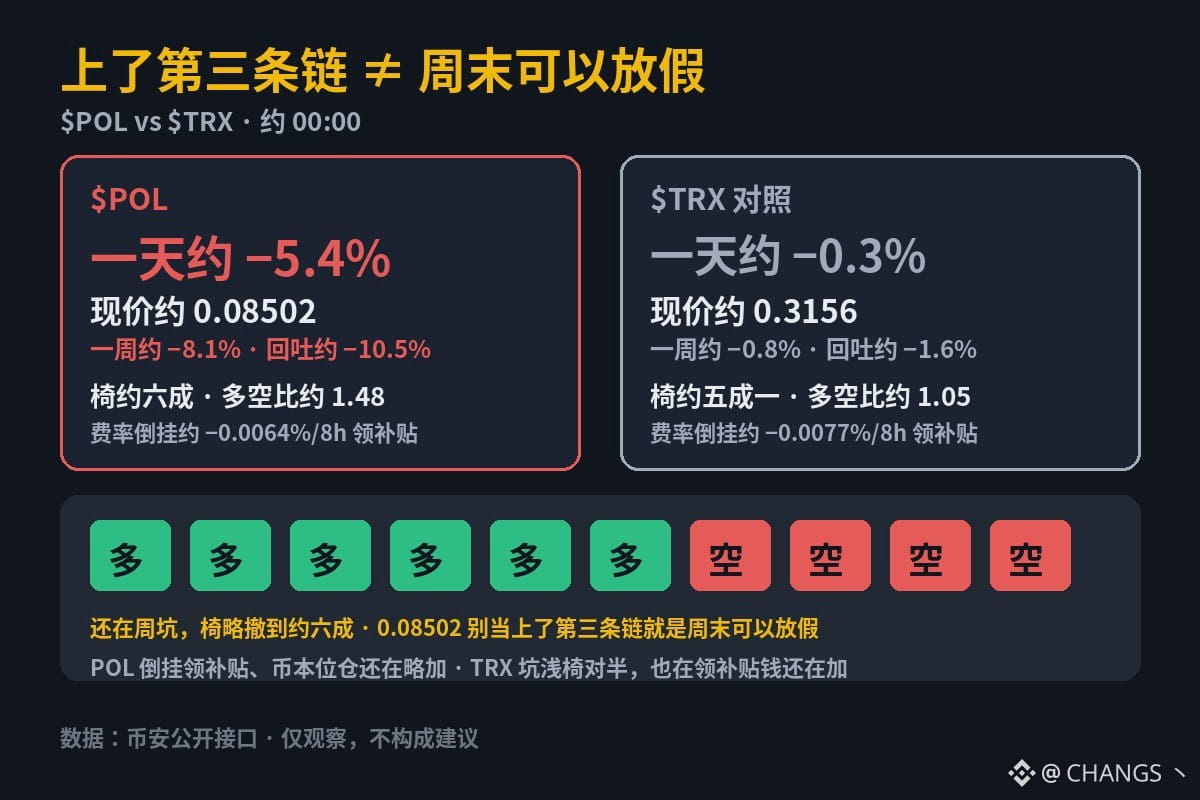
$POL: down about 5.4% on the day and 8.1% on the week, currently around 0.08502. The weekly high was about 0.09499, giving back roughly 10.5%. The account long-short ratio is about 1.48 (a little over 60% long; about a day ago it was 1.60/62%, so longs have eased back slightly). Funding is inverted at about −0.0064%/8h, meaning traders are earning subsidies. Coin-margined OI is up about 1.8% over the past day (USD-margined OI is down about 3.3%, mostly likely due to the price drop). Price slid from the intraday high of about 0.09004 to near the intraday low of about 0.08315, and is still in the weekly trough. Longs have eased back slightly to around 60%, funding is inverted and paying subsidies, while coin-margined positions are still edging up. Don’t take 0.08502 to mean that a bank stablecoin launching on its third chain means the weekend is yours—or that longs easing back to around 60% means leverage has been fully unwound.
Meanwhile, $TRX was nearly flat on the day, down about 0.3%, and down about 0.8% on the week. It’s currently around 0.3156, versus a weekly high of about 0.3209, giving back roughly 1.6%. Longs are around 51% (long-short ratio about 1.05; about a day ago it was 1.07/52%, barely changed). Funding is inverted at about −0.0077%/8h, paying subsidies, and OI is up about 2.3%. The trough is much shallower, longs are already split about evenly, and they’re also earning subsidies while money keeps coming in.
On one side, the news has landed, but the asset is still in the weekly trough, earning subsidies, with coin-margined positions still edging up. On the other, the payment-chain peer is nearly flat, longs are already split about evenly, and it’s also paying subsidies as money keeps coming in. Does that mean payment-chain traders can clock off for the weekend—or has the news landed while the trough is still here? Post your counterexample in the comments.