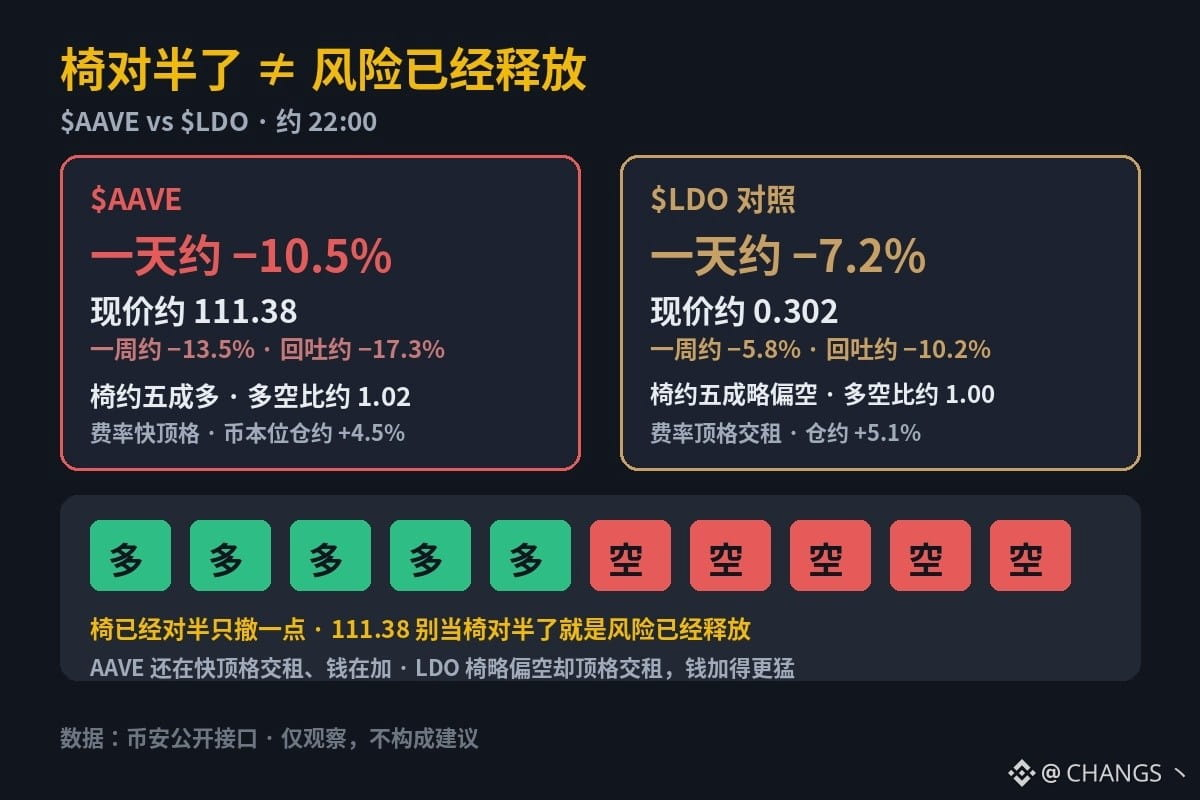
Taking stock of the lending market tonight: prices dropped about 10% during the day, and the chairs are already half empty. Some may take that as a sign that risk has been flushed out. The ledger says otherwise: traders are still paying rent near the cap, and coin-margined positions are still growing.
$AAVE: down about 10.5% on the day and 13.5% on the week, currently around 111.38. The weekly high was about 134.65, a pullback of roughly 17.3%. The account long/short ratio is about 1.02 (a little over half long; around 1.12, or 53% long, about a day ago—the chairs have eased back slightly). Funding is about +0.0093%/8h, near the cap. Coin-margined OI is up about 4.5% over the past day (while USD-margined OI is down about 6.2%, most likely because prices fell). Price has slid from the intraday high of about 125.18, is near the intraday low of about 110.6, and remains in the weekly trough. The chairs are already half empty, but only slightly fewer; traders are still paying rent near the cap, and coin-margined positions keep growing. At 111.38, don’t assume that half-empty chairs mean risk has been flushed out—and don’t assume a roughly 10% drop means leverage has already been cleared.
In the same market, $LDO is down about 7.2% on the day and 5.8% on the week, currently around 0.302. Its weekly high was about 0.3362, a pullback of roughly 10.2%. The chairs are about half full (long/short ratio around 1.00; about 1.18, or 54% long, a day ago—the chairs are clearing out, and positioning has tilted slightly short). Funding is at the cap, around +0.010%/8h, and OI is up about 5.1% over the past day. The dip is a little shallower, and the chairs have also emptied to about half, yet traders are paying at the cap and adding money even faster.
On one side, prices are down about 10%, the chairs are half empty, traders are still paying rent near the cap, and positions are growing. On the other, the staking token in the same market has a shallower dip; its chairs are also about half empty and slightly tilted short, funding is at the cap, and positions are growing even faster. Is this risk being flushed out—or did prices simply fall first, making it look as though the chairs had cleared, while positions keep growing? Post a counterexample in the comments.