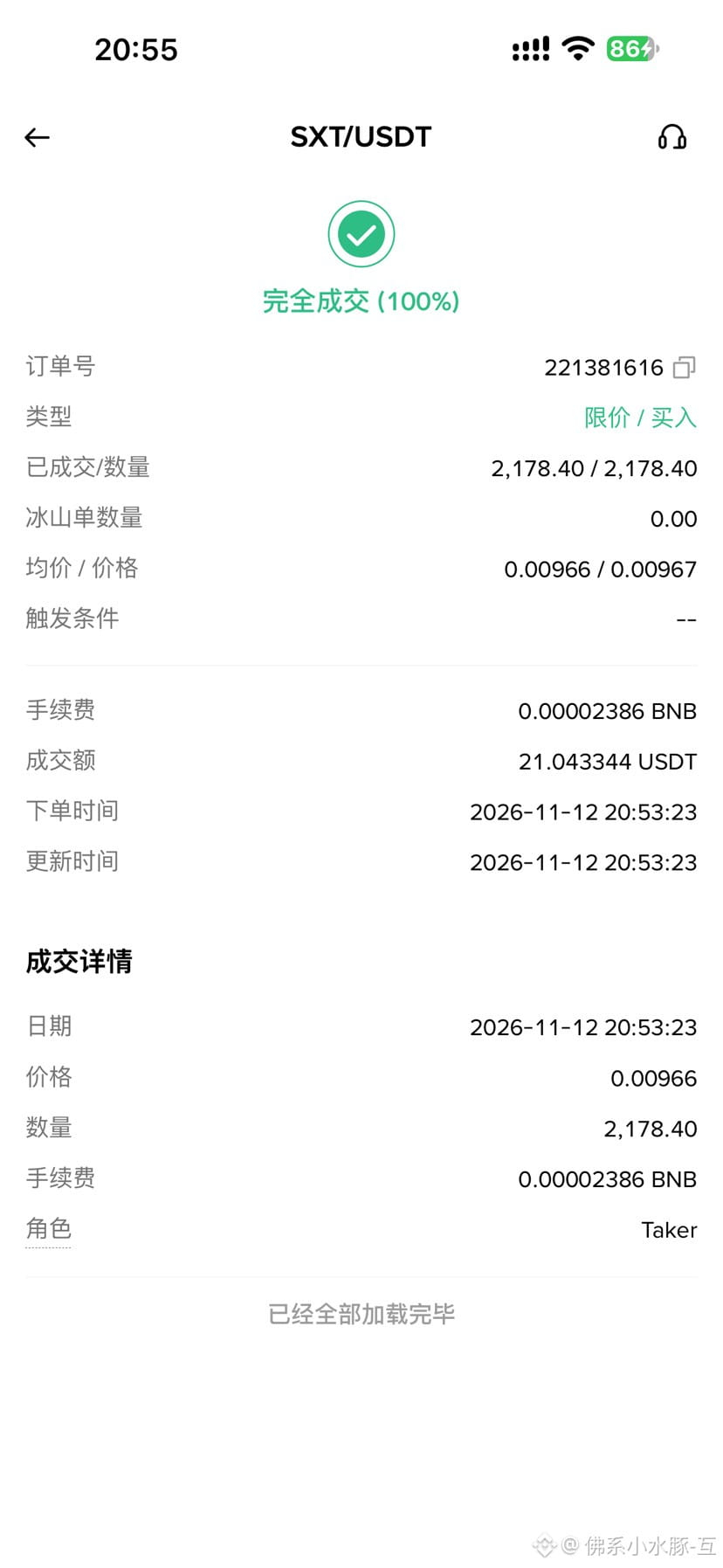
21U scooped up 2178 units of $SXT . I’m not betting on the price, but on “who really gets to define the truth of on-chain data.”
Tonight at 20:53, my hand moved faster than my brain: I placed a limit buy at 0.00967, and it filled as a taker at an average price of 0.00966—2178.40 $SXT , totaling 21.04 USDT, with a fee of 0.00002386 BNB. 21U isn’t even enough for a meal, yet I still stared at the trade record for half a minute. The position is too small to call a “heavy investment,” but I feel very comfortable with this trade. Everyone on the feed is shouting “to the moon,” but hardly anyone is willing to spend ten minutes figuring out what problem the project actually solves. I’m doing the opposite: building a starter position first, then reading up on it at my own pace.
To me, @SpaceandTime ’s logic is very straightforward: smart contracts are “blind” by nature. They can’t see cross-chain or off-chain data, so they have to rely on oracles to feed it in. Its Proof of SQL uses zero-knowledge proofs to prove that “this SQL query was correctly run on untampered data.” The benchmarks disclosed by the team are under a second for 100,000 rows and about a minute for 100 million rows. I can’t independently reproduce those numbers, but I’m confident the approach is sound: rather than building a general-purpose zkVM, it focuses its circuits entirely on SQL. Specialized solutions can often be an order of magnitude faster than general-purpose ones.
The demand is essentially the same across the AI and tokenization narratives. For an AI agent to place orders autonomously, someone needs to prove that the data it saw hasn’t been tampered with. Tokenized assets need reconciliation and proof of reserves, which also depend on verifiable data. DeFi risk controls and liquidation parameters ultimately come down to data, too. What I admire most is that it’s selling “trustworthiness,” not yet another TPS story.
I’m trying to stay level-headed about the token: the designs for staking, paid queries, and governance make sense, but value capture depends on actual query volume. Until demand scales up, the token price will probably still be driven by sentiment. The biggest improvement it should make is turning integrations with ecosystems like Chainlink into on-chain, verifiable call-volume data, rather than leaving them only in technical blog posts.
I won’t make short-term predictions; volatility is normal. In the medium term, I’m watching just one thing: whether anyone is actually paying to use it. I won’t panic if this small position drops, and I won’t hype it if it rises. Whether I add to my position next time will depend on the data, not the candlestick chart. The above is solely a record of my personal trades and opinions, and does not constitute investment advice.
#sxt $SXT
Tonight at 20:53, my hand moved faster than my brain: I placed a limit buy at 0.00967, and it filled as a taker at an average price of 0.00966—2178.40 $SXT , totaling 21.04 USDT, with a fee of 0.00002386 BNB. 21U isn’t even enough for a meal, yet I still stared at the trade record for half a minute. The position is too small to call a “heavy investment,” but I feel very comfortable with this trade. Everyone on the feed is shouting “to the moon,” but hardly anyone is willing to spend ten minutes figuring out what problem the project actually solves. I’m doing the opposite: building a starter position first, then reading up on it at my own pace.
To me, @SpaceandTime ’s logic is very straightforward: smart contracts are “blind” by nature. They can’t see cross-chain or off-chain data, so they have to rely on oracles to feed it in. Its Proof of SQL uses zero-knowledge proofs to prove that “this SQL query was correctly run on untampered data.” The benchmarks disclosed by the team are under a second for 100,000 rows and about a minute for 100 million rows. I can’t independently reproduce those numbers, but I’m confident the approach is sound: rather than building a general-purpose zkVM, it focuses its circuits entirely on SQL. Specialized solutions can often be an order of magnitude faster than general-purpose ones.
The demand is essentially the same across the AI and tokenization narratives. For an AI agent to place orders autonomously, someone needs to prove that the data it saw hasn’t been tampered with. Tokenized assets need reconciliation and proof of reserves, which also depend on verifiable data. DeFi risk controls and liquidation parameters ultimately come down to data, too. What I admire most is that it’s selling “trustworthiness,” not yet another TPS story.
I’m trying to stay level-headed about the token: the designs for staking, paid queries, and governance make sense, but value capture depends on actual query volume. Until demand scales up, the token price will probably still be driven by sentiment. The biggest improvement it should make is turning integrations with ecosystems like Chainlink into on-chain, verifiable call-volume data, rather than leaving them only in technical blog posts.
I won’t make short-term predictions; volatility is normal. In the medium term, I’m watching just one thing: whether anyone is actually paying to use it. I won’t panic if this small position drops, and I won’t hype it if it rises. Whether I add to my position next time will depend on the data, not the candlestick chart. The above is solely a record of my personal trades and opinions, and does not constitute investment advice.
#sxt $SXT