SNDK at $927—would you still dare touch it?
It plunged from $2,350 to $800, a 60% drop. Retail investors cut their losses and left, while analysts are calling for a price target above $2,000. Just now, CoreWeave’s earnings blew expectations away, SNDK surged 13.69% in a single day, and Binance perpetual futures trading volume exploded to billions of dollars. Is this a golden opportunity in AI storage—or one last shakeout before the stock split?
First, the surface picture: it fell so hard it was unrecognizable.
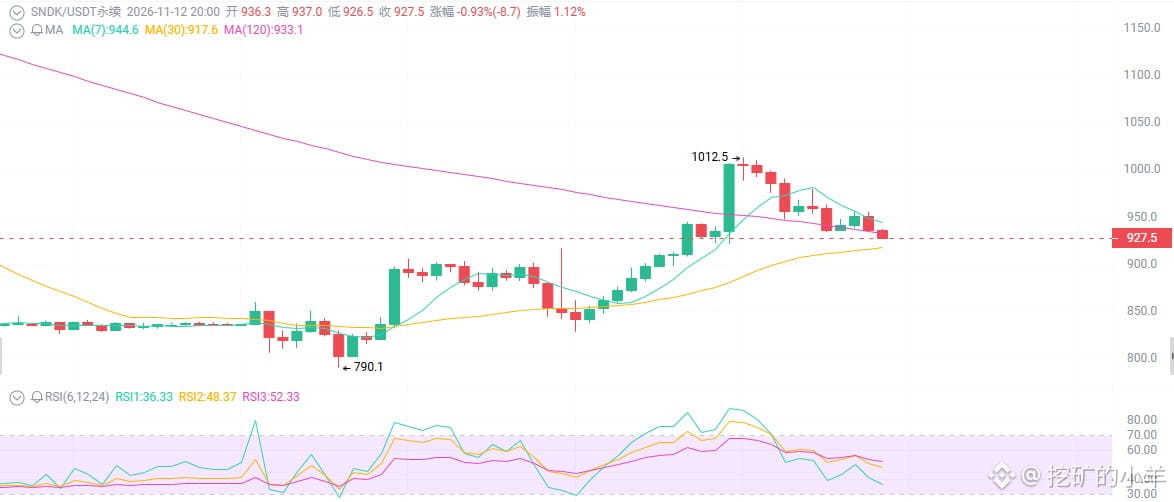
From its June ATH of $2,350, it plunged all the way to around $800, with a maximum drawdown of over 60%. On November 11, SNDK closed at $977.69, up 13.69%. Perpetual futures are now at $927, while premarket trading has pulled back to $930–$940. The candlestick chart tells you this: $800 is a short-term bottom, $927 is a rebound midpoint, and $900–$920 is support around recent lows.
First: CoreWeave’s earnings report pulled SNDK out of the ICU
The trigger for the 13.69% surge on November 11 was simple: CoreWeave’s earnings beat expectations, with both revenue and guidance raised, and strong capital spending on AI data centers.
AI cloud providers are buying storage like crazy, and SanDisk is a pure-play NAND flash stock.
SanDisk also launched its new iNAND CL EM181 embedded flash product, targeting IoT, AI, and edge devices. The AI story is spreading from data centers to the edge, and SNDK benefits from both.
While you’re still wondering whether memory is at the peak of its cycle, CoreWeave is already telling you with real money: AI training needs storage, inference needs storage, and KV cache needs storage too. This isn’t a cycle—it’s a structural shortage.
Second: The earnings were so explosive they seem unreal
FY2027 Q1 (ended October 2, 2026):
Revenue of $11.03 billion, up 23% sequentially and 378% year over year
Non-GAAP gross margin of 85.1%
Non-GAAP EPS of $49.51, far above guidance
Data center revenue of $4.8 billion, up 61% sequentially
The guidance was even more aggressive: Q2 revenue of $12.2–$12.6 billion, gross margin holding at 84.5–85.5%, and EPS of $55–$57. Analysts are broadly rating it Strong Buy, with an average price target above $2,000. The forward P/E has already fallen back to single digits. In an AI storage supercycle, this valuation is ridiculously cheap.
Third: The stock split is coming, and liquidity could explode
The 8-for-1 forward split’s record date has passed. Trading at the post-split price begins on November 20.
A stock split doesn’t change a company’s value, but it does change two things:
The lower nominal share price reduces the psychological barrier, making it easier for retail investors to get in.
Improved liquidity can cause trading activity to surge in the short term.
Historical experience shows that trading volume often increases and volatility intensifies around a stock split. It’s an opportunity for short-term traders, but a meat grinder for leveraged positions.
It plunged from $2,350 to $800, a 60% drop. Retail investors cut their losses and left, while analysts are calling for a price target above $2,000. Just now, CoreWeave’s earnings blew expectations away, SNDK surged 13.69% in a single day, and Binance perpetual futures trading volume exploded to billions of dollars. Is this a golden opportunity in AI storage—or one last shakeout before the stock split?
First, the surface picture: it fell so hard it was unrecognizable.
From its June ATH of $2,350, it plunged all the way to around $800, with a maximum drawdown of over 60%. On November 11, SNDK closed at $977.69, up 13.69%. Perpetual futures are now at $927, while premarket trading has pulled back to $930–$940. The candlestick chart tells you this: $800 is a short-term bottom, $927 is a rebound midpoint, and $900–$920 is support around recent lows.
First: CoreWeave’s earnings report pulled SNDK out of the ICU
The trigger for the 13.69% surge on November 11 was simple: CoreWeave’s earnings beat expectations, with both revenue and guidance raised, and strong capital spending on AI data centers.
AI cloud providers are buying storage like crazy, and SanDisk is a pure-play NAND flash stock.
SanDisk also launched its new iNAND CL EM181 embedded flash product, targeting IoT, AI, and edge devices. The AI story is spreading from data centers to the edge, and SNDK benefits from both.
While you’re still wondering whether memory is at the peak of its cycle, CoreWeave is already telling you with real money: AI training needs storage, inference needs storage, and KV cache needs storage too. This isn’t a cycle—it’s a structural shortage.
Second: The earnings were so explosive they seem unreal
FY2027 Q1 (ended October 2, 2026):
Revenue of $11.03 billion, up 23% sequentially and 378% year over year
Non-GAAP gross margin of 85.1%
Non-GAAP EPS of $49.51, far above guidance
Data center revenue of $4.8 billion, up 61% sequentially
The guidance was even more aggressive: Q2 revenue of $12.2–$12.6 billion, gross margin holding at 84.5–85.5%, and EPS of $55–$57. Analysts are broadly rating it Strong Buy, with an average price target above $2,000. The forward P/E has already fallen back to single digits. In an AI storage supercycle, this valuation is ridiculously cheap.
Third: The stock split is coming, and liquidity could explode
The 8-for-1 forward split’s record date has passed. Trading at the post-split price begins on November 20.
A stock split doesn’t change a company’s value, but it does change two things:
The lower nominal share price reduces the psychological barrier, making it easier for retail investors to get in.
Improved liquidity can cause trading activity to surge in the short term.
Historical experience shows that trading volume often increases and volatility intensifies around a stock split. It’s an opportunity for short-term traders, but a meat grinder for leveraged positions.