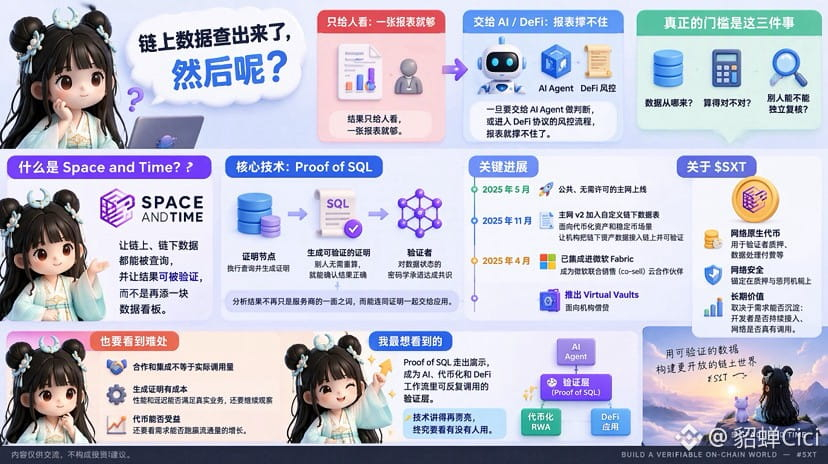
When building on-chain data products, I often get stuck on the same question: the data has been queried—what happens next?
If the results are just for people to look at, a dashboard is enough. But once they need to be handed to an AI Agent to make decisions, or fed into a DeFi protocol’s risk-control process, a dashboard no longer cuts it. Where the data comes from, whether it was calculated correctly, and whether others can independently verify it—those are the real hurdles.
That’s why I’m paying attention to @SpaceandTime . Its goal is to make both on-chain and off-chain data queryable, with verifiable results—instead of adding yet another data dashboard. Its core technology, Proof of SQL, has prover nodes execute queries and generate proofs. Others can confirm the results are correct without recalculating them, while validators reach consensus on cryptographic commitments to the data state. As a result, analytical findings are no longer just a service provider’s word; they can be delivered to applications together with their proofs.
More than the concept, I care about how far it has come. In May 2025, its public, permissionless mainnet went live. In November of the same year, mainnet v2 added custom off-chain data tables for tokenized assets and stablecoins, allowing institutions to connect off-chain asset data to the blockchain and make it verifiable. On the enterprise side, it has been integrated into Microsoft Fabric, became a Microsoft co-sell cloud partner this April, and launched Virtual Vaults for institutional lending.
As for $SXT , I’d rather look at the network’s mechanics before the market price. According to official materials, it is the network’s native token, used for validator staking and paying for data processing, among other things. Network security is also anchored in staking and slashing mechanisms. Its long-term value depends on whether demand can build over time—that is, whether developers continue to integrate with it and whether the network sees real usage.
Of course, there are challenges to consider: partnerships and integrations don’t necessarily translate into actual usage; generating proofs has a cost, and whether performance and latency can meet real business needs remains to be seen; and whether the token can benefit depends on demand outpacing the growth in circulating supply.
What I most want to see is Proof of SQL move beyond demos and become a verification layer that can be called repeatedly in AI, tokenization, and DeFi workflows. However polished the technology sounds, what ultimately matters is whether anyone uses it. #SXT
This content is for discussion purposes only and does not constitute investment advice.
#sxt $SXT