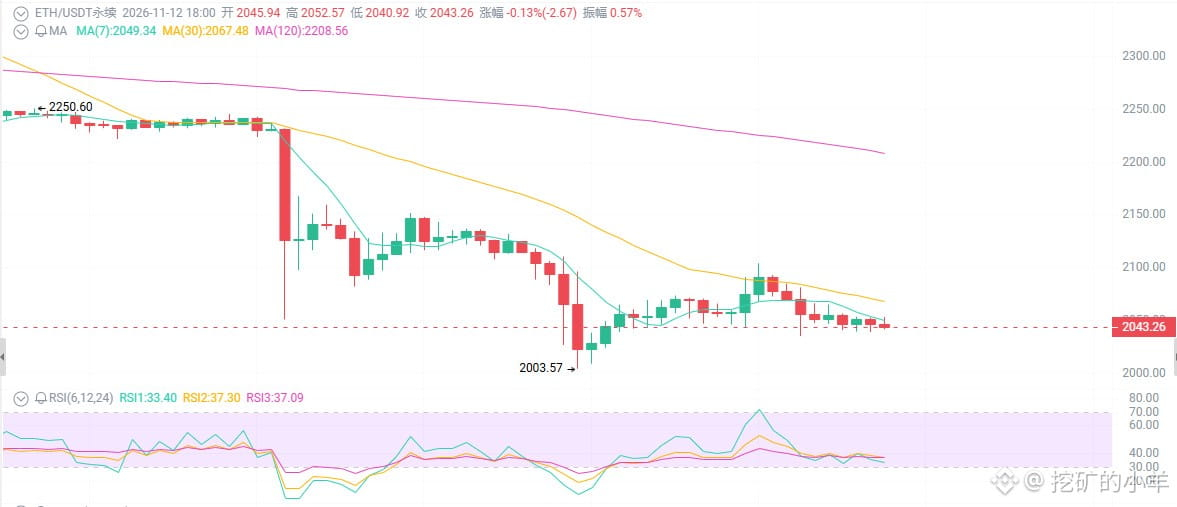
ETH at $2,043: Opportunity or Trap?
The daily RSI has fallen to 29, entering oversold territory. ETFs have seen consecutive outflows, Glamsterdam has been delayed, and hotter-than-expected CPI has raised the odds of an interest rate hike. But just moments ago, daily active addresses on-chain topped 1.3 million, setting a new all-time high. Prices are falling, yet more and more people are using the network. Is this the final drop—or the beginning of an abyss?
First, the surface picture: the technicals are a mess.
ETH is currently at $2,043, down slightly by 0.5% over the past 24 hours. It has fallen 8%–15% over the past 7 days and 15%–18% over the past month. The price has already fallen below the cluster of 20-day, 50-day, and 100-day moving averages (around $2,200–$2,450) and is testing the area near the 200-day moving average. On the 4-hour chart, lows keep moving lower, while the MACD bearish histogram continues to expand. The trend is still bearish—don't try to catch a falling knife.
The daily RSI has dropped to 29–30, entering oversold territory. Historically, when it reaches this level, the market either rebounds or at least slows its decline.
First: ETFs are bleeding, but on-chain activity is surging
U.S. spot Ethereum ETFs have recently seen sustained net outflows, ranging from millions to hundreds of millions of dollars a day. Institutional demand has weakened for now—that's a fact.
But on the other hand, Ethereum's daily active addresses have topped 1.3 million, setting a new all-time high. Stablecoin transfer volumes remain high, around 36% of ETH supply is staked, and the L2 ecosystem continues to expand.
This is a classic feature of a bottoming zone—smart money is rebalancing, while retail investors are panicking.
Second: Glamsterdam has been delayed, but the fundamentals haven't collapsed
The Glamsterdam upgrade timeline has been pushed back, weakening a near-term catalyst. That's bearish; there's no denying it.
But look at the bigger picture—ETH remains the core settlement layer for DeFi, stablecoins, and L2s. Median fees have fallen to around 3.5 cents, making it increasingly cheap to use. Reduced fee burning means supply is no longer strongly deflationary—that's a fact. But lower network costs support long-term adoption.
Citi has raised its 12-month price target to around $3,028. Capital outflows and macroeconomic conditions are weighing on ETH in the short term, but the longer-term thesis remains unchanged.
Third: The macro backdrop is the biggest headwind right now
U.S. CPI data came in hotter than expected, and the odds of a December Federal Reserve rate hike are rising, with discussion of 25 basis points or even more increasing. Risk assets are under pressure, and crypto is highly sensitive to liquidity expectations.
The Fear & Greed Index is at 28–30, in fear territory. Hot inflation plus potential tightening equals short-term headwinds.
Macro pressures the price, not the value. When the macro backdrop turns, the price will come back to meet the value.