


If you’re looking for opportunities in a new ecosystem, start by checking which projects are joining and whether users are actually trading. Before Elysium’s mainnet opened, token launch platforms, DEXs, aggregators, and cross-ecosystem projects had already begun appearing, with several platforms seeing considerable trading activity.
Do these numbers reflect short-term hype, or an ecosystem taking shape? This article reviews notable projects on Elysium by category, then examines trading data, why projects are choosing Elysium, and ecosystem developments to watch going forward.
What is Elysium?
Elysium @Enter_Elysium is a high-performance Layer 2 built by @Kinetiq_xyz for the Hyperliquid ecosystem. It aims to bring more on-chain spot trading, token launches, and liquidity applications onto Hyperliquid’s infrastructure, allowing developers to deploy contracts with familiar EVM tools while exploring composability with the HyperCore order book.
Simply put, Elysium aims to be more than just another EVM chain where contracts can be deployed. It seeks to connect the composability of on-chain applications with the trading and liquidity of the Hyperliquid ecosystem. The network uses HYPE to pay for gas, and developers can use familiar tools such as Solidity, Foundry, and Hardhat.
The team set the mainnet opening date for November 9, 2026. For users, mainnet opening means the network is becoming accessible to a wider group of participants. For the ecosystem, the real test is whether applications can continue to attract transactions, capital, and developers—not just brief attention around launch.
What projects are in the Elysium ecosystem?
The Elysium ecosystem can currently be divided into several categories.
Network and developer infrastructure: Built by Kinetiq, Elysium provides an EVM network, HYPE gas, and a development environment. Bridges, RPC, and block explorers connect assets and applications.
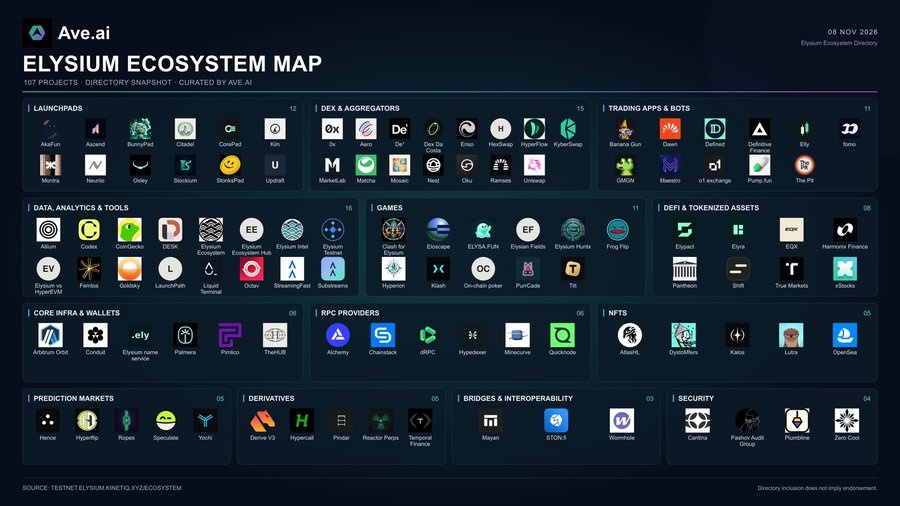
Token launch platforms: Ascend, Montra, Boxa, Obol, ElysPump, Kleos, Volta, and PerpMe all offer token launch services on Elysium.
DEXs and liquidity: The platforms above provide spot trading pools for tokens. Agora aggregates multiple pools and offers trade routing, limit orders, and access to liquidity, while Market Lab provides token liquidity pools on the Elysium testnet.
Market data and trading aggregation: Agora aggregates token and trading information from multiple launchpads, while ElyScreener and OPSIS provide market data and on-chain analytics.
Cross-ecosystem launches and trading: Stockium launches tokens on HyperEVM and connects their trading markets to Elysium once they meet certain criteria.
There are several practical reasons for projects to deploy on Elysium. Developers can continue using EVM tools such as Solidity, Foundry, and Hardhat, reducing migration costs. HYPE is used for gas, and assets can also enter the Hyperliquid ecosystem through bridges. Elysium’s performance targets are block times of about 100 milliseconds and 300M gas per second, making it suitable for high-frequency operations such as token launches and spot trading. The team also allocates 25% of sequencer revenue to builders, offering a direct incentive for early contributors.
Timing also matters. Several launchpads went live before mainnet opened to the public, allowing projects to establish trading venues and attract early users. Kinetiq plans to roll out native HyperCore read-and-write capabilities in phases; this future functionality should not be described as already available.
These factors benefit both developers and users: development teams can reuse familiar tools and receive builder incentives, while trading applications can create market access around HYPE and Hyperliquid users. The early launch of launchpads is the ecosystem’s first sign of this expected supply and demand.
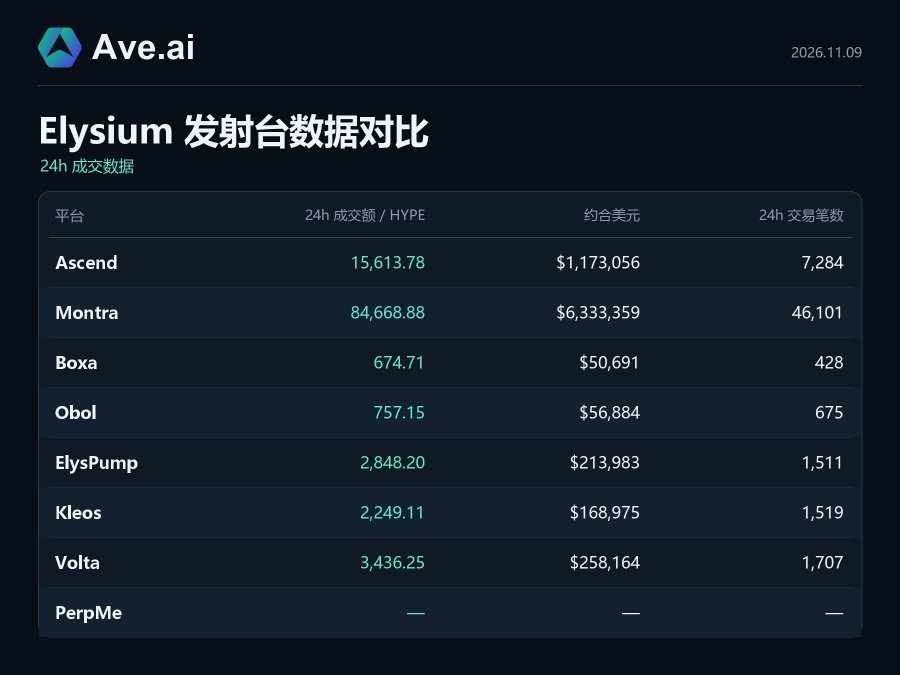
Launchpad trading data
Launchpads on Elysium saw trading activity before mainnet opened. On November 8, Ascend recorded about $4.93 million in trading volume over the previous 24 hours, across 30,733 transactions, with approximately 4,055 traders participating.
On the same day, Montra had cumulative trading volume of about $7.1 million and 58,911 cumulative transactions, with approximately 11,795 active addresses in the previous 24 hours. Stockium had cumulative trading volume of about $1.89 million, with approximately $61,900 in trading volume over the previous 24 hours. Data published by Boxa on October 31 showed 1,937 unique wallets and 10,506 transactions, with cumulative trading volume of about 19,380 HYPE.
These figures show the trading volumes already handled by different platforms and indicate that early activity on Elysium goes beyond project launches and token issuance. Ascend’s daily trading volume, Montra’s cumulative trading activity, and Stockium’s recent volume all show that users are already making real trades on-chain.
Trading volume shows that trades have taken place, but on its own it cannot prove that users will stay or that liquidity is sufficiently deep. After mainnet opens, it will be worth monitoring whether trading activity continues, liquidity remains on-chain, and genuine DeFi and cross-chain demand emerges beyond launchpads. If early markets can turn short-term trading into sustained use, Elysium’s ecosystem may have a chance to grow beyond token launches into a wider range of on-chain applications.
Use Ave.ai to access cross-chain routes and trade on Elysium
Ave.ai supports cross-chain swaps involving Elysium and token trading.
Cross-chain swap
Part 1: Another chain → Hyper EVM (HYPE).
Open “Cross-chain” in Ave.ai and connect your wallet.
Choose the payment network and asset, then select “Hyper EVM” as the receiving network and HYPE as the receiving asset.
Enter the amount, review the quote, fees, and estimated time, then confirm the swap.
Part 2: Hyper EVM (HYPE) → Elysium (HYPE).
Once the first transfer arrives, select HYPE on Hyper EVM as the asset to pay with, choose “Elysium” as the receiving network, and select HYPE as the receiving asset.
Enter the amount, review the quote, fees, and estimated time, then confirm the swap.
Check the status of both swaps under “Cross-chain History.”

Trading Elysium tokens
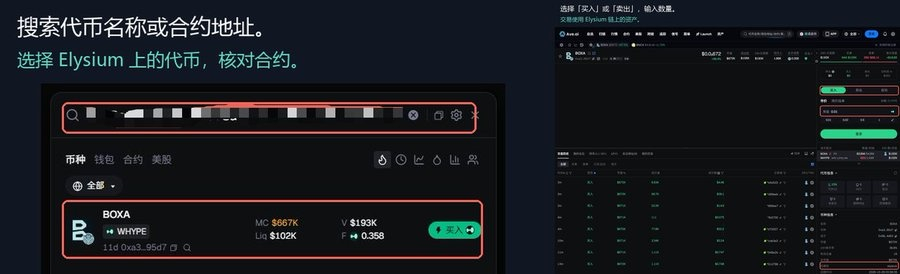
Search for a token name or contract address at the top of Ave.ai, then open the corresponding Elysium token page.
Verify the network and contract address, select “Buy” or “Sell,” and enter the amount.
Review the quote and wallet, then confirm the transaction as prompted on the page.
After mainnet opens, can the ecosystem take its first steps?
Elysium’s appeal lies in bringing Hyperliquid’s trading ecosystem, EVM application development, and a range of early on-chain products together on a single growth path. Before mainnet opened, launchpads such as Ascend and Montra were already live, giving the market a window into application and user activity.
The next key questions are whether early trading can translate into user retention, whether DeFi and infrastructure beyond launchpads can deliver usable products, and whether cross-chain capital and on-chain liquidity can support a wider range of use cases.
For users, understanding the stage each network, application, and data point is at before deciding how to participate is far more useful than chasing a new-chain narrative.