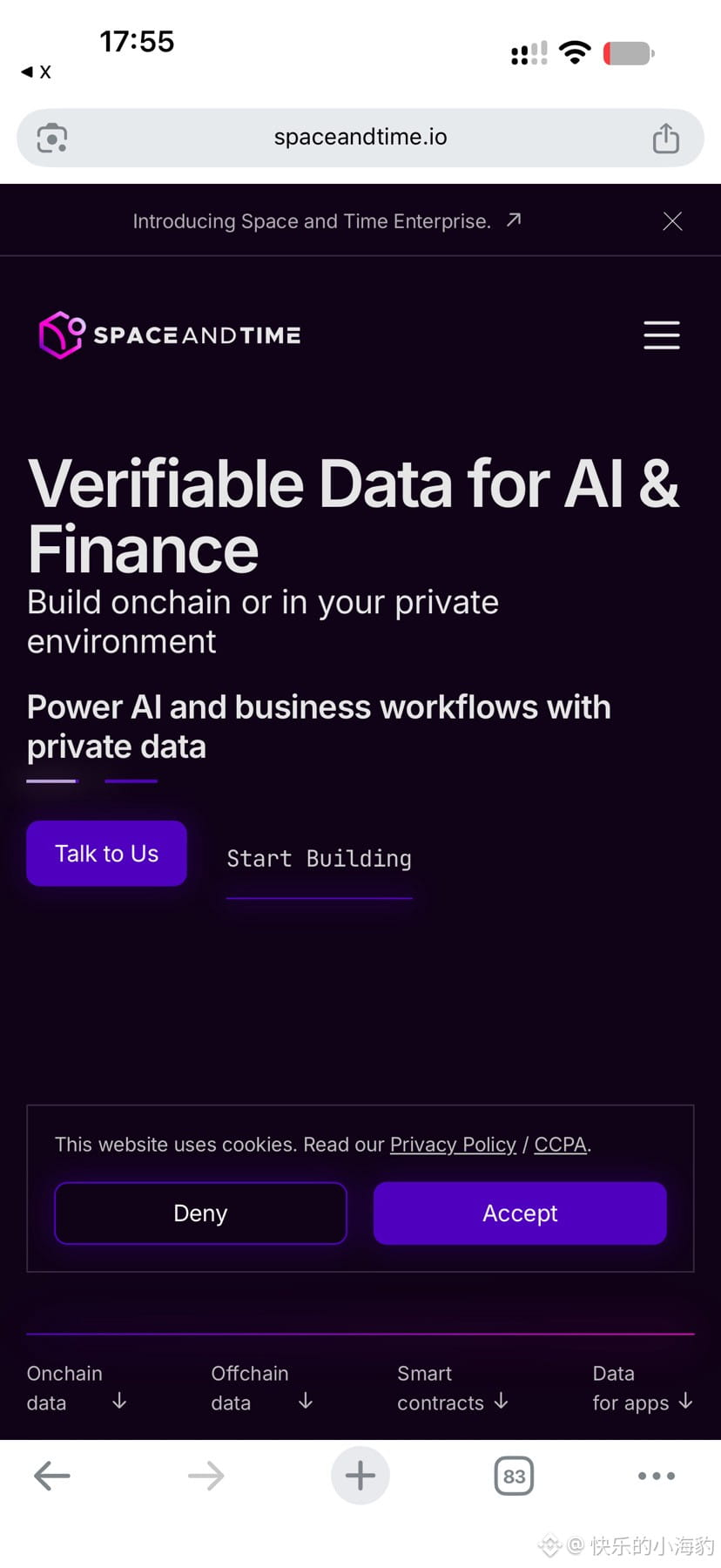

🔥 What is the universe? It’s everything that exists in space and time. This seal recently discovered a “universe coin”—Space and Time ( $SXT ). The name sounds pretty grand, and it has Microsoft ties, but it’s not about philosophy or physics. It’s about building a verifiable data foundation for blockchain.
AI agents are ridiculously useful these days—I’ve already had my fun with the Grok bot. But when AI agents want to trade on their own, tokenized assets need to prove there’s something real behind them, or DeFi wants to query historical and cross-chain data, they all run into the same problem: “Can this data really be trusted?” Traditional databases require you to trust the operator, while smart contracts can’t handle huge volumes of historical data. #sxt SXT has built a decentralized data warehouse, powered by Proof of SQL. Indexers collect historical data from multiple chains, including Ethereum and Bitcoin (and can also connect to off-chain data). Validators stamp the data with cryptographic seals to ensure it hasn’t been altered. Then proof nodes run SQL queries and generate zero-knowledge proofs. Smart contracts only need to verify the proof to know that the result is correct and the data is complete—without recalculating everything themselves or exposing the raw data.
This lets AI allocate more or less capital based on proven historical performance and risk data. Businesses can also generate proofs on their own servers, allowing AI and auditors to check the results without handing over the original records. Tokenized assets can prove that their collateral composition, reserves, and net asset value are genuine, and that on-chain tokens match off-chain assets. DeFi can directly query historical trading volumes, cross-chain liquidity, and wallet risk scores to set dynamic interest rates or build more complex products, relying less on centralized oracles.
In this seal’s view, @SpaceandTime #SXT ’s mechanism is genuinely solid, and the name is suitably grand. But its market cap is still tiny, at only around $20 million, so volatility will be extreme—wild surges and plunges are the norm. Don’t treat it as a source of steady returns. It’s cool that data can prove itself, but the crypto world always reminds you to assess the risks for yourself and always DYOR. Getting lost in this space and time force wouldn’t be pretty.