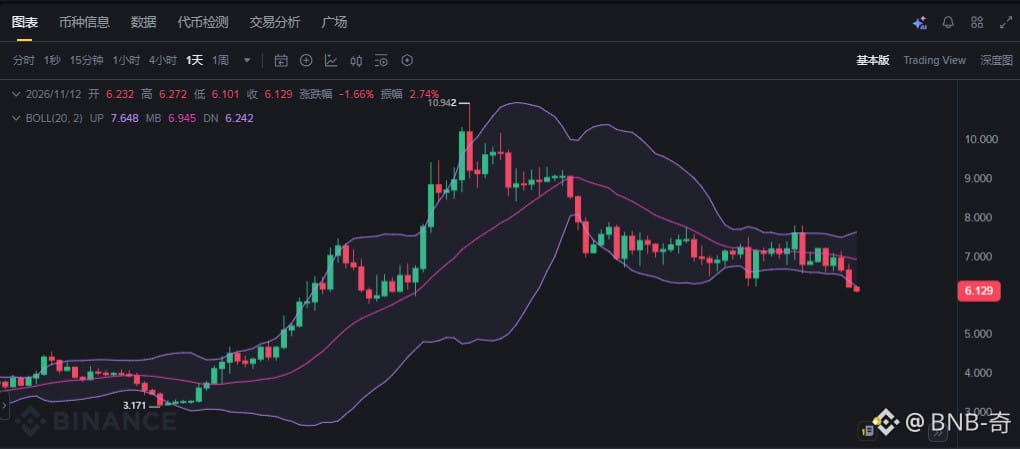
$UNI At the current price of around $6.12, UNI has previously staged a relatively independent countertrend rally. The market once viewed DEXs’ continued gains in market share over CEXs as a core thesis, driving a temporary rebound.
However, in the face of a broad-based sell-off across the crypto market, an independent thesis is difficult to sustain. If $6 fails to hold, earlier gains could quickly be erased.
In the short term, technicals are weak. The price has declined for several consecutive sessions, RSI is in a neutral-to-weak range, and the 4-hour chart is bearish. The $6 level and the $5.8 area below it are key near-term support levels where bulls and bears are battling. A decisive break below them would make it more likely that the previous rebound gains will be given back.
The medium- to long-term thesis continues to strengthen. Uniswap maintains its lead in DEX market share, and DEXs’ share of spot trading relative to CEXs has risen to around 23%–25%.
The protocol holds a significant share of RWA and tokenized stock trading. Following UNIfication, the fee switch has been activated, and protocol fees are being used to burn UNI. A one-time burn of 100 million tokens has already been completed.
The medium- to long-term value-capture thesis built on expanding DEX market share and fee burns remains intact. However, the current price has entered a phase dominated by broader-market beta, making it difficult to fully escape systemic pressure in the short term.
If $6 holds and the price climbs back above $6.3–$6.4, the countertrend thesis may be repriced. If it fails to hold, UNI is more likely to follow the broader market lower first, before investors look for new opportunities as fundamentals and sentiment recover.$UNI