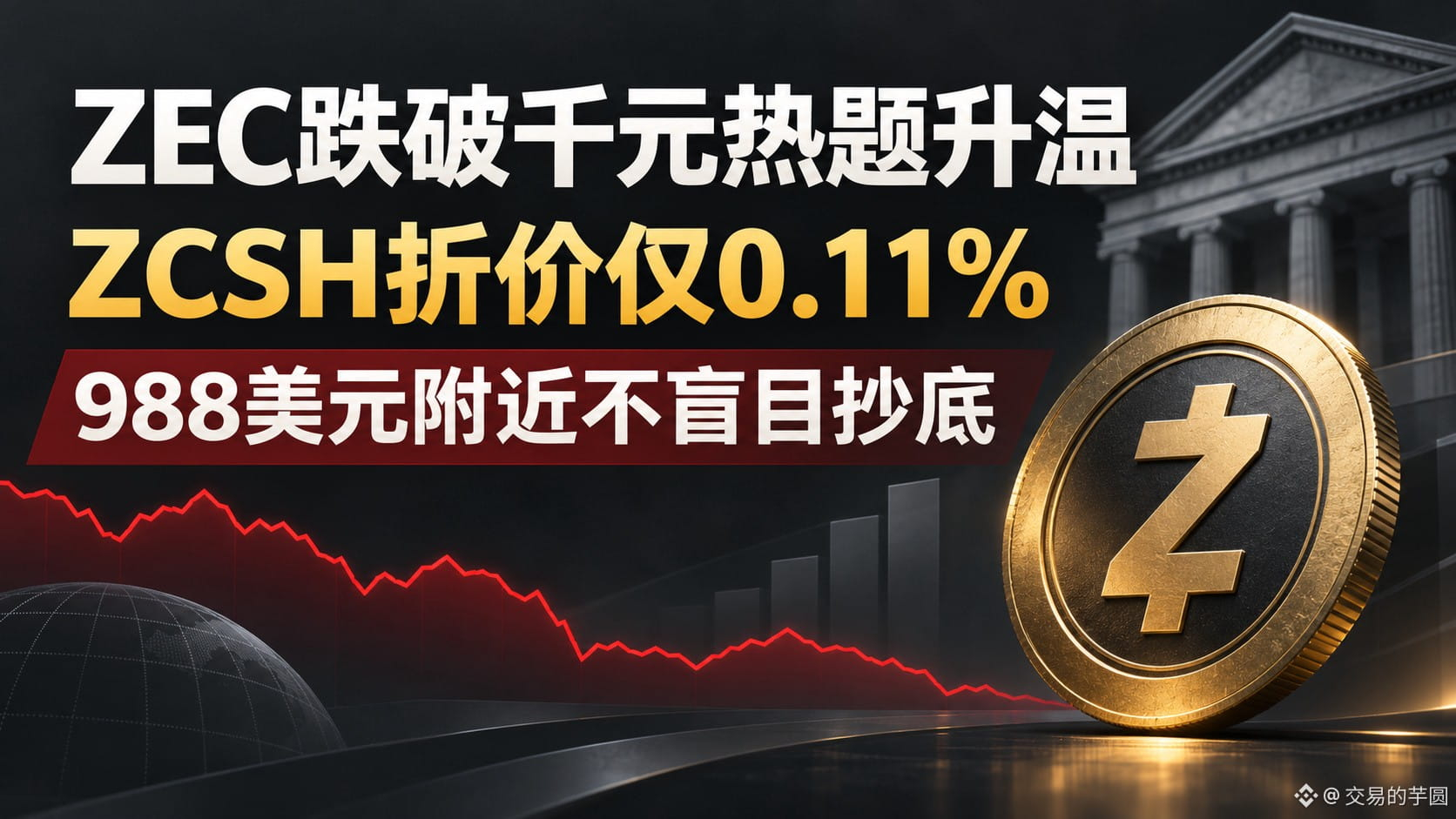
ZEC Falls Below $1,000 as Trending Topic Keeps Heating Up | Fund Discount Just 0.11% | I Don’t Buy the Dip Just Because It’s “Cheap”
My stance upfront: I still treat ZEC as a highly volatile asset, and I won’t automatically buy just because it has fallen below a round-number threshold. The number of discussions about #ZcashFallsBelow$1000ForFirstTimeSinceSeptember in Binance Square’s Trending Topics rose from about 135 when I last checked to 145, showing that interest is still growing; but interest measures discussion, not demand. ZEC has also attracted a lot of attention in Most Searched, which needs to be considered separately from actual fund and spot-market quotes.
This time, I’m looking at things from the perspective of institutional capital. As of November 11, Grayscale ZCSH’s official website listed a market price of $26.53 and a net asset value of $26.56 per share, with an official discount rate of 0.11%; about 2.46 million shares traded that day. This means the fund shares on the secondary market were only slightly below their corresponding NAV. ZEC breaking below $1,000 does not mean the fund is trading at an extreme discount or that institutions are indiscriminately dumping it. Grayscale’s page also lists the fund’s holdings at about 577,300 ZEC, or 0.02658281 ZEC per share; holdings are a snapshot of the fund’s assets, and the number of shares traded that day cannot be used directly to estimate how much ZEC was added or redeemed. The $14.6 million net outflow from Farside on the 11th that I checked last time is a flow metric; the discount and trading volume here are two different kinds of indicators.
Why does this matter for ZEC? The fund price being close to NAV suggests there is currently little evidence of “panic discounting at the share level.” But NAV itself will fall as ZEC falls, and a small discount doesn’t mean spot prices can’t keep dropping. The Zcash community is still discussing the development fund and future upgrade plans. Draft proposals, voting schedules, and network rules that have actually been implemented must be treated separately: the forum says voting is scheduled to begin from November 16 to 30, but whether consensus is reached afterward remains to be seen. Treating these governance proposals as supply changes that have already taken effect would also mislead traders. Macroeconomic interest rates and risk appetite across the broader crypto market can also amplify ZEC’s volatility around round-number thresholds.
The facts currently presented by the market are that Binance ZECUSDT was around $988.37 when checked, down about 1.72% over 24 hours, with a high of $1,024.57 and a low of $951.21. Spot has rebounded from the low, but has yet to climb back above the daily open of $1,005.66. I’m watching $951, $1,006, and $1,025. If it falls below $951 again and fails to rebound strongly, my short-term recovery thesis is invalidated. If it first gets back above $1,006 and then decisively breaks through $1,025, that would suggest buyers have absorbed some of the concerns around fund outflows and governance uncertainty.
If I were trading this myself: I wouldn’t enter now; my position would be 0%, and I’d only consider a conditional, unleveraged spot long. I’d only test the waters with at most 0.2% of my total capital after ZEC gets back above $1,006 and holds that level on a retest. My first target would be $1,025; I’d take half off there and leave the rest to target $1,060. If it falls below $951 after entry, I’d stop out rather than average down. If the breakout fails and the price falls back below $1,006, or fund data shows more pronounced and sustained outflows, I’d close the remaining position. If these conditions aren’t met, I’ll stay out of the market. A plan should not be presented as a completed trade. First confirm whether flows and price are moving in sync, then consider the opportunity.
#ZcashFallsBelow$1000ForFirstTimeSinceSeptember #ZEC
This is solely my personal market observation and does not constitute investment advice.