


Author: Liu Honglin, Mankun Blockchain Legal Services

I saw a news item from Cailian Press today. To be honest, the numbers still caught me off guard.
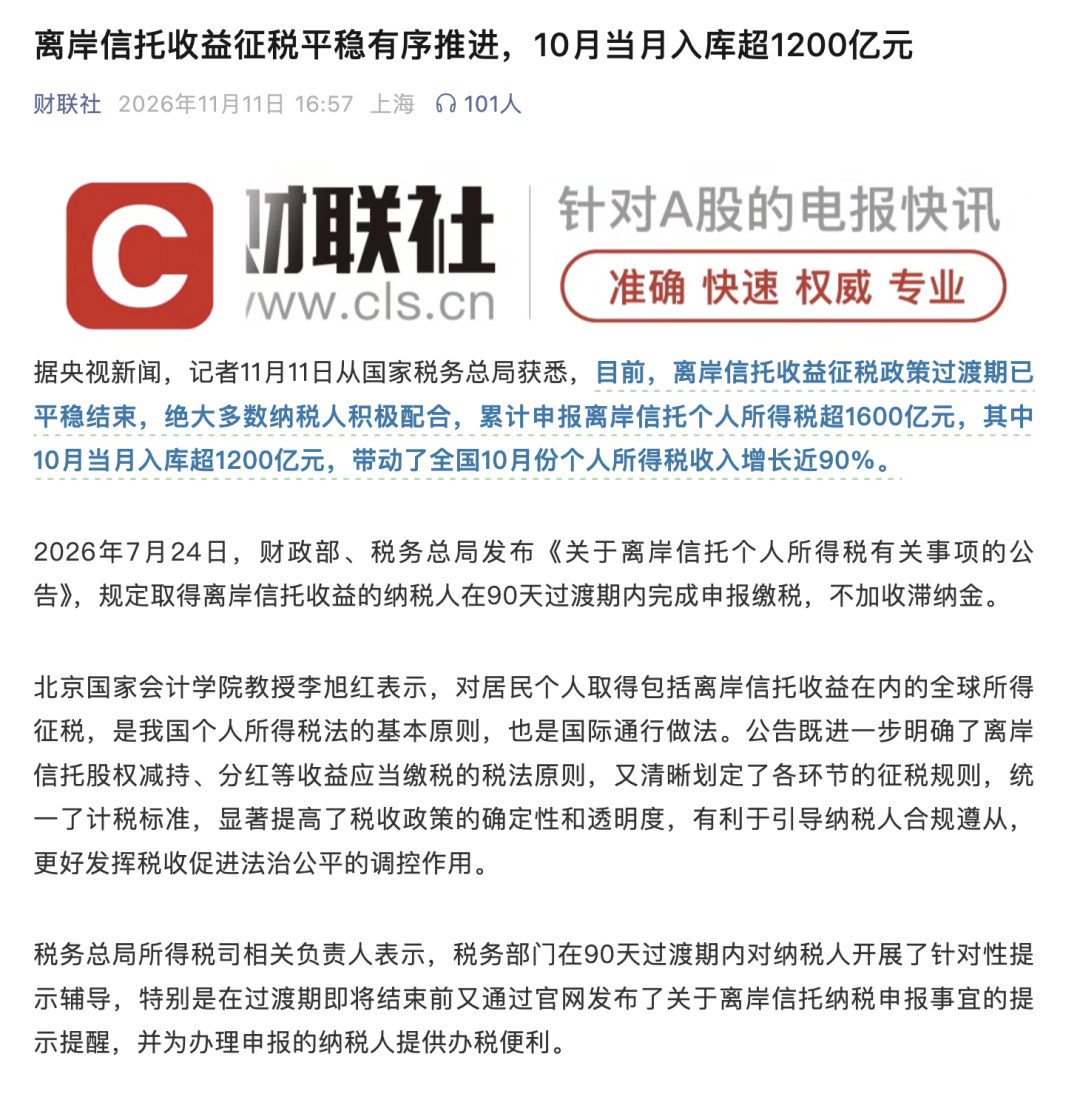
The State Taxation Administration revealed that the 90-day transition period for taxing income from offshore trusts has ended smoothly. Cumulative individual income tax declarations on offshore trust income have exceeded 160 billion yuan, with more than 120 billion yuan collected in October alone, directly driving nationwide individual income tax revenue up by nearly 90% that month.
1,200 billion yuan in one month. This wasn’t the result from a pilot city, but the national figure. In other words, money that had quietly sat in offshore structures for many years has now really been called out to pay back taxes.
Why Hong Kong Stock Market Tycoons Are Scrambling to Raise Cash
If you follow the Hong Kong stock market, you should have noticed a trend over the past few months: the owners and actual controllers of many listed companies have been raising cash at a rapid pace. Some have pledged shares, some have sold down their holdings outright, and some have even borrowed money to tide them over.
Where is all that money going? A substantial portion is being used to pay this tax on offshore trust income.
On July 24 this year, the Ministry of Finance and the State Taxation Administration issued an announcement stipulating that taxpayers receiving offshore trust income must file and pay tax within a 90-day transition period, with no late-payment interest charged. In other words: you have three months to voluntarily pay what you owe, and the past will be forgiven. Once that window closes, there will be no shortage of late-payment interest, audits, investigations, and public exposure.
Looking back, the transition window was very effective. The vast majority of taxpayers chose to cooperate, and the 120 billion collected is the best proof. Those who scrambled to raise cash before the transition period ended didn’t suddenly lose faith in their own stocks; they simply did the math clearly: better to work with the tax authorities than race against them.
2026: Cross-Border Tax Is the Main Event
Looking at the direction of domestic regulatory action this year, a clear pattern emerges: taxes—especially cross-border taxes—are a theme that cannot be ignored in 2026.
In May and June, Futu and Tiger were investigated over their cross-border securities businesses, and the market already felt the impact. Then came the taxation of offshore trusts. Beyond that, the nature of funds held in Hong Kong insurance policies and reporting obligations have also been widely debated. Even cryptocurrency is on the tax authorities’ radar, particularly the use of crypto assets to transfer assets overseas.
In the past, when people talked about cross-border assets, regulators turned a blind eye to some extent—not because they did nothing, but because it was a lower priority and they had fewer tools at their disposal. But starting this year, they’ve opened their eyes wide. They’re tightening the net layer by layer, from securities accounts to trust structures to on-chain assets.
There Are No Secrets Left in Your Accounts
Why has the tax collection been so precise this time? Because, technically speaking, traditional offshore arrangements have long been an open book.
Under the CRS (Common Reporting Standard), mainland China and more than 100 jurisdictions around the world automatically exchange financial account information every year.
The balances, income, and account-holder identities associated with your bank and securities accounts in Hong Kong, Singapore, and the Cayman Islands are basically transparent to tax authorities in China. The idea that “offshore trusts are hidden overseas and can’t be found” has long been outdated in the CRS era.
What’s even more important is what comes next. Starting in January 2027, Hong Kong will join CARF (the Crypto-Asset Reporting Framework). Crypto-asset service providers will also have to report users’ identity information, transaction records, and balances to tax authorities, with information automatically exchanged between jurisdictions.
In other words, what is being uncovered in your bank accounts today will happen again in almost exactly the same way with your crypto-asset accounts next year.
Crypto Exchanges Are Reporting Data Too
There’s still a claim going around the industry: investing in and holding cryptocurrency carries no tax risk because “the blockchain is anonymous.”
That claim doesn’t hold up even in theory. Take a look at the major compliant exchanges: their systems have long had dedicated tax-reporting interfaces built in. What does that mean? It means that from day one of product design, exchanges have been preparing to report data to regulators.
The logic is simple. To survive, an exchange needs to obtain and maintain a license. Whether it is licensed in the United States, Dubai, Singapore, or Hong Kong, compliance obligations are part of the license—and sharing user information is one of the strictest of those obligations. An exchange will not, and dare not, risk its own survival to help a user hide taxes.
So “crypto assets are tax-free” is not an inherent property of the asset. At most, it describes a temporary window before regulation takes effect. A temporary window and an extra layer of protection are completely different in terms of legal consequences.
The Gray Area Is Just a Window of Time
The 160 billion in offshore trusts is further proof of one thing: when regulators want to push something forward in depth, there is almost no resistance at the implementation level. In 90 days, 120 billion was collected. No campaign-style enforcement was needed; an announcement and a transition period were enough.
The same applies to crypto assets. My view is that there may still be some gray area around crypto-asset taxation over the next one to three years: after all, CARF information exchange will not begin until 2027, and many technical and legal details concerning the tracing of historical transactions still need to be worked out. But this is only a matter of time, not a question of whether it will happen.
Treating “the regulators haven’t found out yet” as “the regulators can’t find out” is the most common—and most expensive—misconception in this market.
My Advice
If you or your family have offshore assets, trust structures, or substantial crypto-asset holdings, my advice is straightforward: plan your taxes early, and do it properly.
By “properly,” I mean structuring your affairs within the legal framework: how residency is determined, what structures hold your assets, when and where income is realized, and how reporting obligations are met—each point must have a clear legal basis. Don’t rely on temporary measures like “not reporting,” “underreporting,” or “switching to a different wallet address” and gamble on the regulators’ patience.
The problem with temporary measures is that they’re never free. The hole you avoid today will come back to haunt you two years later in the form of late-payment interest, fines, or even criminal liability—and you’ll have to make up the difference, with interest. The offshore trust case is a perfect example: file voluntarily during the transition period and pay only the tax due; get caught after the transition period, and you’ll owe tax, late-payment interest, and fines—and in serious cases, you may even be publicly named.
When it comes to tax compliance, planning early is a cost; planning late is a penalty. The 120 billion has made one thing clear: the government is serious about collecting this money.