
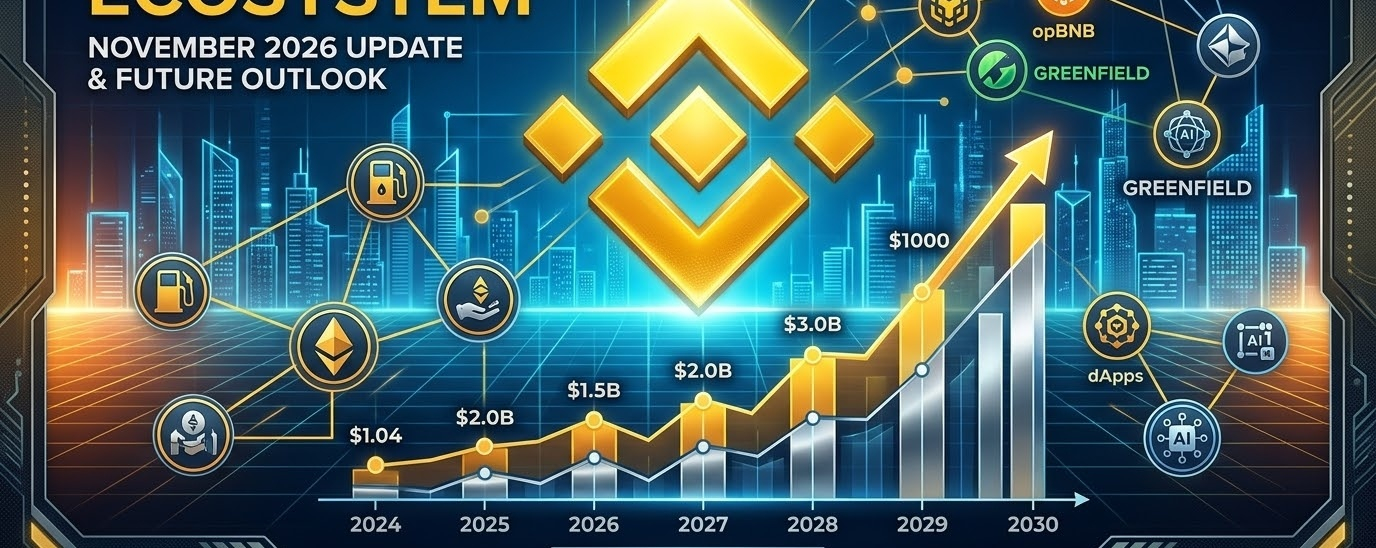

BNB (Build and Build): Ecosystem Overview, November 2026 Market Update, and Future Outlook
Originally launched in July 2017 as Binance Coin—an ERC-20 utility token created to offer trading fee discounts on the Binance exchange—$BNB has evolved into the native gas and governance token of the entire BNB Chain ecosystem. Today, it ranks as the 4th largest cryptocurrency by market capitalization, powering a multi-chain architecture that includes the BNB Smart Chain (BSC), opBNB (a Layer-2 scaling solution), and BNB Greenfield (decentralized data storage).
Core Mechanics & Tokenomics
Unlike purely speculative tokens, BNB derives demand from both real-world utility and an aggressive deflationary supply model:
Network Utility & Gas Fees: Every transaction, smart contract execution, and decentralized application (dApp) interaction on BNB Smart Chain and opBNB requires BNB for gas.
Exchange & Launchpad Benefits: Holders receive trading fee discounts on Binance, exclusive access to token launches via Binance Launchpool/Megadrop, and staking yields.
Deflationary Auto-Burn Mechanism: BNB operates on a strict supply-reduction schedule designed to shrink its total supply from an initial 200 million down to 100 million BNB. Alongside real-time gas fee burning (BEP-95), the quarterly BNB Auto-Burn automatically adjusts the number of tokens permanently removed based on BNB’s market price and on-chain block production. By late 2026, circulating supply has been reduced to approximately 131.5 million BNB.
Current Market Update (November 2026)
As of November 2026, BNB is navigating a consolidation phase following a volatile year in the broader digital asset market.
Current Price & Valuation: BNB is trading in the $677 – $685 USD range (approximately 186,225 PKR), holding a market capitalization of roughly $89–$90 billion. This places it roughly 50% below its all-time high of ~$1,370 reached in October 2025.
Technical & Market Sentiment: Short-term market sentiment leans cautious, with the broader crypto Fear & Greed Index hovering in the "Fear" zone (~29). BNB is finding strong technical support around the $670–$675 level, while facing near-term resistance near its 50-day Simple Moving Average around $739.
Recent Ecosystem Catalysts:
Network Upgrades & Capacity: Following the activation of the Pasteur hard fork in late August 2026, BNB Chain significantly boosted cross-chain bridge security and overall transaction throughput, sustaining roughly 4.5 million daily active users.
AI Agents & Real-World Assets (RWAs): BNB Chain introduced the BAP-578 standard for Non-Fungible Agents—allowing autonomous AI agents to manage wallets and execute on-chain transactions—alongside growing activity in tokenized stocks (bStocks) and stablecoin adoption.Institutional Momentum: Institutional interest continues to build, highlighted by asset managers like VanEck updating spot BNB ETF filings in October 2026 to incorporate native staking.
Future Predictions (2026–2030)
While cryptocurrency markets remain inherently volatile, analyst models and market forecasts generally outline three distinct scenarios for BNB over the coming years:
What Will Shape BNB's Trajectory?
Bullish Catalysts: Approval of staking-enabled spot BNB ETFs in major jurisdictions, sustained growth in opBNB Layer-2 transaction volume, and the compounding scarcity effect as the circulating supply marches steadily toward 100 million.
Key Risks: Ongoing global regulatory scrutiny over centralized exchange-affiliated tokens, intense competition from rival Layer-1 networks (such as Ethereum, Solana, and Sui), and broader macroeconomic shifts affecting liquidity across risk assets.#HuangRisksOusterOverReportedAffairWithSubordinate #AnthropicRejectsIPODelayValuationinQuestion #CoreWeaveJumps10%On168%RevenueGrowth