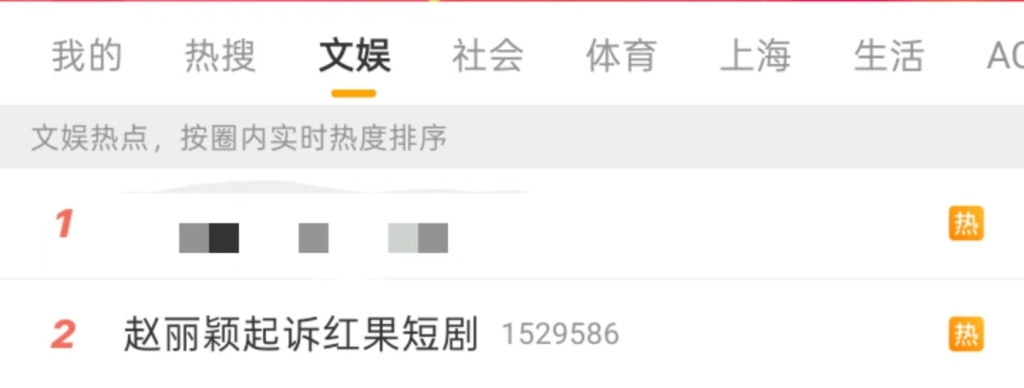

Zhao Liying has sued both Hongguo Short Drama and Douyin. On November 12, the case shot to No. 2 on the entertainment trending list.
Qichacha shows that she filed a portrait-rights lawsuit against Beijing Bimoliuxiang Technology, the operator of Hongguo; its wholly owned shareholder, Beijing Douyin Information Service; and an individual identified as Shi Mou-lun. The case was heard online by the Beijing Mentougou District Court on November 10. No ruling has been issued yet.
She is not just suing over stolen photos. Some short dramas on Hongguo have allegedly used AI face-swapping and face-merging without permission to graft her facial features onto characters, and have used her portrait on their cover images to attract viewers. The key question is whether a face generated by AI legally counts as Zhao Liying’s portrait.
This is not the first time Hongguo has run into this kind of issue. Between March and April this year, the portraits of Yi Yangqianxi, Deng Wei, Yang Zi, Xiao Zhan, Cheng Yi and others were used in AI short dramas on the platform, through face-swapping or synthesis. Their studios issued a flurry of statements asserting their rights. On April 6, Hongguo announced a special campaign to address the issue, saying it had reviewed 15,000 works and taken action against 670 that violated its rules. At the time, customer service said AI short dramas were a new format and that the review process might not be perfect.
Lawyers interviewed by The Paper broke the dispute down into two parts. Hongguo is a short-drama platform where content can go live only after review, so it has a higher duty of care and may find it difficult to claim immunity under the safe harbor principle. Douyin’s responsibility as a distribution channel must be assessed separately. The more fundamental issue is identifiability: China’s Civil Code already treats the use of information technology to fabricate another person’s portrait as an infringement. A synthetic face does not have to be identical to the person; if ordinary members of the public or people in the industry can recognize them, it may be deemed use of their portrait.
The case has yet to be decided, but it has already put two questions that the AI short-drama industry has long been testing directly before the courts: Are synthetic faces protected by portrait rights, and how much responsibility do platforms bear? What is needed next is not another governance announcement, but a ruling that others can cite as precedent.