


Original | Odaily Planet Daily (@OdailyChina)
Author | Golem (@web3_golem)
One thing barely settles before another comes along. The matter of Jensen Huang’s affair with Alice Huang, an executive at Singapore data center company Megaspeed, has yet to be fully resolved, and the media have now uncovered a second extramarital affair. According to The New York Times, Huang also had an affair with Kimberly Powell, a married senior executive at the company.
More seriously, Nvidia’s earlier statement that the incident would not affect Huang’s continued tenure as CEO has now been retracted, following his continued involvement in multiple affairs. According to The Wall Street Journal, Nvidia’s board is considering holding a meeting on Wednesday local time to discuss Huang’s future at the company. It is also considering appointing an interim leader first while working with an outside firm to select candidates for the next CEO.
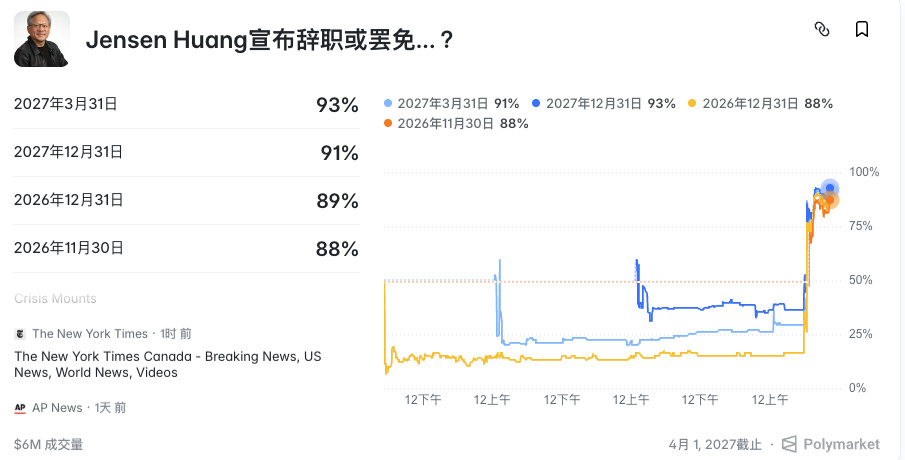
Although the board’s decision has yet to be finalized, market bets on the likelihood of Jensen Huang leaving or being ousted have surged. According to Polymarket data, the probability that Huang will leave by November 30, 2026, has risen to 88%, while the probability of his departure by March 31, 2027, has climbed to 93%.
Musk is still backing Jensen Huang. On November 12, Musk responded on social media to a post by zerohedge that read, "Elon, please hire Jensen," saying, "That would be an honor."

The combination of the two negative developments quickly triggered sharp swings in Nvidia’s share price. Nvidia shares closed up 2.87% on Wednesday, but fell more than 10% at one point in after-hours trading, wiping out over $300 billion in market value. The sell-off also weighed on other AI stocks, with Intel and Dell Technologies falling as well.
The market may not yet have fully absorbed the series of knock-on effects stemming from Jensen Huang’s private life. Neither Huang nor Nvidia has publicly confirmed or denied the second alleged affair. Nvidia already lacks a clear succession plan, and if Huang were forced to leave, an interim successor might struggle to take the reins, potentially dealing an even greater blow to Nvidia’s business and share price.
Married female executive, 15 years younger than Jensen Huang
The woman recently named by The New York Times as having had an affair with Jensen Huang is Kimberly Powell, Nvidia’s vice president of healthcare. The report says the two were filmed having an “intimate interaction” at a hotel in San Jose during Nvidia’s GTC developer conference in March this year. The video has not yet surfaced online (a bystander recorded it on a phone, and Huang’s security personnel intervened and attempted to secure a confidentiality agreement). Huang, Nvidia, and Kimberly Powell have all declined to comment.
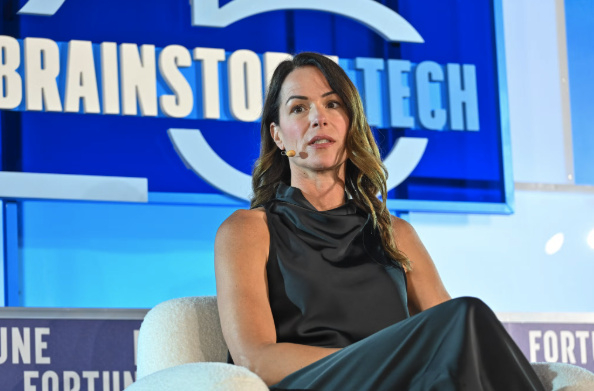
Kimberly Powell
Kimberly Powell is 48 this year, 15 years younger than Jensen Huang, and is one of about 60 executives who report directly to him. She joined Nvidia in 2008 and has been with the company for more than 18 years. She has been a key figure in building Nvidia’s healthcare business from a niche initiative into a major operation. Initially, she was responsible for advancing the use of GPUs in medical imaging. In 2017, she was promoted to vice president of healthcare, overseeing the global healthcare business and applications of accelerated computing, AI, and visualization platforms in areas such as medical imaging.
As for her personal life, media reports say Kimberly Powell is married and has two children. Many companies prohibit inappropriate relationships between employees or between managers and their subordinates, and Nvidia is no exception. Nvidia’s Code of Conduct states that employees should “avoid any situation that could give rise to a conflict,” including “personal relationships.”
If it is confirmed that Jensen Huang, as Nvidia’s CEO, led the way in violating the company’s Code of Conduct, that would seriously damage the company’s image and its efforts to establish future leadership. In light of the board’s broader responsibilities, Huang may have no choice but to leave this time.
No one can replace Jensen Huang
But if Jensen Huang really does leave, Nvidia’s board may face an even more difficult question: Who will succeed him?
Nvidia is not short of executives. CFO Colette Kress, Executive Vice President of Worldwide Field Operations Jay Puri, and Executive Vice President of Operations Debora Shoquist are all veterans with many years of experience in their respective fields. But whether they can run Nvidia and whether they can replace Jensen Huang are two different things.
Nvidia has long used a rather unusual management structure. Reports say the number of executives reporting directly to Jensen Huang once reached 55, and later remained at around 36. This has kept the company’s management layers few and decision-making highly efficient. But viewed from another angle, this structure has also made Huang the center of the entire management system. Business leaders can each run their own divisions, but no one other than Huang can coordinate all of the company’s businesses.
Unlike leaders of other major companies, Jensen Huang seems never to have seriously prepared a clear succession plan. He has discussed succession in interviews before, expressing disagreement with the traditional approach to grooming successors. In Huang’s view, the company’s knowledge and experience should be distributed across the entire team, rather than entrusted to one designated successor.
Jensen Huang is irreplaceable to Nvidia. Over the past three decades, he has bound himself closely to the company. He is not only its founder but also Nvidia’s most important public face. His signature black leather jacket has become his regular attire at global tech conferences, industry summits, and government events. Whether announcing a new generation of GPUs, explaining Nvidia’s technology roadmap, or discussing partnerships with governments and tech giants around the world, it is always Huang representing Nvidia on the public stage.
So while the board can replace the CEO easily and a successor may be able to take over day-to-day operations, inheriting Huang’s industry influence and market appeal in a short time would be far from easy.
For a company valued at several trillion dollars and highly dependent on its founder’s personal influence, replacing the CEO could mean reassessing Nvidia’s future strategic direction. Even if the company’s business does not grind to a halt immediately after Huang’s departure, would Nvidia without him still be the same Nvidia?