How Does the Federal Reserve’s Interest Rate Policy Affect Global Asset Prices?
Many investors follow the daily ups and downs of Bitcoin, U.S. stocks, and gold, but overlook a more important variable: the Federal Reserve’s monetary policy.
Why does a single U.S. interest rate adjustment affect financial markets around the world? Because the U.S. dollar is not only a major global reserve currency, but also a key foundation for international financing, trade settlements, and capital allocation.
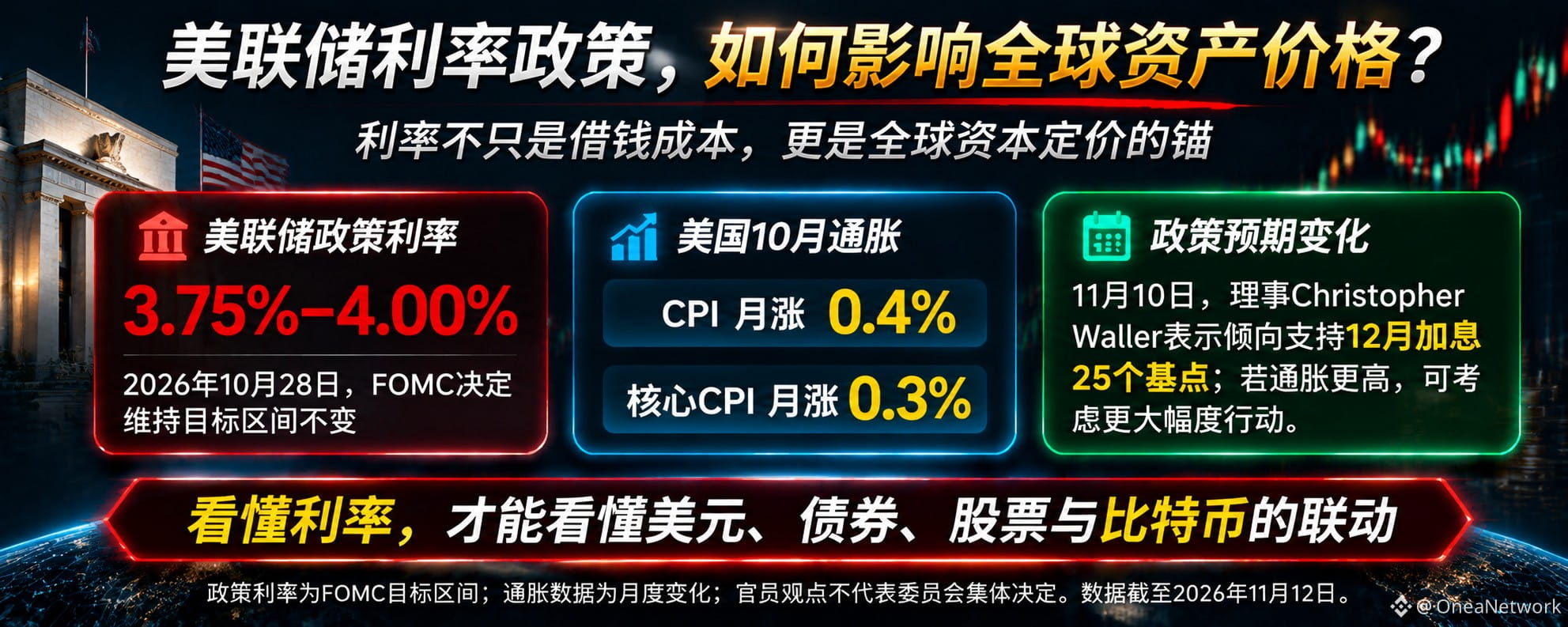
On October 28, 2026, the Federal Reserve kept the target range for the federal funds rate at 3.75% to 4.00%. But that does not mean the market has entered an easing cycle. On November 10, Fed Governor Christopher Waller said he was inclined to support a 25-basis-point rate hike in December; if inflation data remained elevated, a larger move should also be considered. The U.S. CPI released afterward showed a 0.4% month-over-month increase in October, while core CPI rose 0.3%, indicating that inflationary pressures remain worth watching.
How exactly do interest rates affect asset markets?
First, the U.S. dollar. When U.S. interest rates are relatively high, dollar-denominated assets may become more attractive, affecting both global capital allocation and exchange rates.
Second, U.S. stocks. Rising interest rates increase companies’ borrowing costs and reduce the present value of future profits, making highly valued tech stocks especially sensitive.
Third, Bitcoin. Crypto assets are relatively sensitive to liquidity and risk appetite. When borrowing costs rise and investors reduce their risk exposure, the market may come under pressure.
Fourth, gold. Real interest rates and the U.S. dollar’s performance affect the opportunity cost of holding gold, though geopolitical developments and safe-haven demand can also alter this relationship.
So what really matters is not simply predicting whether the Fed will raise or cut rates next, but watching whether inflation, employment, the U.S. dollar, and financial conditions are changing together.
Understanding how interest rates ripple through the economy is key to understanding why global assets move in sync.
What do you think will be the biggest impact of the Fed’s policy in the next phase—and which market will feel it first: U.S. stocks, Bitcoin, or gold?