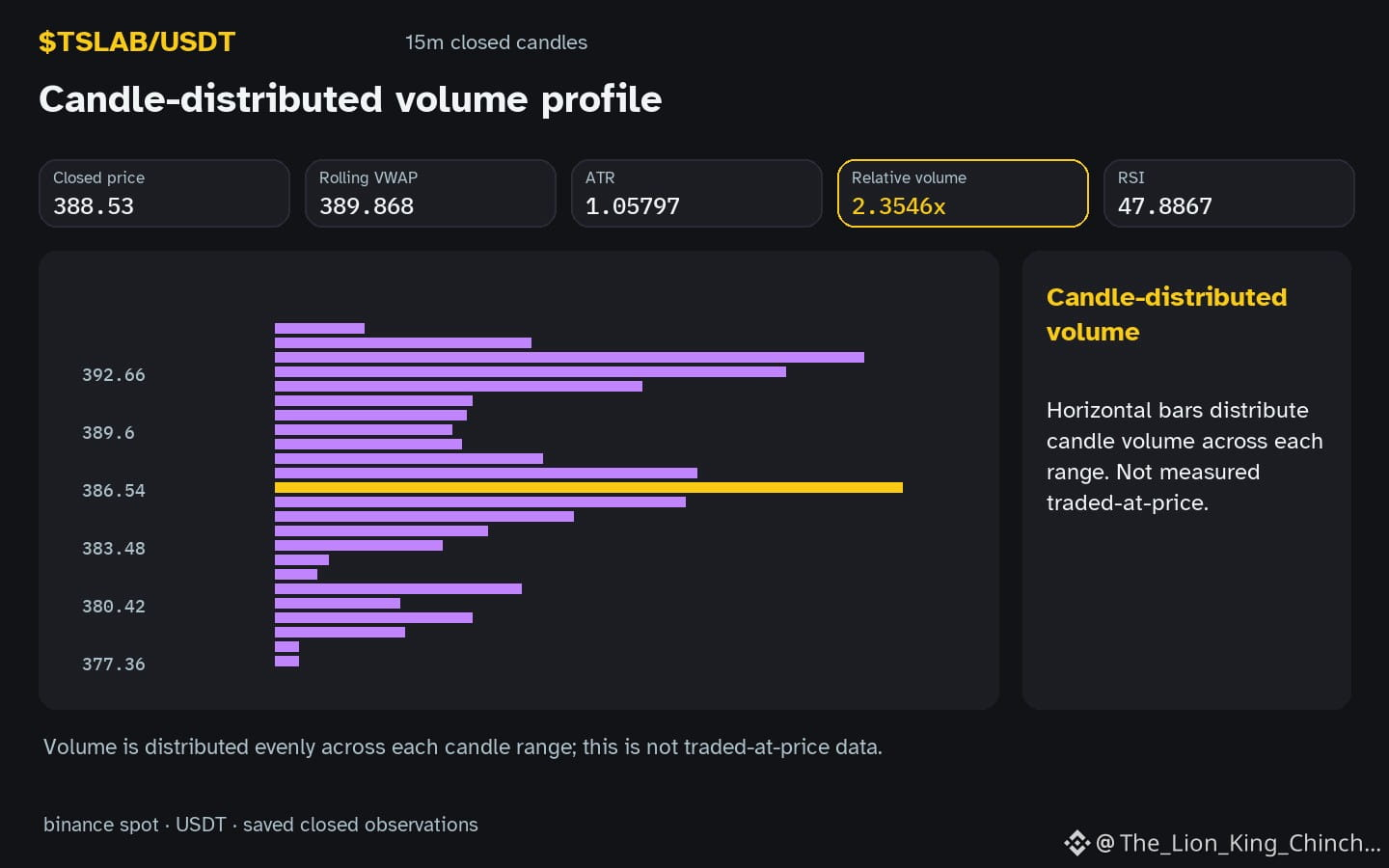
$TSLAB : Single Venue Limits
Does $TSLAB volume prove broad demand? One venue misses global depth. This frames a humility check, not a prediction. The tempting shortcut is assuming one order book mirrors the whole market. That fails because other exchanges hold distinct participants. A more careful interpretation treats venue data as a slice. Here, volume sits 2.35x baseline. That ratio captures only comparisons to prior candles on this specific platform. It does not measure total capital flows or hidden pockets elsewhere. Think of a hypothetical crowd: if one exit jams, the room still empties. Similarly, one feed may miss liquidity from faraway desks. This creates a research gap. The data shows price moving up hourly. Yet the internal observation remains inside the recorded local range. No single candle confirms causation or shared motive. We must resist mapping that movement onto a wider narrative. Instead, ask what evidence would challenge this view. If other major venues show flat participation while this one spikes, the local signal weakens. That divergence signals a venue-specific event, not global conviction. This distinction defends against overconfidence. It also clarifies when to pause analysis. Write to Earn programs sometimes tilt writers toward upbeat narratives. Checking multiple feeds is a simple safeguard. It reminds us that our data is bounded. The goal is clearer limitations, not false confidence. We accept that one screen shows only a part. Future closed candles across several platforms can test whether the volume pattern persists. If it does, the observation gains weight. If not, we revise. This self-check keeps research honest. We focus on what is seen, not what is felt. The tension between local detail and global truth remains central. By honoring that gap, we build a more resilient framework for understanding market behavior. This approach favors careful inquiry over quick labels.
Probabilistic market research, not a recommendation or guaranteed return.
#TSLAB #CryptoCommunity #CryptoLearning