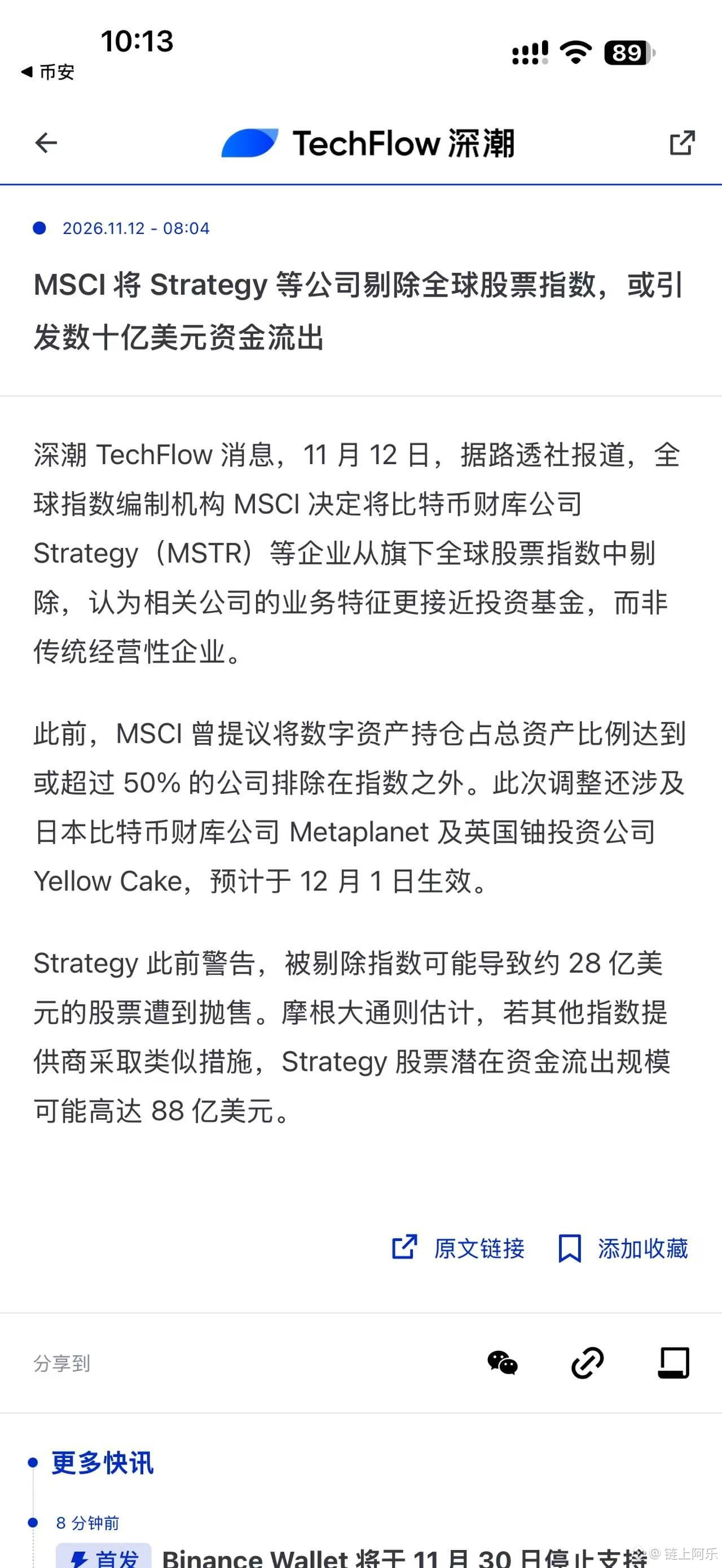
$BTC What does MicroStrategy being removed from the index mean for Bitcoin?
First, it’s important to distinguish between the two: passive funds sell MSTR stock, not Bitcoin itself.
Even if MSTR is dropped from the index, the 848,000 bitcoins it holds won’t be liquidated. So there won’t suddenly be a huge amount of spot Bitcoin dumped onto the market, and there won’t be direct selling pressure in the short term. You can rest easy on that point.
The real impact comes later: MSTR has been able to keep making large Bitcoin purchases through the cycle of “strong share price → raising capital by issuing new shares → buying more Bitcoin.”
After it’s removed from the index, around $1.57–2.8 billion in passive investment is expected to flow out over time. The share price could weaken and its premium could narrow, making it harder to raise money by issuing new shares and use it to buy Bitcoin.
Put simply, it’s not about selling Bitcoin today. It’s that future big buyers may not be as aggressive, so buying pressure could ease over the long term.
In the short term, market sentiment will certainly take a hit—after all, MSTR has long been a “beacon of faith” for Bitcoin. Around the time the news comes out, BTC will likely move along with MSTR’s share price.
But here’s another way to look at it: if this really happens, once the short-term panic subsides, the bad news will be fully priced in and the uncertainty will be gone. What’s more, MSTR had already been slowing the pace of its Bitcoin purchases recently, so the impact is more marginal than a sign that Bitcoin’s fundamentals are in serious trouble.