
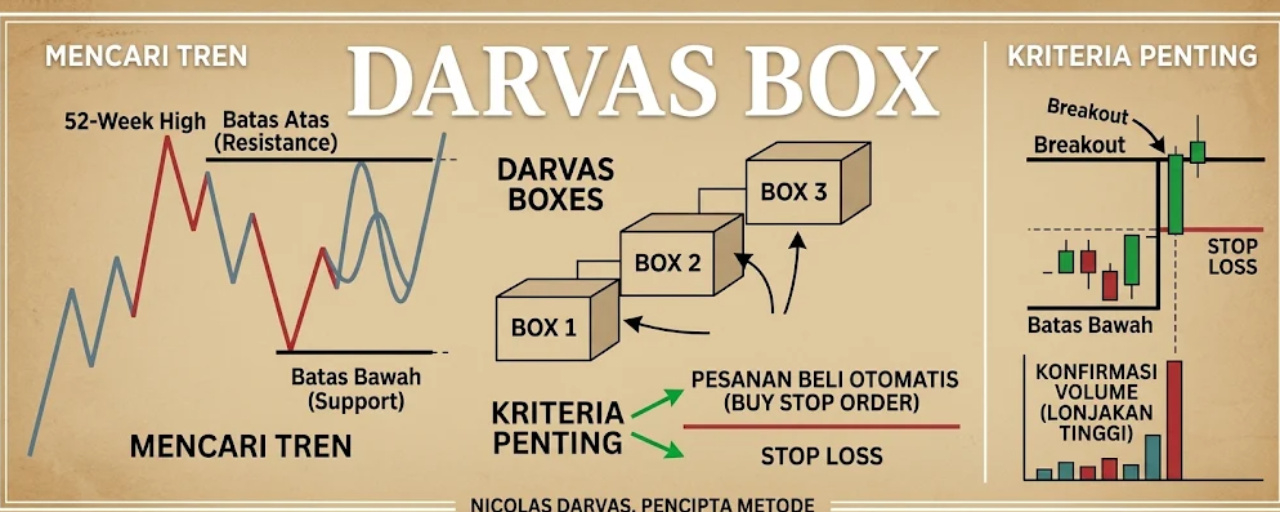

In the world of investing and trading, many strategies have emerged from academics and Wall Street analysts. However, one of the most iconic and time-tested trend-following methods was created by a professional stage dancer named Nicolas Darvas. Through a simple yet disciplined approach, the Darvas Box method turned a small amount of capital into a fortune worth millions of dollars and remains relevant to modern traders today.
Who Is Nicolas Darvas and What Is the Background Behind His Invention?
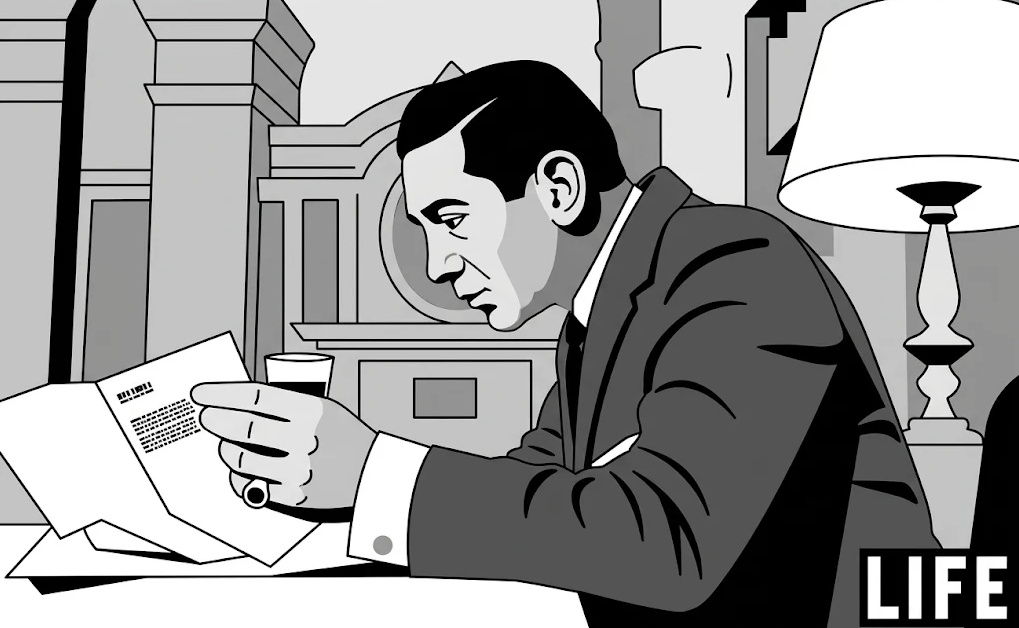
Nicolas Darvas was a professional ballroom dancer from Hungary who also studied economics at the University of Budapest. In the 1950s, while touring the world as a dancer, Darvas became interested in the U.S. stock market. Because access to information was limited at the time—he relied only on newspapers and telegrams to monitor price movements—Darvas could not follow market news every second.
In between performances, he read more than 200 books on the stock market and spent up to eight hours a day studying price patterns, drawing considerable inspiration from the ideas of legendary trader Jesse Livermore. From his observations, Darvas realized that strong stock price movements tend to form successive consolidation patterns, like boxes stacked upward. By applying this system consistently, he turned his initial capital of $10,000 into more than $2 million in just 18 months. His story and technique were later immortalized in his classic book, How I Made $2,000,000 in the Stock Market.
How the Darvas Box Indicator and Strategy Work
The Darvas Box strategy is essentially a trend-following system focused on two main variables: price and trading volume. It maps price fluctuations into an imaginary “box” bounded by an upper line (resistance) and a lower line (support).
The following are the stages in the formation of a Darvas Box:
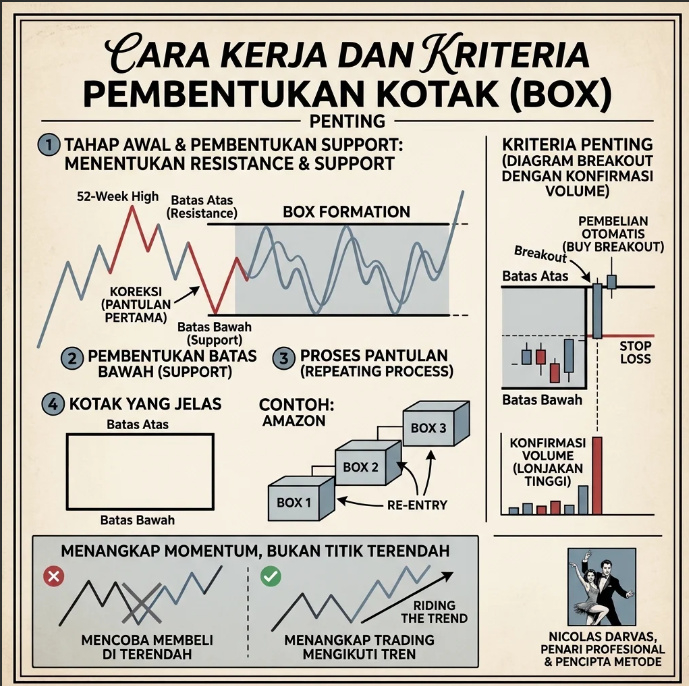
Setting a New High (52-Week High): The first step is to look for stocks in a strong uptrend that have broken through to a new high over the past 52 weeks. This high becomes a candidate for the box’s upper boundary (ceiling).
Correction and Formation of the Lower Boundary (Floor): After reaching a record high, the stock price will usually undergo a temporary correction due to profit-taking. If the price stops falling and begins to rebound for several days without breaking below the correction low, that low is set as the box’s lower boundary (support).
Consolidation Inside the Box: As long as the price moves up and down between the established upper and lower boundaries, it is considered to be inside the “box.” If the price breaks through a new upper boundary before a lower boundary has formed, the upper boundary is adjusted to the new high.
Disciplined Entry and Exit Rules
The main advantage of the Darvas Box method lies in its objective execution rules, which reduce emotional hesitation when making decisions:
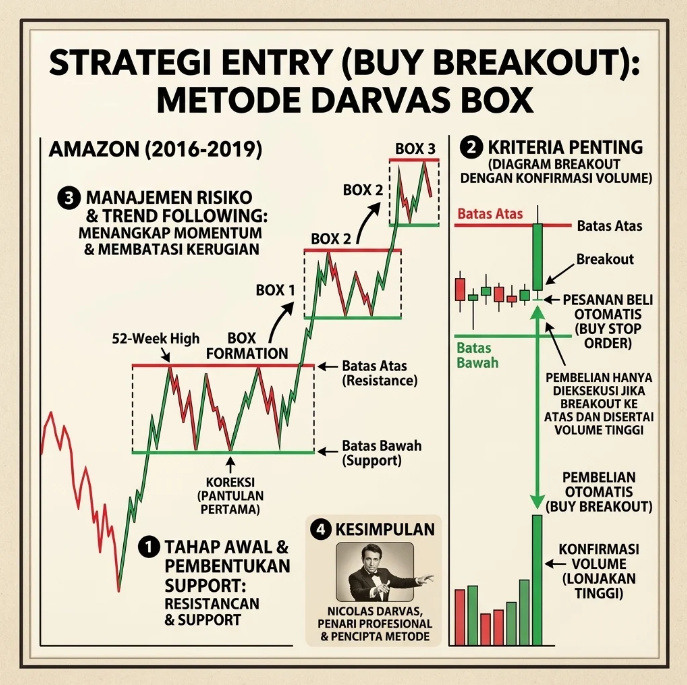
Entry Strategy (Buy Breakout): Darvas never bought stocks while their prices were falling or while they were inside a box. He placed an automatic buy order (buy stop order) slightly above the box’s upper boundary (resistance). A purchase was executed only if the price successfully broke out above the box, accompanied by a significant spike in trading volume as confirmation of strong buying interest.
Pyramiding Strategy (Adding to a Position): If the price continues to rise and forms a new box at a higher level, traders can buy again when the next box breaks out to maximize gains while the trend continues.
Exit Strategy (Stop Loss and Trailing Stop): Risk management is key to this strategy. As soon as a buy position is opened, a stop loss is placed just below the previous box’s upper boundary (or inside the box to limit the risk of loss to around 2% to 5%). As the price rises and forms new boxes above, the stop loss is moved up as well (trailing stop) to the lower boundary of the latest box. The entire position is sold when the trend weakens and the price breaks below the support line of the last box.
The Philosophy Behind the Darvas Box Strategy
Nicolas Darvas’s greatest guiding principle was to capture trend momentum and leave ego out of trading. Darvas believed it was impossible for anyone to consistently buy at the very bottom and sell at the exact peak. In his view, capturing just the middle portion of a major uptrend was more than enough to generate extraordinary profits.
Darvas also consistently likened trading to managing risk and probabilities. A professional trader does not gamble by risking all their capital without a loss limit. Instead, they limit potential losses as much as possible when a prediction is wrong and let profits grow as much as possible when it is right. As he famously put it: “I have no ego in the stock market. If I make a mistake, I admit it immediately and get out as quickly as possible.” By combining the patience to wait for breakout confirmation, the discipline to cut losses, and the courage to hold winning stocks, the Darvas Box strategy remains an important foundation of modern technical analysis.