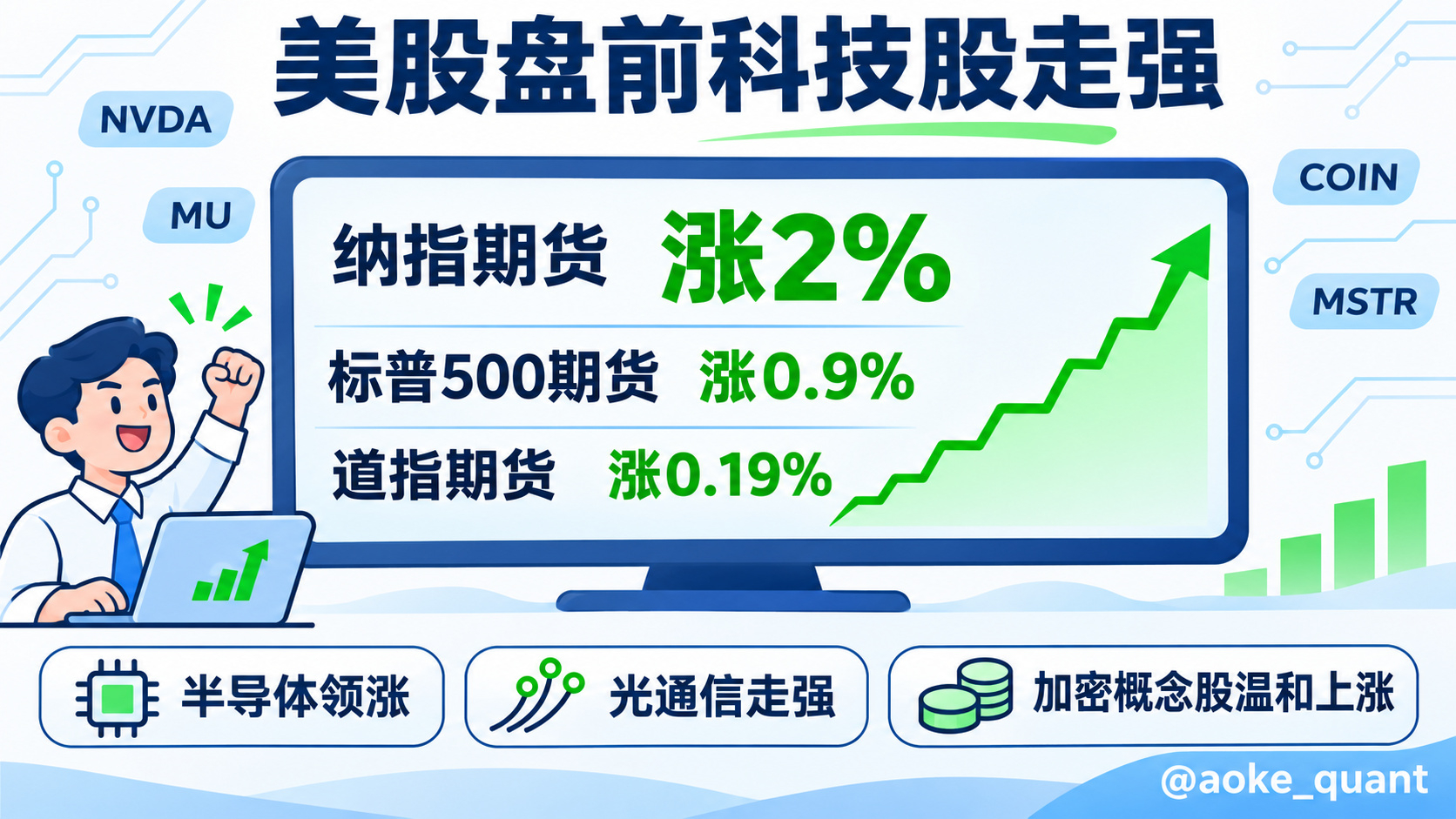
Nasdaq futures rise 2% before the open, with semiconductor and crypto-related stocks climbing in tandem
Risk assets broadly advanced before the U.S. market opened on November 11. According to data from the BIT stock platform, Nasdaq futures extended their gains to 2%, S&P 500 futures rose 0.9%, and Dow futures gained just 0.19%. The three major futures contracts diverged markedly, indicating that this rally was driven mainly by technology and growth stocks rather than a broad cyclical rebound.
Among individual stocks in premarket trading, semiconductors and memory stocks were strongest: Seagate Technology rose 8.64%, Western Digital gained 7.29%, SanDisk climbed 8.59%, Micron Technology advanced 6.88%, Intel rose 6.73%, AMD gained 7.29%, and Nvidia climbed 4.09%. Optical communications stocks were among the top gainers: Lumentum rose 9.47%, Coherent gained 9.40%, AXT climbed 10.15%, and Marvell Technology advanced 8.09%. By comparison, crypto-related stocks posted only modest gains: Coinbase rose 1.70%, SharpLink gained 1.88%, Strategy advanced 1.13%, Circle rose 1.12%, and BitMine gained 0.64%.
A breakdown of the market structure points clearly to the AI hardware supply chain as the main theme behind this premarket action: computing chips, memory, and optical modules were at the heart of the gains, while crypto-related stocks, whose businesses are primarily focused on Bitcoin holdings and trading, generally remained in the 1%–2% range and significantly underperformed semiconductors. This suggests that the capital driving Nasdaq futures up 2% was mainly targeting the AI capital expenditure narrative; crypto-related U.S. stocks appeared more like passive beneficiaries of a recovery in risk appetite than the focus of this rally.
The impact on the crypto market can be understood through three channels. First, sentiment spillover: strength in technology stocks typically improves overall risk appetite, creating a relatively favorable external environment for assets such as Bitcoin. This is an inference based on statistical correlation. Second, proxy assets: companies such as Coinbase and Strategy provide traditional investors with a way to gain exposure to crypto volatility. Their premarket gains suggest at least that U.S. equity investors have not withdrawn from crypto exposure, although the move was modest. Third, narrative spillover: AI computing infrastructure overlaps industrially with areas such as data centers and high-performance computing. If the capital expenditure cycle continues, supply and demand for computing resources could move in tandem. There is currently no direct data to verify this, so it should be treated as an observation to monitor.
What happens next is also important. According to a follow-up update from the same source, the Nasdaq 100 closed up more than 2% that day, recovering all of its losses since the midterm elections; the Philadelphia Semiconductor Index rose 6.1%, SanDisk gained more than 15% intraday, and CoreWeave's gain at one point widened to 20%. This shows that the premarket futures strength carried over into the cash market, and that the AI supply chain's momentum was not a one-off spike.
Editor's view: This rally offers indirect support for the crypto market rather than being driven by it; the underperformance of crypto-related stocks is itself a signal. The key thing to watch is whether risk appetite in technology stocks continues to spill over. A catch-up rally in crypto stocks, or a recovery in Bitcoin's relative strength versus technology stocks, would signal that capital rotation is truly underway. Premarket futures are highly volatile, and it is uncertain whether a single day's moves will continue. This is for informational and analytical purposes only and does not constitute investment advice.
#NasdaqFuturesRise2% #BTC #ETH #BNB