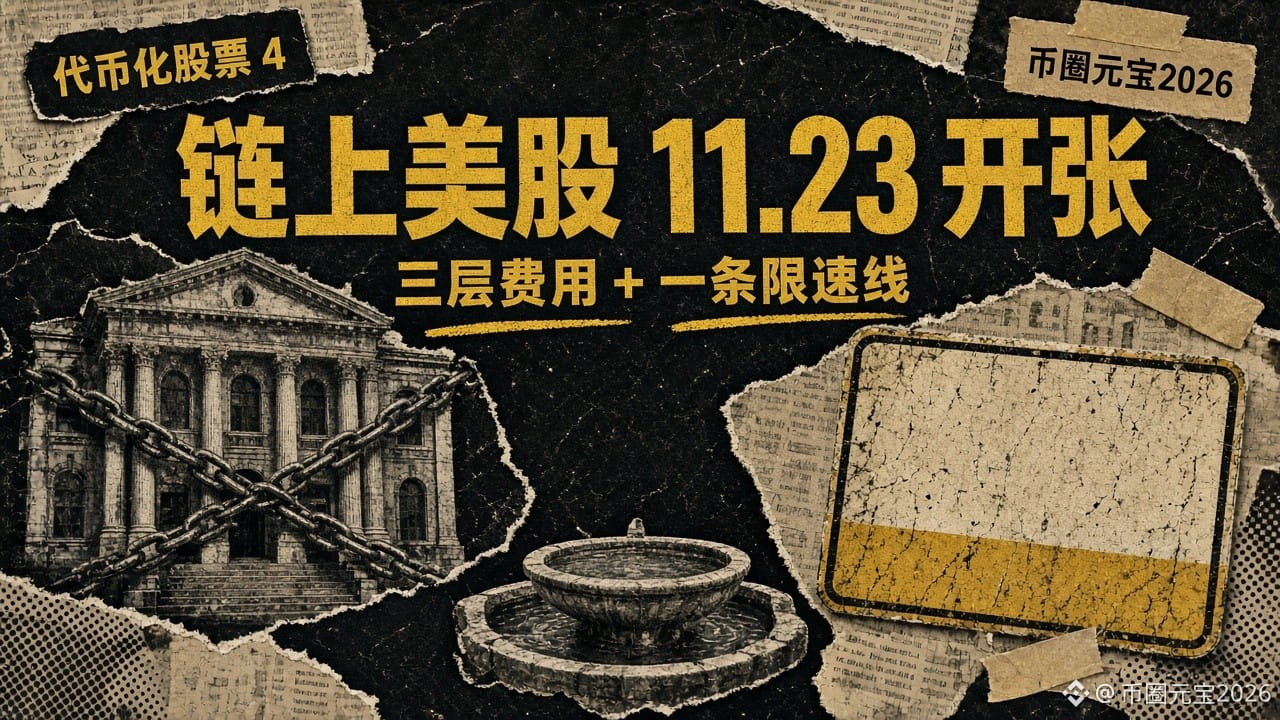
The on-chain U.S. stock trading venue launched jointly by OKX and NYSE parent company ICE opens on November 23. Can you use it? How many layers of fees do you pay before buying?
First, the launch date and scale (announced by OKX and ICE on November 11, according to Reuters and The Block): The OKXICE tokenized securities trading venue opens at 9 a.m. ET on November 23, or 22:00 Beijing time that same day. More than 70 assets have been confirmed, including Coinbase, Circle, Robinhood and Strategy, plus 59 Direxion ETFs. Not all of them are necessarily going live on day one. Also, according to multiple media outlets citing a notice published on November 5, 67 publicly traded companies have objected, including Apple, Tesla and Meta.
Next, can you use it? It’s only open to verified OKX customers in the United States. If you’re outside the U.S., this has nothing to do with you.
Here’s how it works (from the original OKXICE notice published on October 23):
1. There’s no order book. Trades are executed through Uniswap v4 liquidity pools deployed on X Layer, with stablecoins like USDC and USDG as trading pairs. Only wallets holding a non-transferable credential (SBT) issued by the venue can trade.
2. Each token represents one share held in custody by a broker, with rights such as dividends and voting retained. Tokens stay in users’ own wallets; the venue doesn’t custody them or lend them out.
3. Trading is available 7×24 hours.
4. The notice states that the venue is not registered with the SEC, and the SEC has not endorsed the contents of the notice. It operates under an SEC innovation exemption introduced in September.
Two practical points to keep in mind:
- Each trade comes with three layers of fees: a venue service fee (deducted from your stablecoins upfront when you buy), a liquidity pool fee (paid to liquidity providers), and an on-chain gas fee. Add up all three before placing an order, then check your slippage settings. When a pool has little liquidity, slippage can cost more than the fees.
- There’s a “speed limit”: Under the SEC exemption, Tier 1 stocks are capped at 75 tickers, and their on-chain trading volume must not exceed 0.25% of that stock’s average daily trading volume in the previous month. Tier 2 allows up to 250 tickers, with a 2.5% cap. If the same stock exceeds its limit a second time, trading is suspended for 3 months; trading may also be suspended early as it approaches the limit. In other words, the more popular a stock is, the more likely trading could be halted. Don’t assume you’ll always be able to sell.
A blunt take: being able to trade 7×24 hours doesn’t mean there’ll be someone on the other side of your trade 7×24 hours.
Of the more than 70 assets, which category would you like me to cover first in my next post: company stocks, preferred shares, or ETFs? Tell me in the comments.
Follow me—this week, I’ll be breaking down the opening day, coverage and restrictions of 【tokenized stocks】. You won’t have to hunt around the feed for the next post in this series.
#代币化股票 #RWA #OKX #U.S.StocksOnChain