

While both Bitmine Immersion Technologies (BMNR) and Strategy / MicroStrategy (MSTR) act as publicly traded balance-sheet proxies for top digital assets, their underlying financial engineering and tokenomic goals reflect the fundamental differences between Ethereum (Proof-of-Stake) and Bitcoin (Proof-of-Work).
1. Underlying Asset & Core Thesis
MicroStrategy (MSTR) — Store of Value & Absolute Scarcity: Michael Saylor’s playbook treats Bitcoin as a non-sovereign, non-yielding digital gold with a hard supply cap of 21 million BTC. The objective is to maximize "BTC per Share" through relentless dollar-cost averaging, removing liquid BTC supply from open circulation indefinitely.
Bitmine Immersion Technologies (BMNR) — Yield Generation & Network Utility: Led by Tom Lee, Bitmine's thesis leverages Ethereum as both a store of value and a programmable yield-bearing protocol. Bitmine focuses on native protocol participation and capitalizing on tokenization supercycles.
2. Revenue & Cash-Flow Mechanics
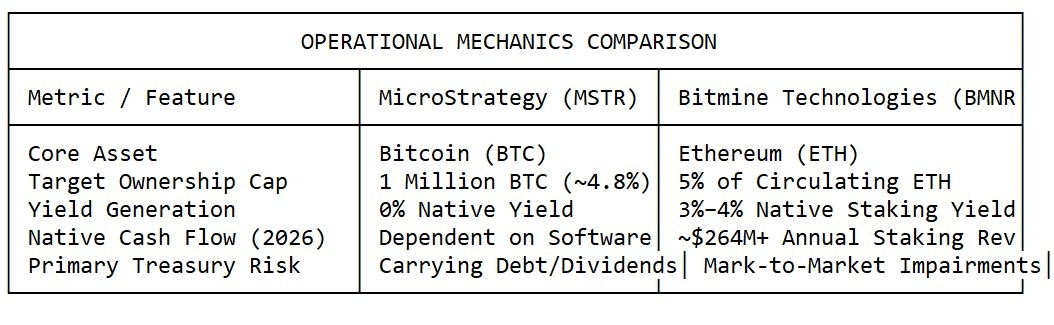
The Yield Advantage: MicroStrategy holds a non-yielding asset; its debt service and preferred stock dividend obligations rely on corporate financing and legacy software operations. In contrast, Bitmine stakes roughly 73%+ of its ETH treasury (over 5 million ETH staked through its MAVAN validator network). This generates hundreds of millions of dollars in native annual staking revenue, creating organic corporate cash flow independent of asset price appreciation.
Volatile Accounting Disclosures: Because of mark-to-market accounting rules, both companies experience severe headline net loss volatility during market drawdowns. Bitmine's fiscal 2026 GAAP net loss reflected non-cash unrealized paper markdowns on its massive ETH stack, even while its top-line operational revenue grew via staking rewards.
3. Supply Control & Network Impact
Bitmine's 5% ETH Cap Target: Bitmine holds ~6.07 million ETH (representing roughly 4.97% of total circulating supply). Staking this volume gives Bitmine structural influence over Ethereum validator consensus and network security while creating a deflationary supply sink.
MicroStrategy’s 1 Million BTC Target: MicroStrategy holds over 850,000 BTC, aiming for 1 million BTC (~4.76% of ultimate supply). By vacuuming up spot float, MSTR directly exerts upward price pressure on an illiquid market.
4. Capital Raising & Financial Architecture
MicroStrategy's Leveraged Credit Engine: Saylor pioneered issuing convertible senior notes, at-the-market (ATM) equity sales, and perpetual preferred shares (STRC) to purchase spot BTC, effectively turning MSTR into a leveraged Bitcoin ETF alternative.
Bitmine's Hybrid Infrastructure Model: Bitmine combines equity financing (ATM/PIPEs) with hybrid crypto operations, incorporating institutional validator infrastructure (MAVAN) alongside mining and hosting operations to fund treasury expansion organically.
💡 Summary
MicroStrategy acts as a leveraged accumulation vehicle designed to capture Bitcoin's price appreciation, whereas Bitmine acts as a yield-generating protocol partner that converts corporate treasury assets into ongoing cash flow via PoS staking.
To see a detailed breakdown comparing corporate crypto treasury models and how institutions structure BTC versus ETH balance sheets, check out MSTR vs BMNR vs STKE: Comparing Crypto Treasury Stocks, which explores the operational risks and yield mechanics of these treasury strategies.
Disclaimer: Digital asset treasury strategies involve significant capital structure and volatility risks. This comparative analysis is for educational purposes only.