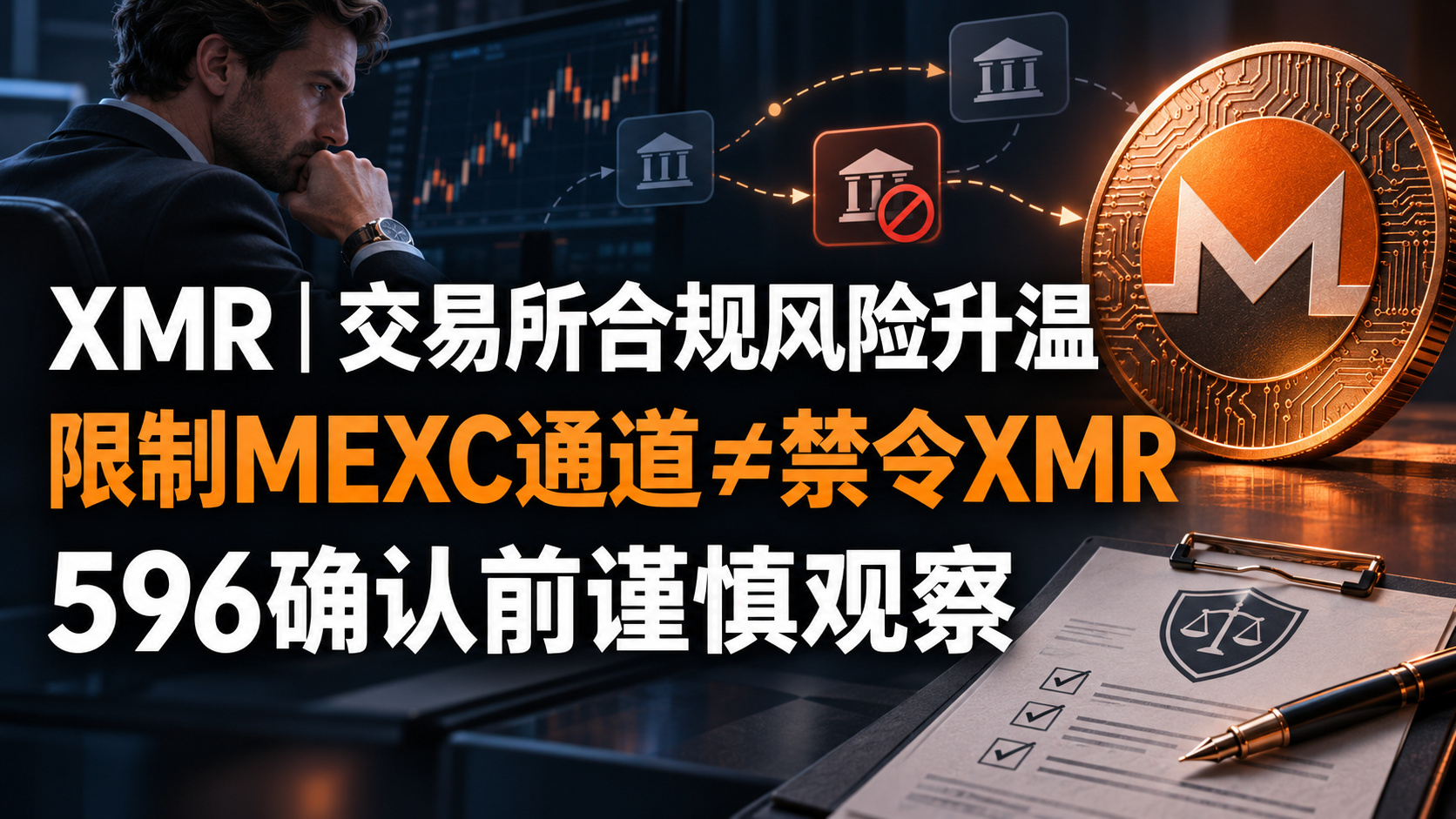
XMR: FinCEN restricts MEXC’s access to funding channels | Exchange compliance risks rise | Caution near 596
My stance is to watch and wait. I will not misrepresent regulatory action targeting one exchange as a ban on XMR. On November 6, the U.S. Treasury Department’s Financial Crimes Enforcement Network (FinCEN) announced an order restricting MEXC Global’s access to the U.S. financial system. FinCEN said its investigation involved at least $16 billion in suspicious illicit transactions. That is the regulator’s claim; it does not mean every transaction or any particular coin was illegal. Binance later announced on November 10 that it would no longer process transfers involving the listed MEXC-related entities: outgoing transfers initiated by Binance to those entities would be rejected, deposits from those entities would be temporarily held for compliance review, and related accounts could also face restrictions. What the two primary-source documents corroborate is scrutiny of funding channels and counterparties—not a penalty against the Monero protocol, nor the delisting of XMR from every exchange.
Why should XMR traders pay attention to this? The price of privacy assets is determined not only by on-chain technology, but also by fiat on-ramps, exchange availability, and how smoothly transfers between platforms can be made. If transfers between platforms require stricter source-of-funds checks, the cost of rotating arbitrage and market-making capital could rise, and local price spreads could widen. However, this is only a risk scenario based on a possible transmission mechanism; I have no evidence that the MEXC restrictions have already directly reduced XMR liquidity, and XMR should certainly not be treated as a target named in the regulatory documents. The latest official release currently shown on the Monero website remains version 0.18.5.4, released in October, and there is no new protocol incident to explain today’s price movement.
The market data available to me shows XMR/USD on Kraken at around $584.79 when I checked, with an intraday high of 595.93 and a low of 558.30, and an opening price of about 562.64. This indicates a rebound, but the price has not yet held above the intraday high. The 595.93–596 range is short-term resistance; if a breakout is confirmed, 610 and 620 are the next levels to watch. Below, the first level to watch is 580, followed by 558.30. Today’s rise in XMR cannot simply be attributed to the FinCEN news, since it was announced several days ago and risk assets such as BTC have also moved in the meantime. If XMR falls back below 580 and cross-platform liquidity deteriorates, my cautiously bullish outlook would be invalidated; if it breaks below 558.30, I will stop trading the rebound setup.
If I were trading this myself, I would not chase the rally or open a leveraged short position right now. I would consider a small spot long in the direction of the trend only if the price moves decisively above 596, holds that level on a retest, and order-book spreads have not widened significantly. I would risk no more than 2% of my total capital, initially deploying half of the planned position. At 610, I would take profit on half and hold the rest for 620. If the price moves up and then falls back below 596, I would reduce the position; below 580, I would close it entirely at a stop-loss. If 558.30 is breached before an entry trigger, I would cancel the plan outright. Another exit condition would be further tightening of exchange deposit and withdrawal rules, or a sustained decline in the trading depth I can verify. In that case, even if the price moves sideways, I would not keep tying up risk capital. Read compliance documents word for word, and execute trades according to conditions.
Sources: FinCEN announcement dated November 6; Binance platform transfer announcement dated November 10; Monero website. #XMR
This is solely my personal market observation and does not constitute investment advice.