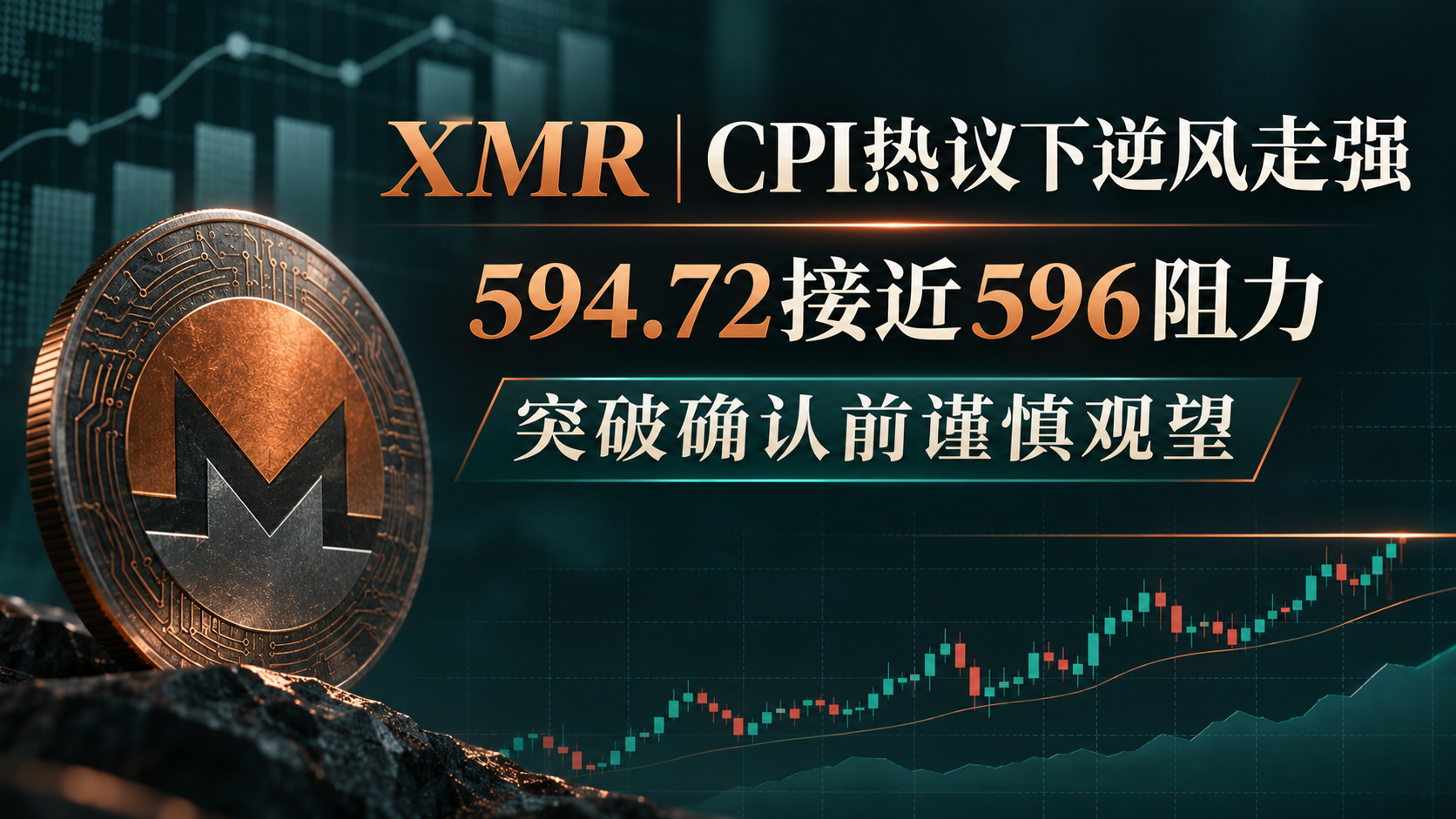
XMR: Debate over expectations of a December rate hike | Price approaches 596 against the headwind | First, distinguish what is driving the rise
My stance is cautious and observant: XMR's strength deserves respect, but rising prices alone are no reason to conclude that macroeconomic risks have been resolved. The top topic currently on Binance Square is #HotCPIDecemberHikePriced. The U.S. Bureau of Labor Statistics reported that October CPI rose 0.4% month over month; that is firsthand data. “A December rate hike is fully priced in” is a market topic and expectation, not a Federal Reserve decision. The Fed's official statement on October 28 still kept the federal funds target range at 3.75% to 4.00%, and the outcome of the December meeting has yet to happen. I especially would not present a popular hashtag as a policy announcement, nor use it to explain every XMR trade.
The way macro news is transmitted to privacy coins is not unusual: higher rate expectations may raise the opportunity cost of holding non-yielding assets, and when risk capital contracts, thinner markets often see sharper volatility. But XMR also has its own trading channels, liquidity, and privacy-demand factors, which cannot be directly equated with BTC's ETF creation and redemption mechanism. Monero's official website currently shows no announcement of a new release today, so what follows is about “the disconnect between macro data and market reaction,” not a project-upgrade catalyst. If there are subsequent regulatory or trading-platform announcements, their original wording and scope must be checked; general discussion should not be turned into a claim that new restrictions have been imposed on XMR.
When I checked Kraken's XMR/USD spot market, the latest price was around $594.72, with an intraday open of $562.64, a high of $595.93, and a low of $558.30. The price is near its intraday high, suggesting that buyers have not immediately retreated in response to the CPI headline. But this only describes price action during the observation window; it does not prove where the funds came from or guarantee a breakout. Around 596 is the immediate short-term hurdle, while 600 is a psychological round number. If the price pulls back below 585 after moving higher, the case for continued gains should be downgraded. A further drop below 580 would, in my view, invalidate the rationale for this round of buying; a return to around 562 would suggest that the entire intraday rise may be repriced.
If I were trading this myself, I would not chase the price now; the only direction I would consider is a small spot long position. My trigger would be for XMR to break decisively above 596 and hold 590 on a retest. Only then would I consider opening a position with 2% of my total capital. I would initially target 605, sell half the position there, and let the rest run toward 615. I would place a stop-loss if the price fell below 585 after entry. If it first drops below 580, I would cancel the long plan and stay out of the market. If it breaks above 596 but quickly falls back below 590 and fails to reclaim it, I would proactively close the remaining position rather than wait for the stop-loss. This plan uses no high leverage, and I would not increase my position because of the “priced in” wording in a popular topic. First, see whether the actual price can hold the breakout; then decide whether to take on the risk.
#HotCPIDecemberHikePriced #XMR
The above is solely my personal market observation and does not constitute investment advice.