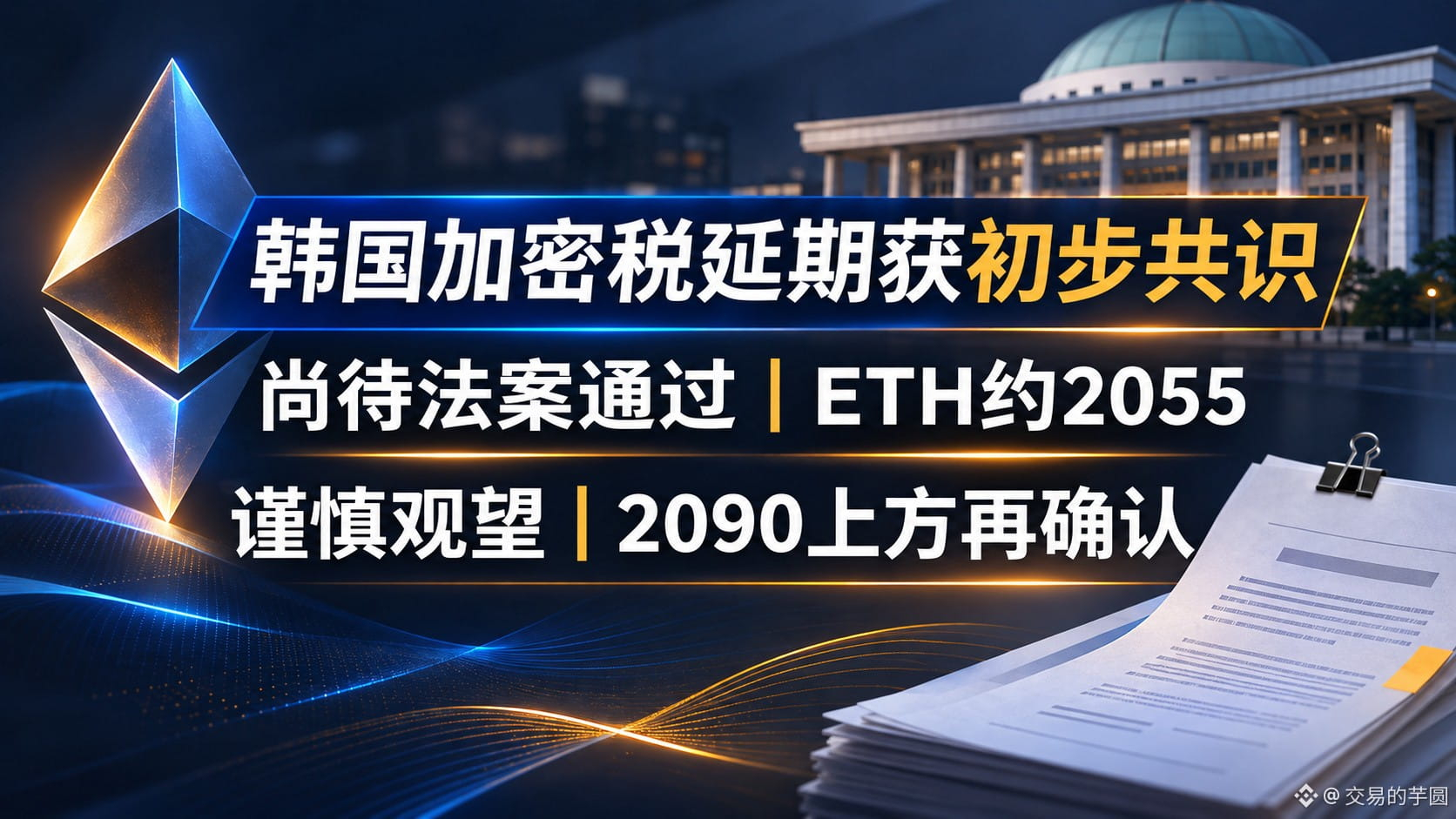
South Korea reaches preliminary consensus on crypto tax delay|ETH could benefit, but the bill still needs to be seen|I’m staying on the sidelines around 2055
My stance is cautious and watchful. The trending topic on Binance Square, #SouthKoreaPartiesTentativelyAgreeToDelayCryptoTax, relates to today’s discussion of South Korea’s tax on virtual asset income. South Korea’s Chosun Biz and The Korea Herald report that ruling and opposition lawmakers on the National Assembly’s tax subcommittee say there is preliminary consensus to delay the crypto asset income tax, originally scheduled to begin in 2027, by another two years until 2029. However, details such as the basic deduction, loss carryforwards, and platform reporting requirements are still under discussion, and the relevant amendment to the Income Tax Act still needs further review and approval. For now, it is accurate to say “lawmakers have expressed support and reached a preliminary consensus”; it would be wrong to say South Korea has completed the legislative process or that ETH has gained a new tax-exempt status. I have not yet found an official published document that could serve as a substitute for the final statutory text, so I’m maintaining that distinction.
The possible impact on ETH concerns South Korean investors’ expected tax burden and willingness to trade, not the supply rules of the Ethereum network. If the final bill does delay taxation, some traders may face less pressure to sell early because of the tax deadline. But between policy discussions and actual net spot buying lie the statutory text, implementation rules, trading-platform behavior, and overall risk appetite. South Korea’s tax debate will also not directly change subscriptions and redemptions for US spot ETH funds. Farside’s figures show net outflows of about $1.3 million from US spot ETH funds on November 10; full-day data for the 11th is not yet available. At the very least, this reminds me not to interpret a policy expectation alone as evidence that global institutional funds have already turned to inflows.
The market has not provided strong confirmation either. ETH/USDT on Binance is around $2,055.59, down about 1.29% over 24 hours, with a range of $2,006 to $2,083.28. If the news can independently drive sustained buying, the price would at least need to reclaim the area around $2,083 and hold it. For now, discussion is gaining traction, but the price remains in the middle of its range. I’m setting the upper confirmation zone at $2,084–$2,090, with $2,020 as the first downside level to watch, followed by $2,006. If it breaks below $2,006 and then fails to reclaim it on a rebound, my short-term stabilization view is invalidated. If it moves above $2,090 but quickly falls back below $2,083, I would also count that as a false breakout. The US October CPI and the Fed’s earlier decision to hold rates continue to influence risk assets; ETH cannot be priced based solely on a single piece of news from South Korea.
If I were trading this myself, I would not enter now. I would only consider a small spot long if my conditions are met. I would wait for ETH to close a one-hour candle above $2,090 and hold $2,083 on a retest, while BTC does not simultaneously break below its own 24-hour low. Only then would I use 0.3% of my total capital to test an entry, with no leverage. My first target is $2,125, where I would take half off; the second is $2,160, where I would close the remaining position in stages. I would set a stop-loss at $2,065. Based on an entry around $2,090, the estimated risk to my account for this trade would be about 0.004%. If the retest breaks below $2,083 and the price cannot recover it within an hour, I would exit early. If the subsequent South Korean bill fails to pass or its provisions change significantly, I would cancel this plan based on policy expectations. Until the conditions are met, I’ll remain out of the market; observation should not be presented as profit.
#SouthKoreaPartiesTentativelyAgreeToDelayCryptoTax #ETH
The above is solely my personal market observation and does not constitute investment advice.