

Another major piece of bearish news recently is whether MicroStrategy will be removed from the MSCI Index. The result is expected after 6 a.m. Beijing time on the 12th. So, what is the MSCI Index? Why is MSTR at risk of being removed? What impact would the result have?
1. MicroStrategy (MSTR, now renamed Strategy)
As everyone knows, MicroStrategy was originally an enterprise BI software company founded by Saylor. After 2020, it transformed its business model: issuing shares and bonds to raise funds, then continuously buying BTC. It is the publicly listed company with the largest BTC treasury holdings in the world. Put simply, it’s a public company with a software façade whose core business is hoarding BTC, relying on a flywheel of “share-price premium → fundraising → buying coins → driving up the share price.”
2. What is the MSCI Index?
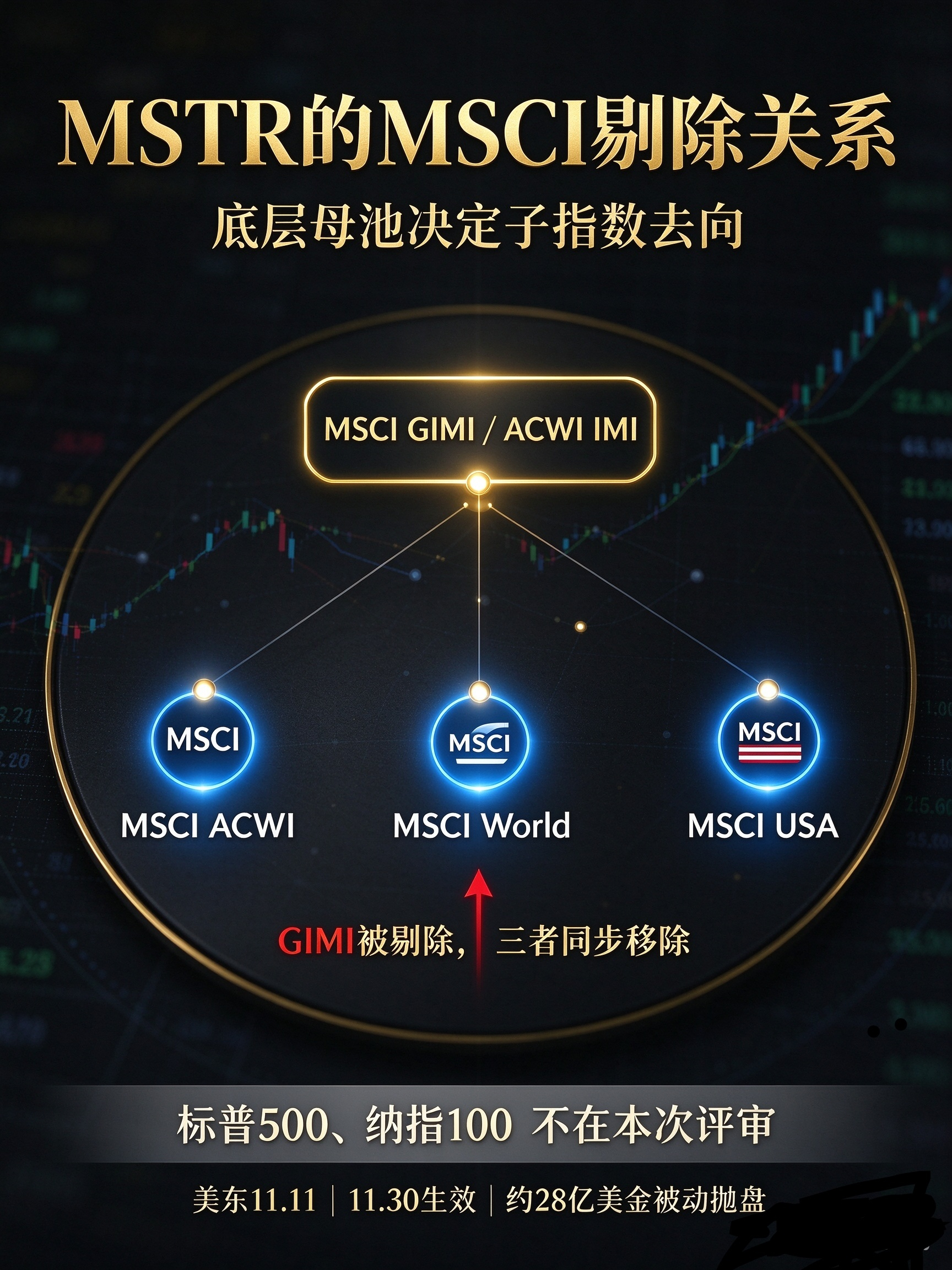
The world’s leading index provider. Many international passive ETFs and institutional funds directly track its indices (ACWI, MSCI USA, etc.). Passive funds prioritize rules over market movements: if the index says to sell, they have to sell. The underlying pool for this review is GIMI. If a company is removed from GIMI, it is also removed from ACWI, MSCI USA, and MSCI World; this has nothing to do with the Nasdaq 100 or S&P 500.
3. Why is there a risk of removal?
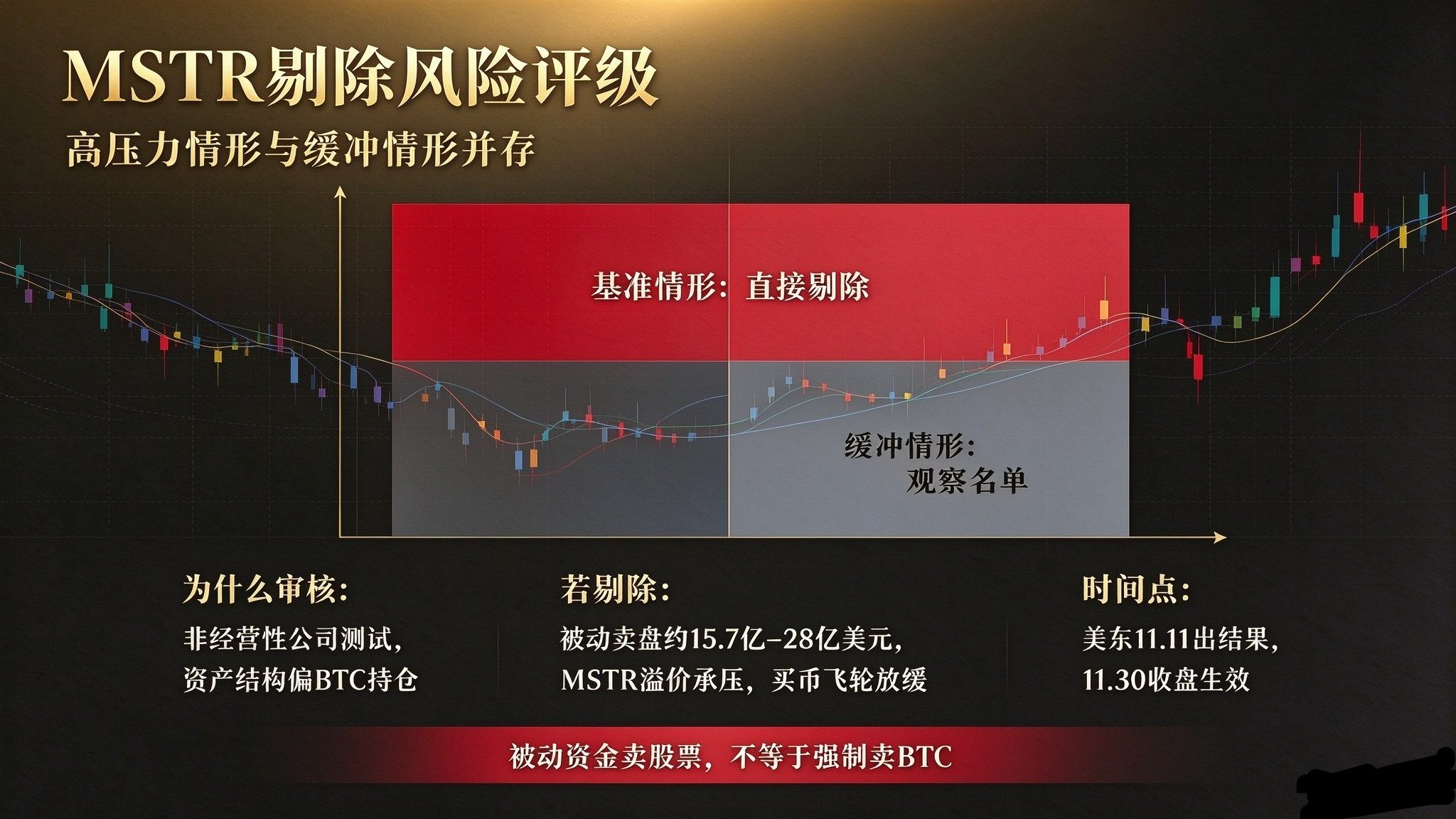
In October, MSCI introduced a new rule: its indices will only include “operating companies,” not entities that are effectively investment-holding shells. Most of MSTR’s assets are in BTC, while its software business accounts for a very small share. It was judged to be more of an asset-holding vehicle than a conventional operating company.
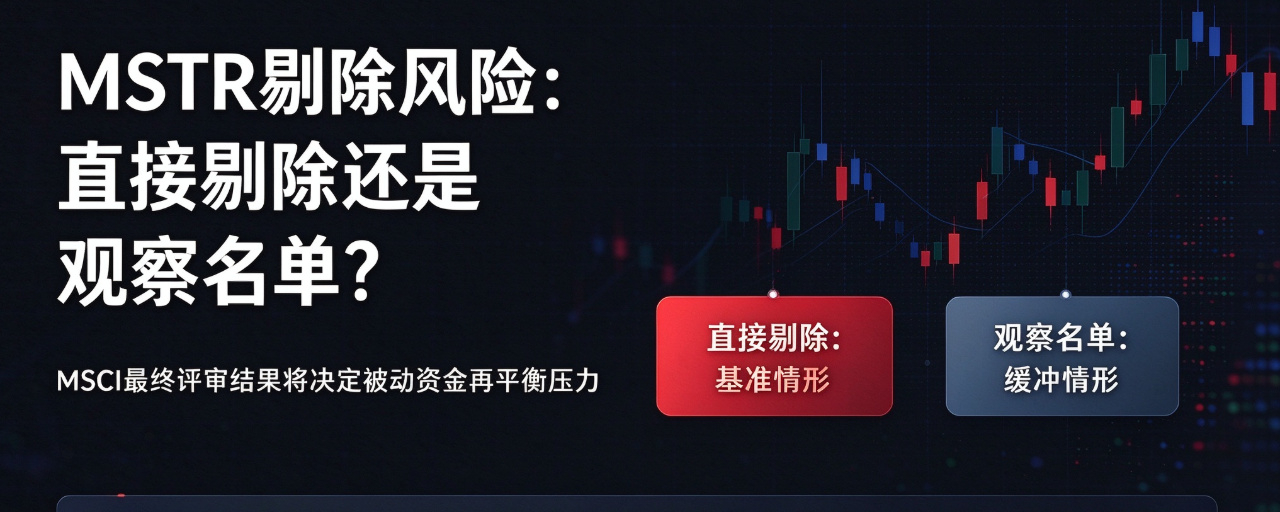
Key point: This is not because BTC violates any rules; it’s an issue with the index’s definition. The market is also weighing the possibilities: under the rules, existing constituents must fail to meet the requirements for two consecutive reviews before being removed. This time, MSTR could be removed immediately, or it could be placed on a watchlist and spared removal for now.
4. Impact of the two possible outcomes
Scenario A: Confirmed removal (more likely)
MSTR stock: An estimated $2.8 billion in passive funds would be forced to sell. Many institutions can only buy MSCI constituents, so they would be unable to hold MSTR after its removal, making its valuation premium more likely to decline. BTC: MSTR would not be forced to sell the BTC it holds. However, MSTR’s financing channels would weaken and its premium would shrink, reducing its ability to raise funds to buy BTC through future share offerings. BTC would lose a source of steady institutional buying. Industry signal: It would become much harder for publicly listed treasury companies to imitate Saylor’s model of accumulating BTC. Once the negative news is priced in, BTC could make one final drop before rebounding.
Scenario B: Not removed, but placed on a watchlist In the short term, the negative news would be out of the way, making MSTR and BTC more likely to rebound. But the risk would remain: the review would continue next quarter.