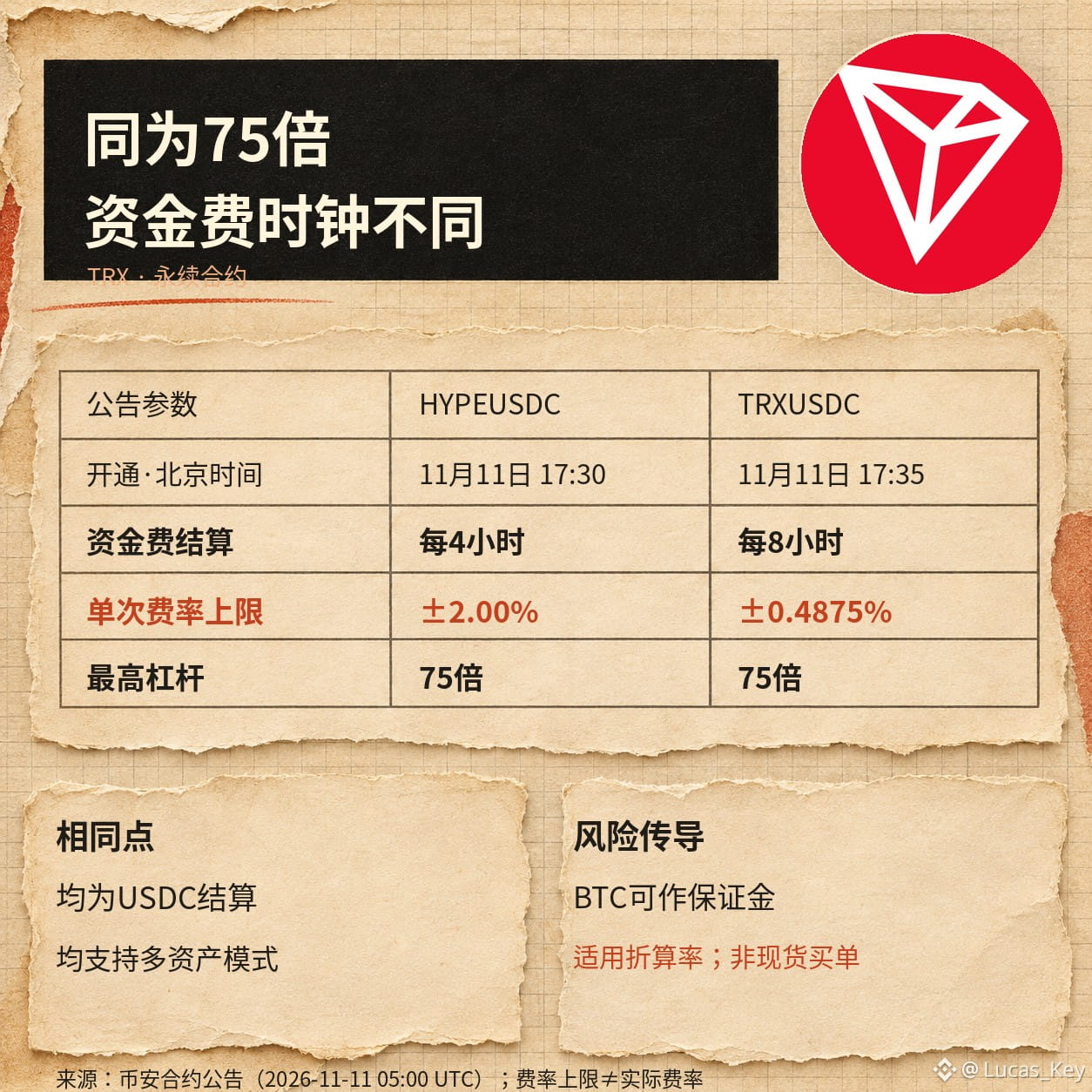
$TRX and $HYPE are new USDC-settled perpetual contracts launching today, and both announcements say “up to 75x.” Focusing only on leverage misses a factor that has a greater impact on holding costs: the HYPE contract settles funding every 4 hours, with a cap of ±2.00%; the TRX contract settles every 8 hours, with a cap of ±0.4875%. These caps are per-settlement limits, not actual rates, and should not be directly compared as daily costs.
There is a straightforward case for the view that “new trading venues can improve price discovery”: different settlement assets and funding schedules may attract positions that were previously hedged elsewhere. Binance’s announcement lists the Beijing opening times as 17:30 and 17:35 on November 11, respectively, and both contracts support multi-asset mode. When the conversion rules are met, $BTC can also serve as margin for these contracts, so funding them does not necessarily require selling spot holdings for USDC.
The concern on the other side is also reasonable: adding another venue for trading contracts does not necessarily bring a corresponding net buying flow into spot markets. Open interest can grow as both long and short positions expand, and the 75x cap does not mean that most traders actually use that much leverage. Only if funding rates remain deviated, open interest grows, and spot trading volume keeps pace is there reason to discuss whether the new demand is carrying over to the underlying asset. If trading is merely shifting between different contracts, the price narrative should be tempered.
I’m more interested in whether actual funding rates, open interest, and spot trading volume move in the same direction after launch than in using the caps in the announcement to estimate returns or risk costs. Leverage can magnify losses and trigger liquidation; this article is not trading advice.