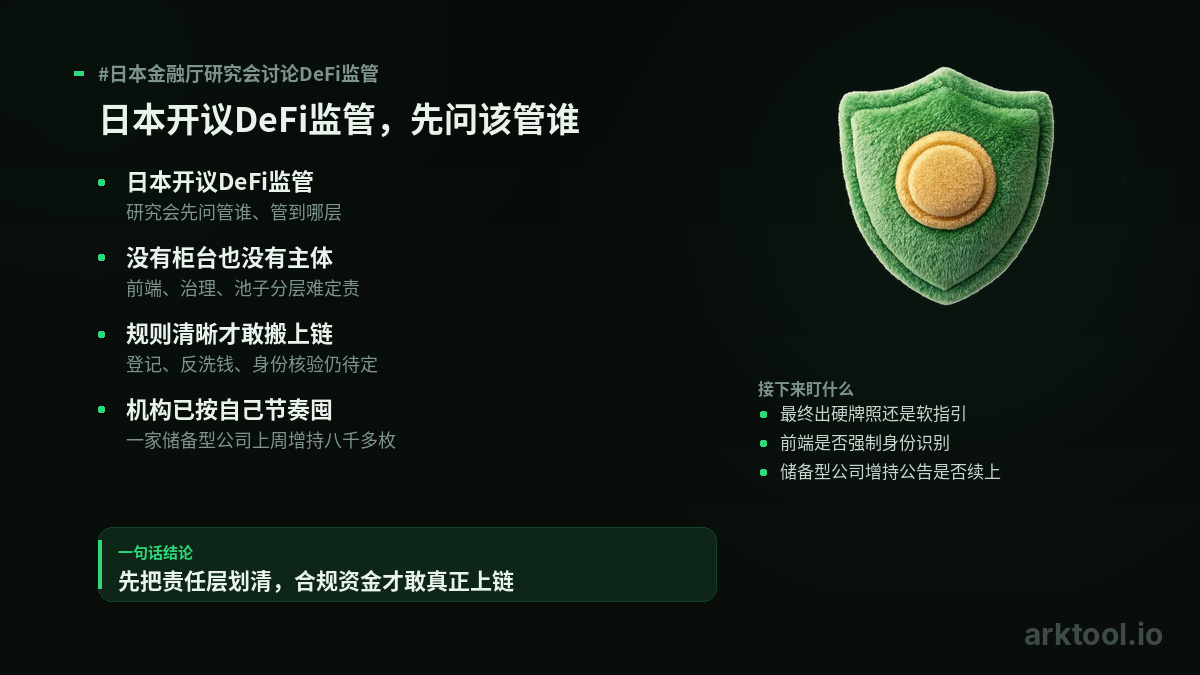
A study group at Japan’s Financial Services Agency has started discussing how DeFi should be regulated. The key question isn’t whether to regulate it, but who to regulate.
DeFi has no counter, no customer service, and no clearly defined operator. Who is responsible at each level—the people who build the front ends, vote with governance tokens, or maintain liquidity pools? That’s the first question.
The second, more practical question: should on-chain lending and exchanges be registered under the same framework as traditional crypto asset businesses, and how should anti-money laundering rules and identity verification apply? If front ends are required to set up barriers to entry, it will become harder for Japanese users to participate in on-chain protocols. Conversely, a code-neutral approach with light licensing would send a clear signal to compliant capital that’s been sitting on the sidelines.
For $SOL , this is a fundamentals issue. The chain’s selling points are speed and low cost, and high-frequency activities such as on-chain lending and exchanges are major use cases. Once the rules are clear, institutions will be more willing to move settlement and lending on-chain. More users would mean more on-chain activity and fees to support the network. Meanwhile, a listed company that treats it as a token reserve added more than 8,000 coins last week, bringing its total holdings to over 2.6 million—evidence that some institutions are already accumulating at their own pace before the rules are finalized.
Watch for three things next: whether the final outcome is a strict licensing regime or softer guidance; whether front ends will be required to verify users’ identities; and whether this type of reserve-holding company will announce further purchases.
#日本金融厅研究会讨论DeFi监管
DeFi has no counter, no customer service, and no clearly defined operator. Who is responsible at each level—the people who build the front ends, vote with governance tokens, or maintain liquidity pools? That’s the first question.
The second, more practical question: should on-chain lending and exchanges be registered under the same framework as traditional crypto asset businesses, and how should anti-money laundering rules and identity verification apply? If front ends are required to set up barriers to entry, it will become harder for Japanese users to participate in on-chain protocols. Conversely, a code-neutral approach with light licensing would send a clear signal to compliant capital that’s been sitting on the sidelines.
For $SOL , this is a fundamentals issue. The chain’s selling points are speed and low cost, and high-frequency activities such as on-chain lending and exchanges are major use cases. Once the rules are clear, institutions will be more willing to move settlement and lending on-chain. More users would mean more on-chain activity and fees to support the network. Meanwhile, a listed company that treats it as a token reserve added more than 8,000 coins last week, bringing its total holdings to over 2.6 million—evidence that some institutions are already accumulating at their own pace before the rules are finalized.
Watch for three things next: whether the final outcome is a strict licensing regime or softer guidance; whether front ends will be required to verify users’ identities; and whether this type of reserve-holding company will announce further purchases.
#日本金融厅研究会讨论DeFi监管