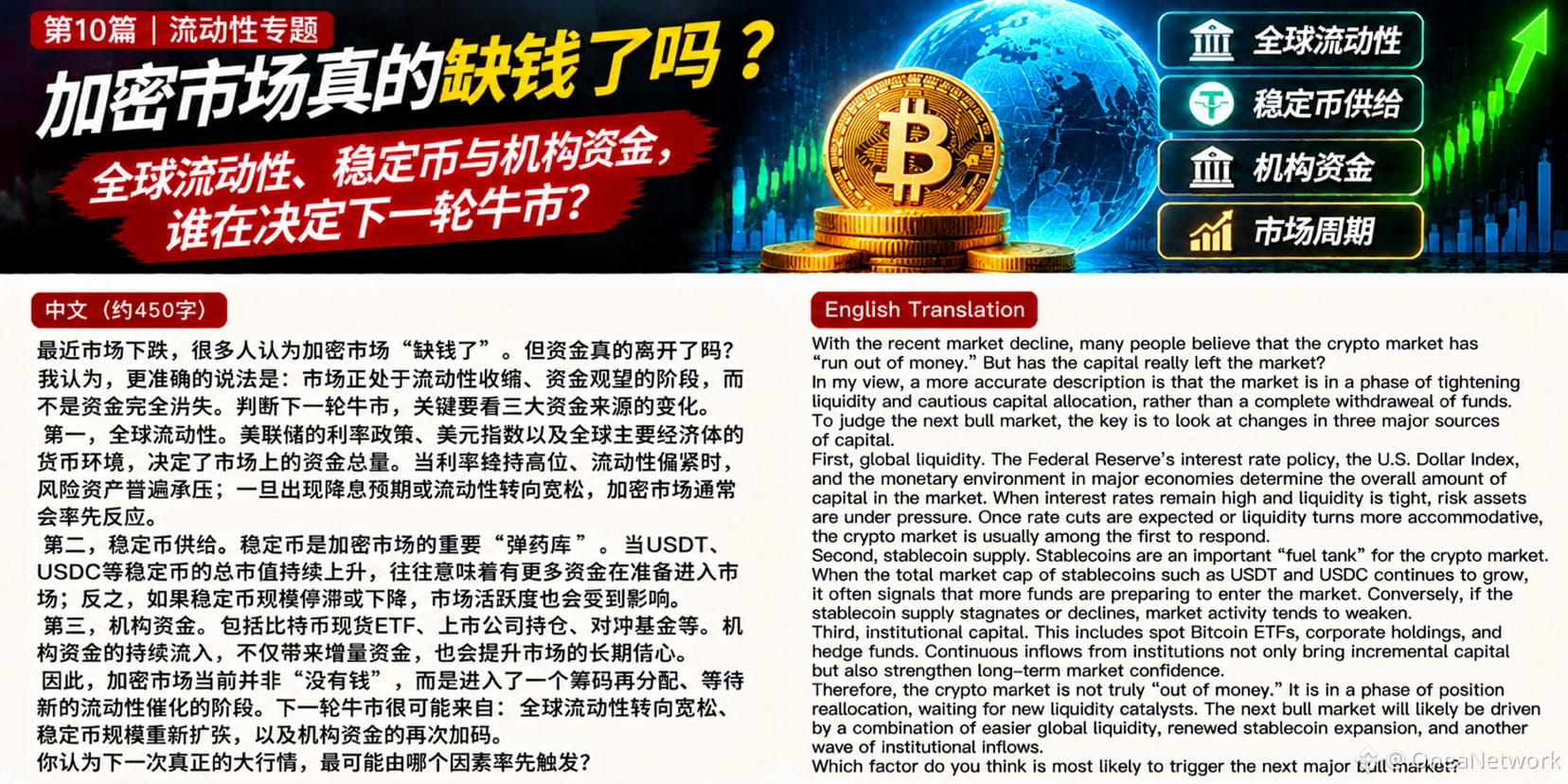
Is the Crypto Market Really Running Out of Money? Who Will Shape the Next Bull Run?
The crypto market has continued to decline recently, and many investors have started to believe that no new money is entering the market. But I think a more accurate way to put it is that the market is going through a period of tightening liquidity, cautious investors, and asset repricing.
To gauge the next bull run, we need to focus on three sources of capital.
First, global liquidity. Federal Reserve interest-rate policy, the U.S. Dollar Index, and the monetary environments of major economies around the world determine the overall cost of capital in the market. When interest rates remain high and liquidity is tight, risk assets tend to come under greater pressure. Conversely, if expectations of future rate cuts strengthen and financial conditions gradually ease, the crypto market may be among the first to react.
Second, stablecoin supply. USDT and USDC are important trading instruments and stores of capital in the crypto market. Changes in the total stablecoin supply can help us gauge whether the market’s capital base is expanding. However, it’s important to note that an increase in stablecoin supply doesn’t necessarily mean that the money will immediately be used to buy Bitcoin.
Third, institutional capital. Spot Bitcoin ETFs, publicly listed companies’ holdings, and the allocation decisions of professional investment firms are reshaping the flow of capital in the crypto market. Sustained institutional inflows can bring in capital and may also strengthen long-term market confidence.
So I don’t think the crypto market is truly out of money. Rather, capital is choosing new directions. The next bull run may require three conditions to come together: improving global liquidity, renewed growth in stablecoin supply, and a sustained return of institutional capital.
What’s worth watching isn’t short-term trading volume, but whether new capital begins to establish a sustained trend.
What do you think will be the first signal of the next bull run: Fed rate cuts, growth in stablecoin supply, or institutions resuming large-scale Bitcoin purchases?